
Innovate Like a Pro: The 7 Hottest Software Development Technologies for 2023

According to Gartner, Inc.’s most recent projection, global IT investment would reach $4.6 trillion in 2023, an increase of 5.5% from 2022. It’s simple to become lost in all the technological advances and trends that are emerging at an incredible velocity which makes it difficult to stay up with them. 

So, what are the  Top 7 Trending Software Development Technologies to Innovate in 2023?

Let’s check out.

But before let’s understand what are software development technologies in simple terms-

What are software development technologies?

Imagine you’re a chef trying to cook a gourmet meal without any utensils or appliances. You wouldn’t be able to chop vegetables, sauté meat, or even boil water. Software development technologies are like chefs’ utensils and appliances. They allow developers to create code, test applications, and deploy software products with ease.

Programming languages like Python, Java, and C++ are like chef’s knives, spatulas, and ladles. They are the basic tools that allow developers to create software applications from scratch. Frameworks like React, Angular, and Vue are like a chef’s oven, microwave, and grill. They provide a foundation for building complex applications quickly and efficiently.

Databases like MongoDB, MySQL, and PostgreSQL are like a chef’s pantry. They provide a place to store and organize ingredients and recipes. Software development technologies help businesses by making it easier for them to build and deploy software products quickly and efficiently. They enable businesses to innovate and stay competitive in a rapidly changing market.

Software development technologies are tools and frameworks that developers use to create and deploy software applications. These technologies can range from programming languages, databases, and development platforms to cloud computing services, version control systems, and testing frameworks.

Software development technologies are helping tech businesses in several ways.

1-Tthey allow developers to build applications more efficiently and with fewer errors, reducing development time and costs. This enables businesses to get their products to market faster and stay ahead of the competition.

2- Software development technologies provide businesses with a range of options for developing and deploying their applications, such as cloud computing services and containerization. These options allow businesses to scale their applications quickly and easily, providing the flexibility needed to meet changing market demands.

3- Software development technologies provide businesses with the ability to analyze and understand their data, enabling them to make better decisions and gain a competitive advantage. For example, machine learning and artificial intelligence technologies allow businesses to analyze vast amounts of data to identify patterns and trends that can inform business strategies.

Seven Software development technologies for 2023:
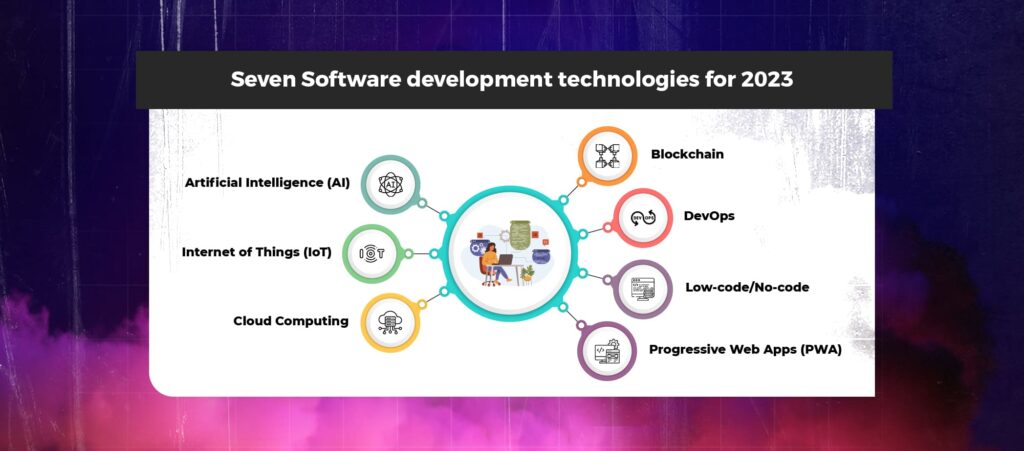
Seven Software development technologies

Artificial Intelligence (AI): AI has been a popular topic for several years, and it’s not going away anytime soon. AI is being used in various applications, such as natural language processing, image and speech recognition, chatbots, and self-driving cars. In 2023, AI is expected to continue to evolve and improve, with more sophisticated algorithms and more advanced use cases.

Internet of Things (IoT): IoT is the network of physical devices, vehicles, home appliances, and other items that are embedded with sensors, software, and connectivity, which allows them to connect and exchange data. IoT is expected to grow in popularity in 2023 as more devices become connected, and the need for real-time data analysis and decision-making increases.

Cloud Computing: Cloud computing allows businesses to access computing resources on demand, such as servers, storage, and applications, over the internet. Cloud computing is becoming more popular as businesses look to reduce IT infrastructure costs, improve flexibility, and enable remote work. In 2023, cloud computing is expected to continue to grow, with more companies adopting cloud-based solutions and services.

Blockchain: Blockchain is a distributed ledger technology that allows multiple parties to have a shared view of transactions, without the need for intermediaries. Blockchain is being used in various applications, such as cryptocurrency, supply chain management, and voting systems. In 2023, blockchain is expected to continue to evolve, with more use cases and applications emerging.

DevOps: DevOps is a set of practices that combines software development and IT operations to enable faster and more reliable software delivery. DevOps is becoming more popular as businesses look to reduce time-to-market, improve collaboration, and increase agility. In 2023, DevOps is expected to continue to grow, with more organizations adopting DevOps practices.

Low-code/No-code: Low-code/no-code development platforms allow non-technical users to build and deploy applications without writing code. Low-code/no-code platforms are becoming more popular as businesses look to increase agility, reduce development costs, and enable citizen developers. In 2023, low-code/no-code platforms are expected to continue to grow, with more businesses adopting them.

Progressive Web Apps (PWA): PWAs are web applications that provide an app-like experience to users, with the ability to work offline, receive push notifications, and access device features such as a camera and microphone. PWAs are becoming more popular as businesses look to improve user experience, increase engagement, and reduce development costs. In 2023, PWAs are expected to continue to grow, with more businesses adopting them.

Conclusion

To stay competitive in the market, businesses must be willing to embrace these technologies and incorporate them into their work. 

At Communication Crafts, we have over 17 years of experience in software development, and we are always looking for ways to innovate and stay ahead of the curve. Our team of experts is dedicated to providing cutting-edge and dependable software solutions that are tailored to the specific requirements of our clients.

8 Steps To Build A Robust Software Release Plan

Resist The Software Release Fears

Half-baked releases are unaffordable. And if downtime and bugs are becoming nightmares for you, then it’s time to take a closer look at your software release plan.

Investing in a robust release management strategy is crucial if you want to keep your firm functioning smoothly and avoid pricey failures.

A survey claims that the lack of a thorough software release plan is the sole cause of 75% of software problems. These problems, later on, might simply result in extra expenses and a bad impression in the target audience’s eyes.

So, Software release planning is fundamental for a successful software release, but how do you build one?

In this blog, let’s turn all the stones of the software release plan and find answers to significant questions like, What is a software release plan? How is a release plan created? What are software release management tools?

Let’s go!

What Is A Software Release Plan?

In simple words, a software plan is developed to ensure the quality, efficiency, and speed of software delivery. It covers all aspects of a software development lifecycle, including the stages of developing, testing, deploying, and sustaining a software release.

The main goal of software release planning is to establish a desirable schedule for multiple software release dates and guarantee that the schedule is followed.

Additionally, by developing a thorough software release plan, you can guarantee that your team has all the information required to maximize the likelihood of a successful release.

How To Create A Concrete Software Release Plan For Your Business

1- Define the software type

The first step in building a software release plan is figuring out exactly what kind of software you are delivering. Is the software a PWA, a mobile app, a web application, or something else entirely?

2- Specify the features

The next step in planning a first-time software release is deciding what requirements must be met for your program to be released. This typically involves detailing the features you plan to include and the user flow for your product as a whole.

3-Set crystal clear expectations

It’s critical to define the software project’s objectives and deliverables in detail. Each team member’s understanding of their duties and responsibilities is assisted with thorough project outlines. As each stage is completed, the team will be able to monitor their progress. Additionally, making expectations explicit help customers grasp what the product release will provide.

4-Prioritize product backlog

The success rate is higher for developers with a simple product backlog. Software release management is well-planned and structured by prioritizing work lists and explicitly stating the order of items in the product log.

5- Work up your software proposal

Your proposal should project the course of events for the days preceding the actual software release. The software release proposal is most useful for establishing objectives, assigning tasks to team members, and establishing a deadline for project completion.

6-Look out for risk

All potential setbacks that might happen at various stages of development are included in the risk analysis. Developers can prepare for potential outages during the software release by incorporating risk analysis into the process.

7- Test.Test. Test.

In the production stage, routine testing should be conducted on every element of the software release. Beta testing allows programmers to identify potential problems and fix them right away.

8- Get.Set. Launch

The final step consists of just releasing your product to end users while closely monitoring performance to make sure everything is operating as it should.

What Is The Software Release Management Process?

Stage 1: Planning

Starting software planning with the stakeholders is the first step. This stage can be completed in a number of ways, but typical actions include conducting a start meeting, creating a business case, and developing a work breakdown structure that is in line with the project dependencies.

The release manager will be able to finish the system development life cycle with the help of all of these tasks. In order to gain permission to develop the software and prepare it for development, it’s crucial to get in touch with operations teams and management during the planning phase.

Stage 2: Building

The second stage of the release process, when team members begin developing the software, takes the longest. At this point, stakeholders should be given clear information about the project and its goals.

Once the information is clear, the team may begin developing the software while testing and optimizing the necessary features. It is advised that you begin keeping an eye out for other potential dangers or bugs in your production environment in order to be prepared for the testing phase.

Stage3: Testing

To make sure the product is ready to use and functions properly, testing is essential. While it’s crucial to start user testing explicitly at this point, it’s as necessary to have team members assist in finding and fixing any bugs that occur. Additionally, user testing gives potential clients the chance to try out your product in exchange for compensation.

Stage 4: Preparing

Your team should finish the needed modifications and feature improvements in the staging environment during the pre-release phase. This indicates that all of the software is in good working condition and is ready for use.

It is advised that you perform a final quality check, if not more than once, to ensure that all functionalities are effective. You and your team can accomplish this, but it’s crucial to enlist assistance from team members who are not directly involved since they will be able to view the software from fresh perspectives. Start deploying the program to a live setting as soon as it has been finished and authorized.

Stage 5: Deploying

The last stage of a software release is deployment. It involves extending functionality into the natural setting in order to attain the software’s original idea.

Additional testing is necessary before deploying a software release to guarantee that the functionality is maintained in operation. Once this is complete, it is strongly advised to regularly assess integrations and make the required modifications to enhance functionality.

Benefits of a software release plan

1- Enhanced Release activities
2- Higher organizational performance
3- Accelerated time to release
4- Eliminated Failures

Final Thoughts

Creating a software release plan is not a five-finger exercise. But definitely worth the effort.
Additionally, software release planning offers you a clear grasp of your company’s objectives and goals and puts you in a better position to meet them all.

Build a Robust Software Release Plan with Communication crafts

A software release plan is important for any company to make steady progress and continue delivering results for customers over an entire product lifecycle. And that’s where communication crafts play their role.

Onboard 10x tech talent and end-to-end development support from communication crafts to ensure a risk-free and smooth software release.

We’re not just any ordinary software development, but your technology partner in success.

This means that we’re always with you in every step of the visionary process; planning, design, development, and delivery of digital products and services. Reach all of your business objectives successfully, discover different business prospects, and gain unquestionable recognition in a crowded industry. We assist businesses of all sizes, from start-ups to large corporations, in overcoming current business obstacles and achieving maximum growth.

Looking for professional assistance to build
Software release plan?