Laravel VS CodeIgniter: A Comprehensive Comparison Between the Top PHP Frameworks

PHP frameworks have been gaining popularity among developers for enterprise-grade web application development. Business owners of various industries are searching for the best framework to develop high performing and dynamic web applications.

Currently, two of the best PHP frameworks are Laravel and CodeIgniter. With so many varying features, benefits and drawbacks, it is extremely difficult to choose one to meet the required web development needs.

Our expert web developers have come up with this article to thoroughly examine and explain the difference between Laravel and CodeIgniter, hoping to aid you in making well-informed decisions.

We’ll carefully examine each aspect of these two PHP frameworks and form a comprehensive comparison.

Before we get into it, check out this quick video by Happy Developers:

https://www.youtube.com/watch?v=U3JWFgTjq94&feature=youtu.be

Introduction: Laravel VS CodeIgniter

What is Laravel?

“The PHP Framework For Web Artisans”

Laravel is an open-sourced PHP web framework, adored by developers for its exceptional benefits like server-side routing, blade templating, HTML authentication, etc.

Developed by Taylor Otwell and released in 2011, Laravel’s architecture is Symfony-based and written in PHP with reusable libraries and components. Also, it is a modern substitute for the CodeIgniter framework.

This PHP framework can be used to develop dynamic, modern and robust web applications using the MVC architecture. Laravel provides many tools and benefits for developing a flexible backend for full-stack development, SaaS products, high performing web applications and more.

What is CodeIgniter?

“The Small Framework with Powerful Features”

CodeIgniter is a powerful and open-sourced PHP framework that leaves a negligible digital footprint. It is an ideal framework for developers who prefer a simple and smart toolkit for building feature-rich web applications.

Launched in 2006, this lightweight PHP framework was developed by EllisLab, facilitating the development of dynamic and flexible websites and web applications.

CodeIgniter substitutes complex functionalities with simple solutions that provide robust security and offer clear documentation. Additionally, this framework lets the developer have complete control with zero reliance on the architectural pattern.

Popularity & Community: Laravel VS CodeIgniter

The data from Stackoverflow trends paints a clear picture of the popularity between CodeIgniter VS Laraverl in terms of “most discussed”

 CodeIgniter VS Laraverl

Image Source: StackOverflow

CodeIgniter led this race till 2014 and then witnessed a steady decline in popularity, on the other hand, the popularity of Laravel shot up after 2014. This makes it clear that Laravel is the most talked-about PHP framework when compared between CodeIgniter VS Laravel.

According to BuiltWith, both Laravel and CodeIgniter are being used by more than 1.4 million websites on the entire internet.

The information from BuiltWith and SimilarTech explains the popularity in terms of usage.
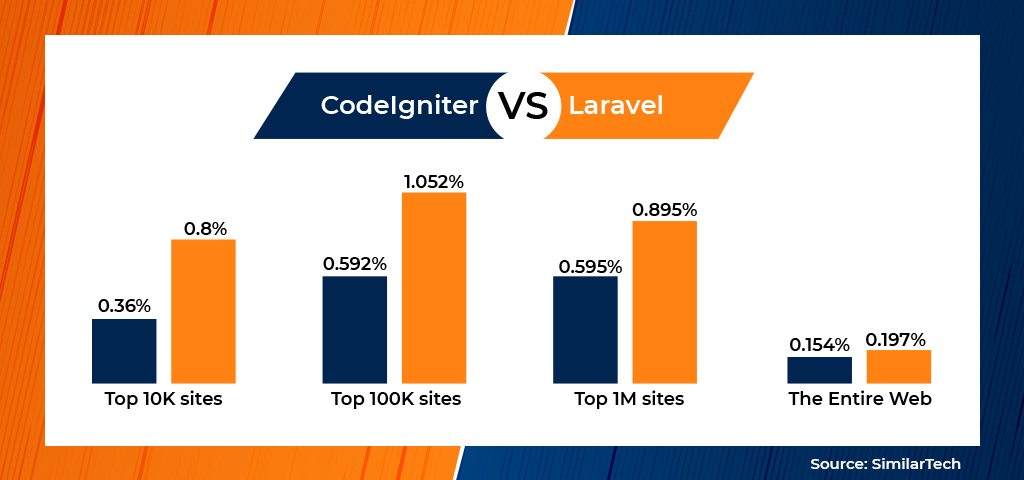
 Laravel and CodeIgniter

Image Source: SimilarTech

In terms of usage, Laravel takes the trophy by defeating CodeIgniter in all website categories.

Let’s study the comparison of the top backend frameworks:
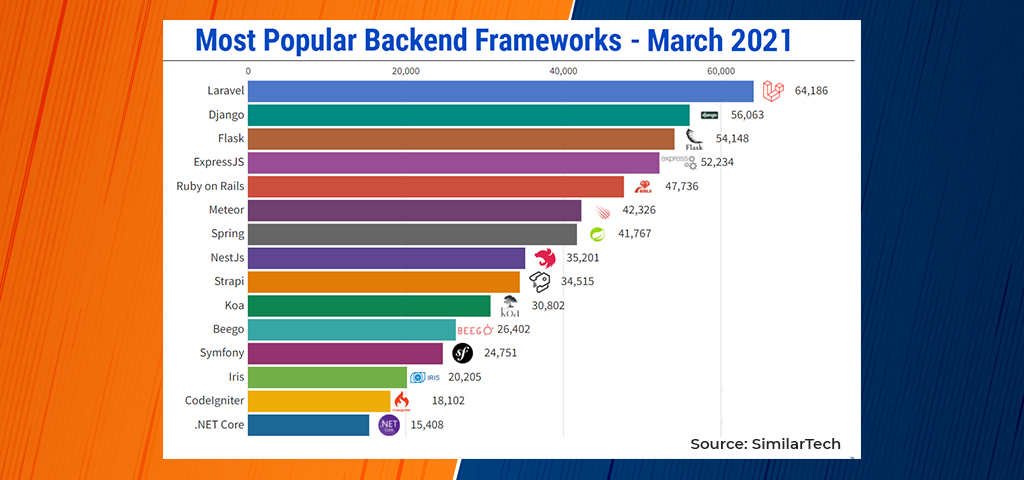
 top backend frameworks

Image Source: Statisticsanddata

As of March 2021, Laravel takes first place among the top backend frameworks, proving once again, the dominance of Laravel around the globe.

It is extremely important to study the maturity and community support of a web development framework before implementing it.

A well-matured framework with strong community support provides the necessary documentation, tools, libraries and source codes for an easy development process.

GitHub accurately represents the maturity for a web framework, let’s look at the data:

 GitHub StarsGitHub Forks
Laravel67.4k21.8k
CodeIgniter18.2k7.8k

Performance: Laravel VS CodeIgniter

Although Laravel is used for complex enterprise-grade web applications, the performance and speed can be slow at times. But there are many ways to enhance the performance by optimizing the backend logic, facilitating web applications to run efficiently and seamlessly below 20ms.

Already stored data and information can be utilized to further improve the performance and latency of a Laravel-based web application with the help of cache tags.

Web applications run with CodeIgniter display unwavering performance. According to speed and performance tests, it shows impressive response times with respect to the user population.

Here’s a representation of the data:

100 users11.5 seconds
500 users45.6 seconds
1100 users26 seconds

Scalability: Laravel VS CodeIgniter

Many enterprise-grade web applications are using Laravel and successfully scaling up over the years. Being a PHP-based framework, continuous support and maintenance are available from the ever-growing community, making it ideal for businesses of all sizes.

Maximum scalability can be attained by using an effective database management system like MySQL. The load balancer and modern caching systems can also be used to enhance scalability even more.

The lightweight structure of CodeIgniter makes it ideal for scalable web applications as it renders only the required or requested data/information. Optimizing the caching system can further boost scalability in CodeIgniter. Increasing vertical scaling in this framework requires you to develop an architecture that supports the addition of new modules and features without affecting the performance.

Architecture: Laravel VS CodeIgniter

Laravel is based on the Model-View-Controller framework architecture which allows the developer to segregate different parts of the web application for an easy and efficient development process. For instance, one developer can work on the frontend part of the development, while another develops the backend logic at the same time.

The MVC architecture offers complete control to the developer in the development process. Additionally, the codebase and the backend logic can easily be reused with an MVC architectural pattern along with effortless API integrations and enhanced SEO capabilities. Therefore, the MVC structure helps you create web applications with flexible backends for long-term usage.
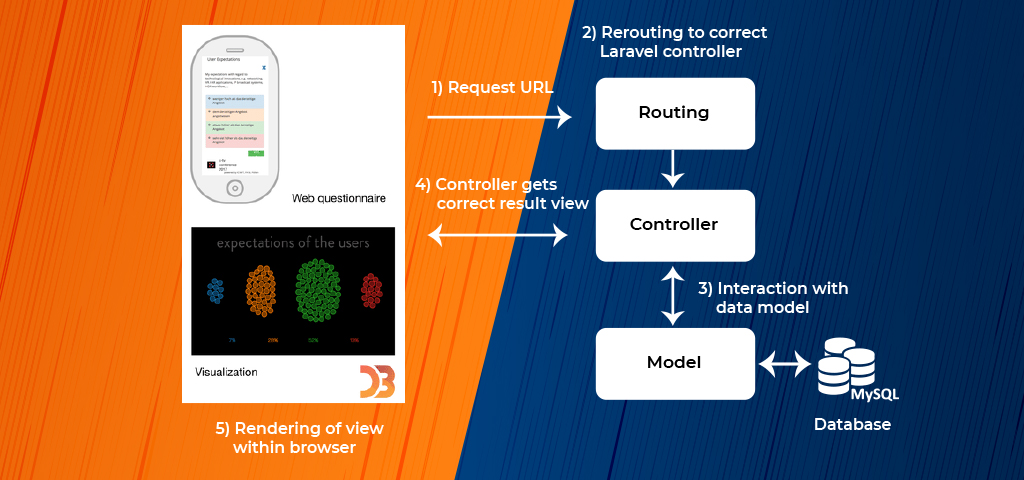
Architecture: Laravel VS CodeIgniter

Image Source: Researchgate

The CodeIgniter PHP framework also follows the Mode-View-Controller (MVC) architectural pattern, facilitating rapid development speed, high functionality, JavaScript-based framework integration, and much more.

Testing: Laravel VS CodeIgniter

Bearing in mind that Laravel is a PHP-based framework, there is an abundance of tools accessible for testing your web application, enabling a post-development testing process that delivers a flawless web application.

Testing in a Laravel-based web application occurs in two different levels:
– Unit tests
– Feature tests

The tools and documentation available for testing a web application in the Laravel framework are more than adequate. Additionally, developers can execute mock tests to make sure that the web application code is error-free and ready to launch.

CodeIgniter offers a very simplified version of unit-testing, allowing the developers to conduct tests for the web application. It may not be an extensive test, but it does deliver a basic evaluation of the quality of the code with precise results.

Microservices: Laravel VS CodeIgniter

The Laravel PHP framework supports the microservices architecture quite efficiently. It divides the application logic in a modular pattern, separating them into small units which serves different functionalities.

APIs are used to link the modules and deliver constant communication with each other, providing the perfect environment for the microservices architecture.

Another lightweight alternative, the Lumen framework was developed specifically for using the microservices architecture with Laravel.

CodeIgniter offers the full-stack libraries and tools of PHP for developing powerful microservices. The CodeIgniter3 provides the best approach for utilizing the microservice architecture.

This method optimizes the code for better performance and combines the data for building a highly efficient microservice infrastructure. As a result, it delivers utmost performance, scalability and database management support.

Database Management: Laravel VS CodeIgniter

Presently, Laravel supports 4 database management systems:

  • Postgres
  • SQLite
  • SQL
  • MySQL

Query builders like Eloquent ORM and raw SQL further enhance and simplify the interaction with the database management systems.
The web application development process is completely unconstrained with the available database management systems in Laravel.

CodeIgniter facilitates both Query Builders and traditional structures for efficient and effective database management. The simplicity of this framework’s structure makes it even easier to store, integrate, modify and migrate information in the database.

Here are some of the database management systems along with their drivers that can be used in CodeIgniter:

MySQLMySQLi driver
PostgreSQLPostgre driver
MSSQLSQLSRV driver
SQLite3SQLite3 driver

Pros & Cons: Laravel VS CodeIgniter

Now that we have discussed the comparison between the significant factors, let’s look at the pros and cons of Laravel and CodeIgniter

Advantages of Laravel:

  • Pre-built packages are available for executing simple functions like testing APIs and user authentication, further simplifying the web app development process;
  • Blade Templating system lets you modify data and add new features/modules without affecting the web application logic;
  • Reverse Routing automates the creation of URIs (Uniform Resource Identifiers), increasing flexibility and creating a connection between relevant links and Laravel routes;
  • Artisan CLI facilitates the automation of repetitive tasks in the web application, increasing usability even more;
  • Post-development testing is also automated in the Laravel PHP framework, saving valuable time and creating an environment for launching bug-free web applications;
  • In-built security system features efficient authorization and authentication, providing a safeguard against unauthorized or unregistered users. Also, Laravel’s Object-Relational Mapping (ORM) utilises PDO that fends off hidden or unintended SQL injections.

Advantages of CodeIgniter:

  • Security features and protocols can be added according to needs due to the high customizability of web applications;
  • User-friendly and highly flexible UI can be developed with versatile functionalities and high responsiveness;
  • Seamless migration of data between servers, regardless of the size of the web application;
  • A massive community support offering pre-built source codes, third-party tools, documentation, etc.
  • Expression Engine is used for attaining high modularity, simplifying the developers’ work even more.

Disadvantages of Laravel:

  • The Laravel is a lightweight PHP framework, it can feel like a benefit in some cases but it adversely affects the performance of the web application due to data bottleneck;
  • Even though Laravel is open-sourced with large community support, it gives rise to undependable third-party libraries;
  • System upgrades may cause problems to the web application, that’s why it is recommended to take precautions before updating the Laravel version.
  • The development process seems slower when compared to other PHP frameworks in some cases.

Disadvantages of CodeIgniter:

  • The growth and development of the framework has stopped, offering fewer updates in contrast with other PHP frameworks;
  • Lack of extensive libraries, making it difficult for developers to get used to this framework;
  • Maintenance of the codebase is a hassle in this framework, making it time-consuming for developers to regularly modify and update the code.

Use Cases: Laravel VS CodeIgniter

When should you use Laravel?

  • Steaming platform web applications;
  • EdTech web applications;
  • Web applications for stock trading;
  • Recognition and rewards based web applications;
  • SaaS-based web applications;
  • CMS systems with multilingual functionalities;
  • Monitoring and tracking apps for website performance;
  • SEO-friendly web applications;
  • Web applications with unmatched security to prevent SQL injections, unauthorised users, etc.

When should you use CodeIgniter

  • Web applications for eCommerce;
  • Steaming platform web applications;
  • CRM system with high customizations;
  • Invoice management system;
  • Point Of Sales (POS) system;
  • SaaS-based web applications;
  • Web applications for processing payroll;
  • Web applications with dynamic and flexible UI;
  • Web applications with enhanced security;
  • Lightweight web applications.

Conclusion

In the battle between CodeIgniter VS Laravel, there is no conclusive winner. Both of these PHP frameworks are exceptional for developing highly dynamic and scalable web applications.

You must study the aforementioned aspects and leverage the pros and cons to determine the best technology for fulfilling your web development needs.

Between CodeIgniter VS Laravel,

Laravel is ideal for enterprise-grade web applications and CodeIgniter is a lightweight alternative for building feature-rich web applications.

Take your pick!

If you require further assistance, we’re happy to help!

With a wide range of clientele and 16+ years of hands-on experience, Communication Crafts provides expert Laravel developers and top-notch PHP development, delivering highly scalable and result-driven web development solutions for building top-quality web applications.

Building your present, for a fruitful future.

From design to deployment, get end-to-end web development solutions.

You’re in the right place!
Laravel Framework: An All-Round Solution for Successful Web Development

The blend of a Native app and a browser website is known as a web application.They’re run on a browser without the need to download from an app store, but exhibit all the features of a mobile app.

Web applications are one of the hottest trends in eCommerce and many other industries. Delivering flawless user experiences can leadto lost-lasting brand loyalty and increased brand awareness.

Web applications have shown a 36% higher conversion rate than mobile apps with 50% higher user engagement.

Business owners are looking for better ways to develop web applications to meet their business goals efficiently.

And this is where Laravel service providers come into play!

Being one of the most popular PHP frameworks, web developers can’t get enough of the endless benefits and features exhibited by Laravel.

Before we begin, let’s understand the Laravel definition.

Laravel Definition: What is Laravel Technology?

Laravel: The PHP Framework For Web Artisans

Initially released in 2011, Laravel was developed by Taylor Otwell in an attempt to create a modern substitute for the CodeIgniter framework.

Laravel is an open-sourced PHP framework used for building robust and dynamic web applications with ease. One of the blessings for Laravel developers is that it comprises many useful features of various programming languages like RoR and other PHP frameworks like CodeIgniter and Yii.

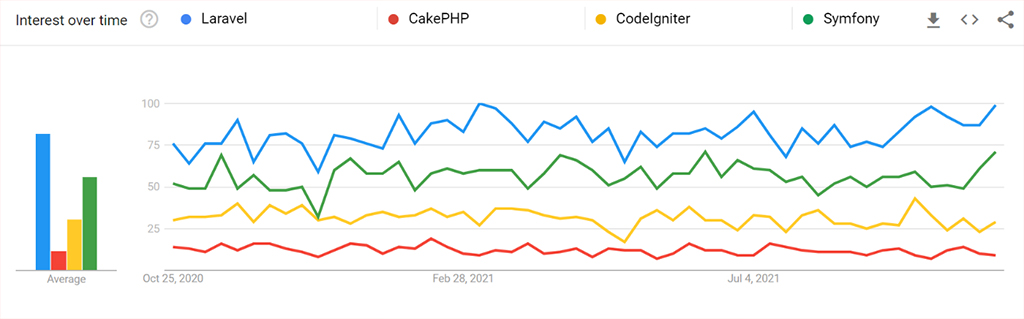
Here’s a Google Trends comparison between the top PHP frameworks in the last 12 months:

Image source: Google Trends

With 1.4 million live websites, Laravel technology is one of the most preferred and prevalent PHP frameworks in 2021, proving its significance in the field of web development.

Now that we’ve discussed the Laravel definition and its importance, let’s explore the factors that make it so desirable for web application development.

Laravel Benefits: What are the advantages of the Laravel framework?

Here are the top 9 reasons why you should opt for a Laravel service provider:

1. High Usability:

With so many libraries, templates, and tools, the Laravel framework is very developer-friendly. This perk lets you build powerful web applications from scratch, eliminating the need for writing lines of code repeatedly.

Along with object-oriented programming, you can utilize JavaScript, HTML, or CSS to meet your desired web development goals.

The ease of developing multi-lingual apps with Laravel is the cherry on the cake in this category. Laravel service providers can easily create feature-rich and high-functioning web applications for your business.

2. Unmatched Security:

With over 2,200 cyberattacks per day, web security is one of the most important factors for businesses in the digital era.

Security is one of the major benefits of opting for Laravel services. Full-proof security cannot be guaranteed by any web development framework, but Laravel technology provides adequate features to prevent cyberattacks and deliver a safe online experience for your users.

Laravel’s Object-Relational Mapping (ORM) utilizes PDO that fends off hidden or unintended SQL injections. Moreover, its syntax and other security features help you avoid cross-site request forgery and cross-site scripting.

The in-built security system of Laravel also features efficient authorization and authentication, providing a safeguard against unauthorized or unregistered users.

Laravel is undoubtedly the best choice for building a secure web application.

Check out the in-depth blog on OWASP’s top 10 list of security risks to learn more about web application vulnerability.

3. High Performance:

Laravel service

Laravel services are the most preferred option for enterprise-grade businesses, offering high-end performance and features.

With an efficient cache storing system, the Laravel web framework provides rapid development speed. Laravel service providers can also add custom features to the web application for optimum performance.

Integrating tools like Redis and Memcached during development further boosts the web application’s performance.

4. Open-Sourced Nature & Strong Community:

This is a major benefit of choosing a Laravel service provider. The open-sourced nature gives you control over the development process, offering high flexibility and a completely transparent development process.

Developing the codebase for a web application without any assistance seems like a nightmare, but the Laravel web framework solves this concern with powerful community support. Web developers can easily avail help from other professionals and experts for overcoming challenges faced during development.

Having strong community support also means that Laravel technology is updated and maintained regularly. Moreover, the community of Laravel is constantly growing with more than 48k members already, providing a wide range of resources and documentation for a smooth sailing development process.

The maturity of a web framework is of utmost importance, and Laravel proves this feature with more than 67k stars and 21k forks on GitHub.

5. Blade Templating:

Blade Templating engine is one of the most significant features of the Laravel web framework. Web developers can easily use pre-made templates to build the codebase quickly, providing an intuitive and lightweight method for web development.

Some examples of the available blade directives:

  • If Statements
  • Switch Statements
  • Loops
  • The Loop Variable
  • Conditional Classes
  • Including Subviews
  • RawPHP
  • Comments

Unlike other PHP templating systems, Laravel does not restrict the web developer and allows them to use their own PHP codes.

6. Effortless Database Migration:

 web developer

Easy data migration is a major advantage of using the Laravel web framework, allowing the developers to easily and efficiently modify the database of a web application.

Data migration in a PHP framework is a painful task, but Laravel solves this issue quite effectively. Laravel offers an easy and straightforward way to migrate and modify data, so the developers can scale a web application without hassle.

Additionally, this feature allows the Laravel service provider to undo recently made modifications to the codebase and reduces the risk of data loss.

7. MVC Architecture:

The Model-View-Controller architecture offers optimal performance and a plethora of functionalities for your website or web application.

MVC separates the application logic into components, providing a simplified development process for web developers. The Model, View, and Controller can be separately developed and managed.

Along with rapid development speed, the MVC structure provides asynchronous development, enhanced performance, efficient documentation, and multiple Views for a single Model.

This feature also allows multiple developers to collaborate and makes it easier to spot mistakes and bugs.

Most PHP frameworks don’t have an MVC architecture, and this is one of the biggest reasons for Laravel’s popularity.

8. Simplified Unit Testing:

Post-development testing is a significant part of web development, which makes this feature a pivotal benefit of choosing a Laravel service provider.

Unit testing is the phase of post-development where the developer thoroughly checks each component of the web application for potential bugs or mistakes.

Laravel offers easy unit testing, allowing you to deliver impeccable web applications with a bug-free user experience.

9. Scalability & Traffic Handling:

Traffic Handling

The main objective of a web application for business is to drive more traffic every day. Traffic attracts more and more users to your business website. Traffic represents the visits and requests that your web application receives.

The traffic keeps increasing along with the load on hosting. Furthermore, the hosting expenses will rise automatically. Without hosting up-gradation, a web application load time increases, which ultimately results in a bounce rate spike.

That’s why the Laravel web framework is highly recommended. It offers an automated message queue system and acts as a load balancer in the web application.

It guarantees that the web application’s queue is free with healthy hosting.

This function improves the functioning speed and maintains the database. Laravel simplifies hosting up-gradation according to traffic and delivers enough space to save data in the server.

Final Thoughts
Laravel is the most popular PHP framework for many reasons, providing an easy and efficient path for web application development.

From high usability and in-built security features to high scalability and effortless post-development testing, Laravel is an all-around solution for successful web application development.

Are you looking for top-tier Laravel service providers? Get in touch!

With a wide range of clientele and 16+ years of hands-on experience, Communication Crafts provides expert Laravel developers, delivering result-driven and highly scalable Laravel solutions for building top-quality web applications.

Building your present, for a fruitful. future.

From design to deployment, get end-to-end web development services.

You’re in the right place!
Magento vs Shopify: Choose only the best for your online store

As the digital age keeps growing, the options for building eCommerce stores are getting much better and simpler.

Online consumerism is the main focus for modern business owners. Hence, new and improved eCommerce development platforms are emerging as a result.

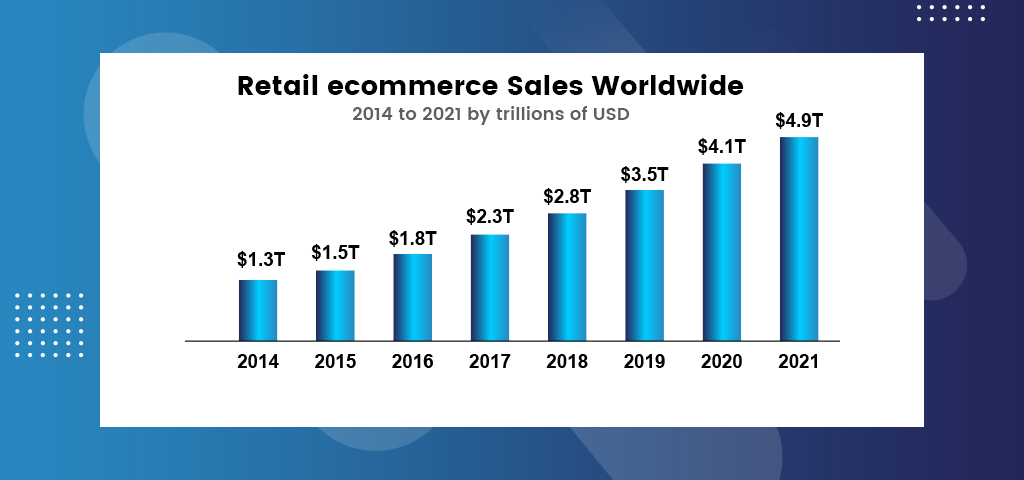
The market of eCommerce has been growing at an exponential rate since the start of the digital era, and the covid-19 outbreak has made it almost mandatory for businesses to invest in eCommerce. Online stores are the new normal for new-age businesses.

 eCommerce development platforms

Image source: Techtimez

Magento and Shopify are two of the most trusted and leading eCommerce development platforms in 2021.

It’s a no-brainer that business owners must gain a deep understanding of eCommerce development to successfully start an online business.

In this blog, we’ll go over a detailed comparison between two of the best eCommerce development platforms, Magento VS Shopify, and answer frequently asked questions like:

  • What is the difference between Magento and Shopify?
  • Is Magento the same as Shopify?
  • Which is better, Magento or Shopify?
  • What is the Shopify VS Magento market share

Without further ado, let’s dive in.

Introduction: Shopify VS Magento

Let’s understand the basic definitions of two of the best platform for eCommerce in 2021- Magento and Shopify.

What is Shopify?

A new-age online store for modern businesses.

Shopify is a cloud-based software that simplifies online store development for eCommerce businesses. An all-inclusive eCommerce platform that works on a monthly or yearly subscription model and SAAS service model.

Founded in 2006 by Tobias Lutke and Scott Lake, Shopify is the ideal choice for many eCommerce developers because it eliminates the need to learn to code and delivers outstanding online retail experiences.

What is Magento?

A flexible eCommerce platform for growing businesses.

Magento is an open-sourced eCommerce development platform with splendid content creation and promotional features. Written in PHP, it can be used for building highly customizable online stores.

Introduced in 2008 by Varien, Magento was acquired by Adobe for $1.68 million 10 years later, delivering highly scalable long-term online stores with a professional look.

Popularity: Shopify VS Magento

Google trends represent the popularity difference between Magento and Shopify in terms of most discussed or most searched:

Popularity

Magento was leading the Google trends race by a large margin since its inception. However, Shopify has gradually gained more popularity, advancing to first place after 2020.

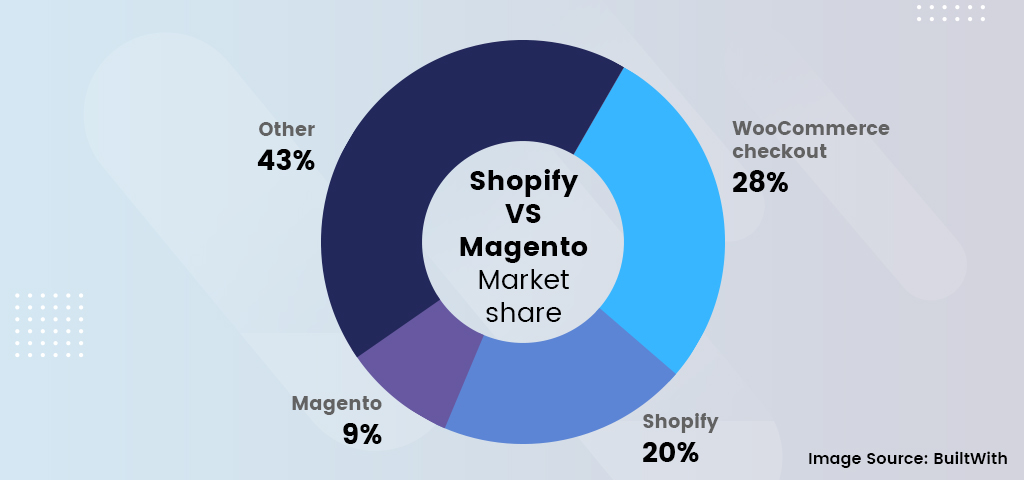
Popularity in terms of usage can be determined by studying the stats given by BuiltWith.

A representation of the technologies used in the top 1 million websites around the globe.

Shopify VS Magento

Image source: BuiltWith

This image provides a precise representation of Shopify VS Magento market share.

Shopify leads this category with a total of 26,000 top 1 million websites, while Magento is used by 11,000.

Being an all-inclusive online store creation software, Shopify is responsible for around 25% of websites on the entire internet, making it one of the most prevalent technology for building websites.

Ease of Use: Shopify VS Magento

Magento and Shopify, both are fairly simple to use with efficient user interfaces to simplify building websites and online stores.

Shopify provides a drag and drop feature along with a wizard mode, making it easier for novice developers. An easily customizable option to quickly set up a functioning online store for new business owners.

Although Magento is open-sourced and more flexible, it is not a hosted eCommerce building platform, unlike Shopify, making it much more tedious and difficult to use for new users.

Shopify is the victor in the category of “ease of use” as it is extremely simple and convenient for new users.

Pricing: Shopify VS Magento

Magento is a free to download and use platform for eCommerce development. Aspiring eCommerce business owners can set up and launch their online stores without any payments.

It is a free eCommerce platform, but it requires payments for additional features and hosting nonetheless. Purchasing a domain and a hosting provider is the user’s responsibility. Additionally, payments are also required to use Magento to its fullest potential with different app integrations and add-ons.

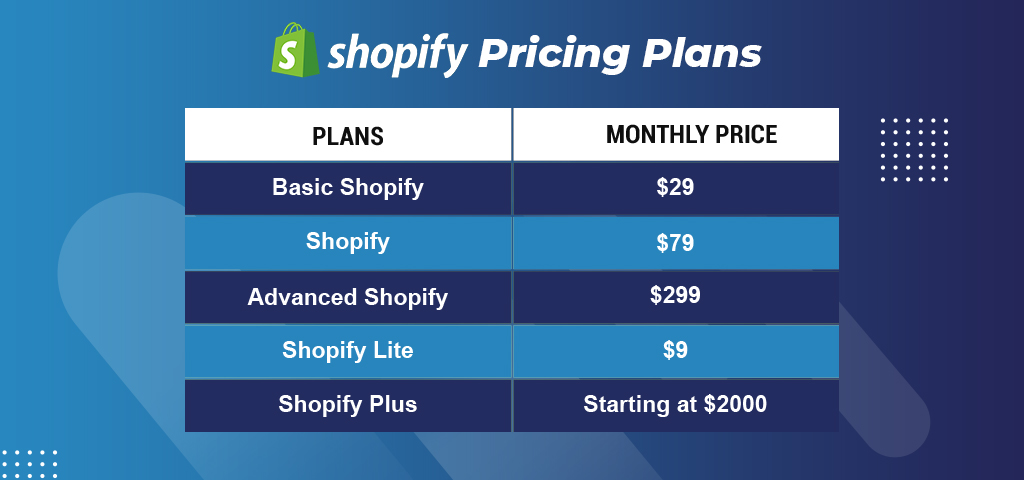
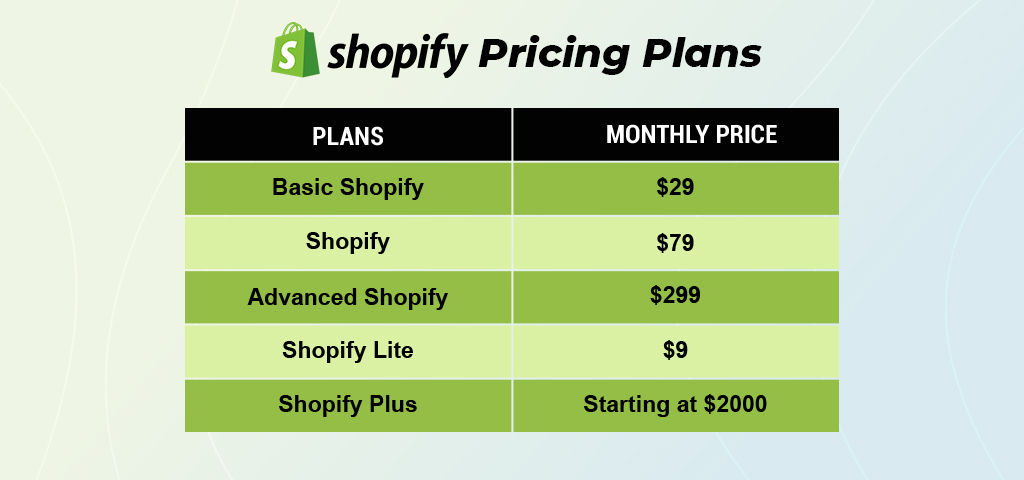
On the flip side, Shopify works in a subscription-based payment model. There are 5 different versions available for monthly subscriptions, providing an all-inclusive solution for eCommerce development.

However, Shopify requires additional charges for different themes, which is cheaper than the themes available in Magento in most cases.
Here’s a list of Shopify monthly subscription packages:

 eCommerce development

Image Source: Litextension

  • Basic Shopify: ideal for starting businesses with core functionalities;
  • Shopify: Best for growing businesses with high scalability;
  • Advanced Shopify: Provides more functionalities and features for mid-sized to enterprise-grade businesses;
  • Shopify Lite: The cheapest option for opening up an online store with limited options for scalability;
  • Shopify Plus: The high-end option for enterprise-grade eCommerce businesses.

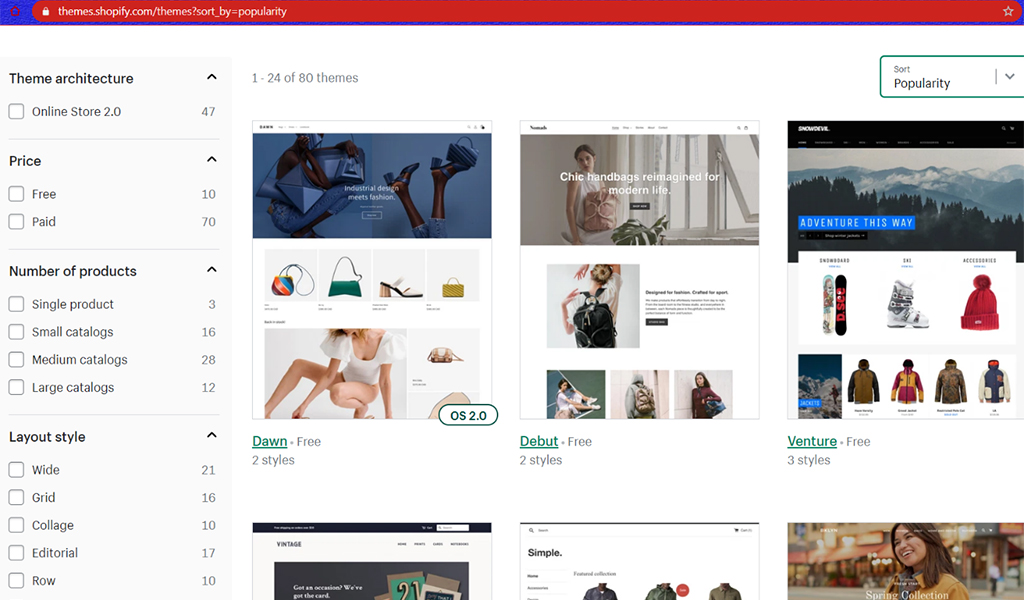
Themes: Shopify VS Magento

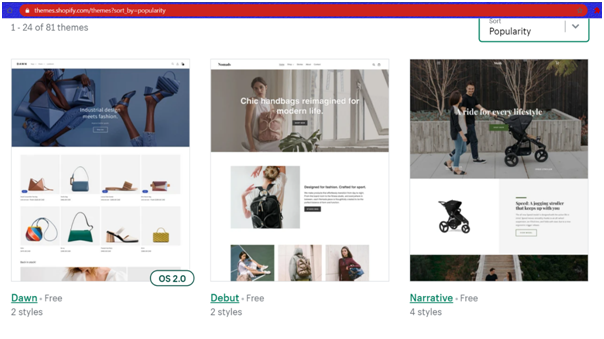
Shopify has a few free themes and templates to choose from and 64 premium ones. These themes cost around $100-$180 for building a beckoning online store.

Benefits of Shopify themes:

  • Drag and Drop feature
  • Mobile-optimized themes
  • Easy to add new web pages
  • Colour customizations to fit your brand’s personality
  • Easy social media integrations
Shopify VS Magento

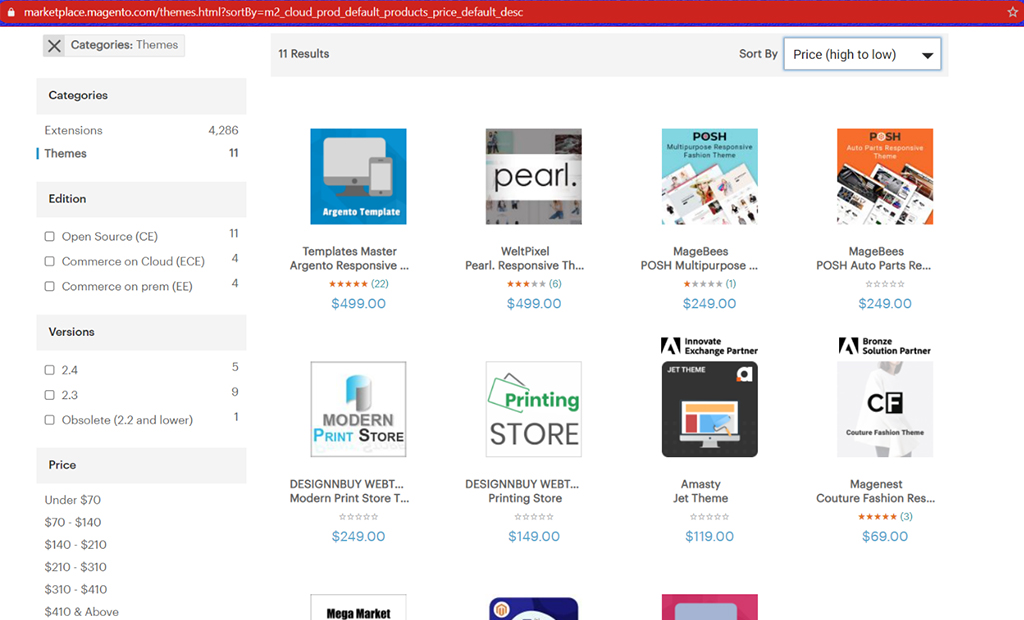
Magento offers 10 premium themes which cost up to $500. These themes are completely mobile-friendly and highly appealing for attracting online consumers. The Magento 2 version offers many more themes.

With knowledge of coding or a well-versed developer, you can even create your own theme on Magento.

Benefits of Magento themes:

  • Easy tweaking and customization options with technical knowledge
  • Lets you add animations to attract more online consumers
  • Homepage product slider option
  • Offers additional footer space for newsletters
  • Cross-selling blocks for product pages
Benefits of Magento

Shopify may offer a wider range of themes for building online stores, Magento provides more flexibility and customizations for delivering a completely personalized user experience.

Apps & Extensions: Shopify VS Magento

Themes may define the look and feel of your eCommerce business, but add-ons broaden the functionalities of your online store.
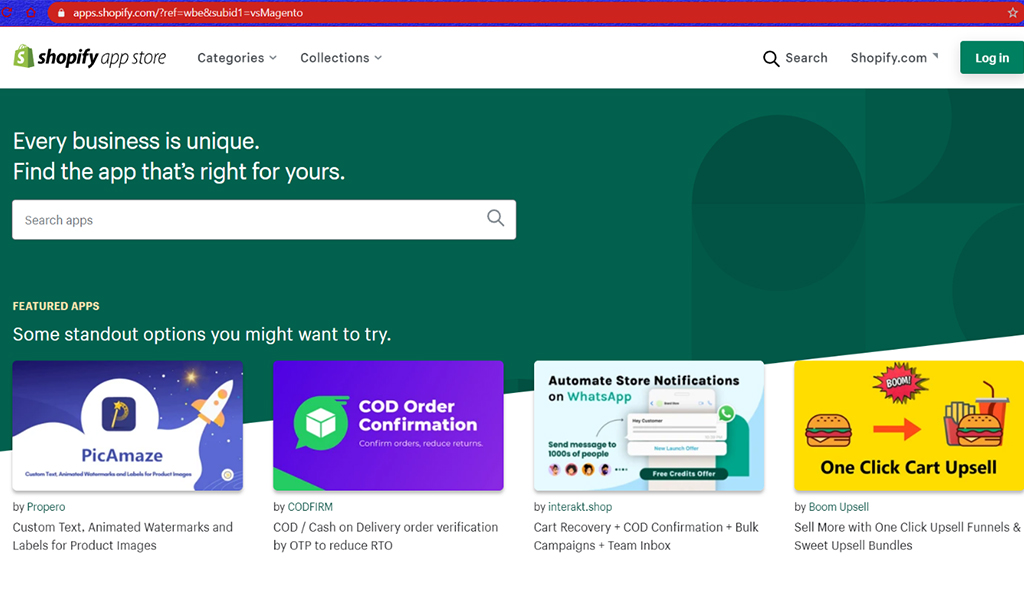
The in-house app store of Shopify offers more than 1,200 free and paid apps for different functions such as shipping, marketing, social media advertising, etc.

Some of the most used Shopify apps:

  • Trust Hero
  • Trackr
  • MailChimp
  • Analytics Buddy
Shopify apps

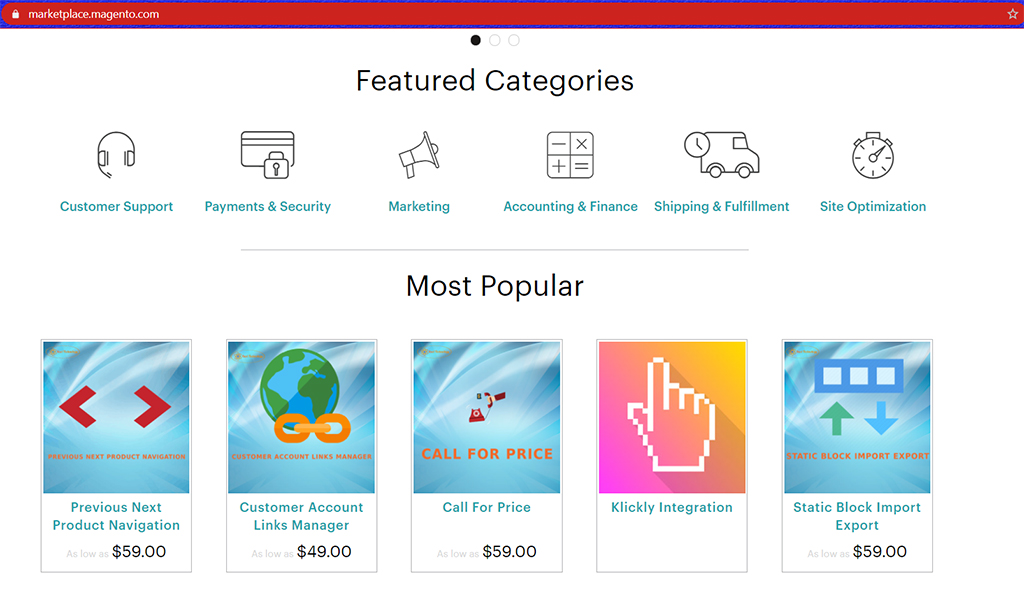
The Magento Marketplace has more than 5,000 extensions in total and approximately 2,000 extensions are free of cost, providing a wide range of functionalities.

Some of the most used Magento extensions:

  • Multi Vendor Marketplace
  • Remarkety
  • Banner Slider
  • Product Pre-Order
Magento eCommerce development

SEO: Shopify VS Magento

SEO is crucial when it comes to running an eCommerce business. Your online store needs to rank high on SERPs to attract online consumers and boost organic traffic.

Shopify relies on add-on apps for SEO functionalities. Customizations for SEO purposes are limited when it comes to Shopify eCommerce development.

On the other hand, SEO is one of the major benefits of Magento eCommerce development. Magento has in-built features that let you customize and edit URLs and image alt tags freely.

Magento offers in-built SEO features, while Shopify is reliant on add-on apps for SEO functionalities.

Complete Comparison: Magento or Shopify

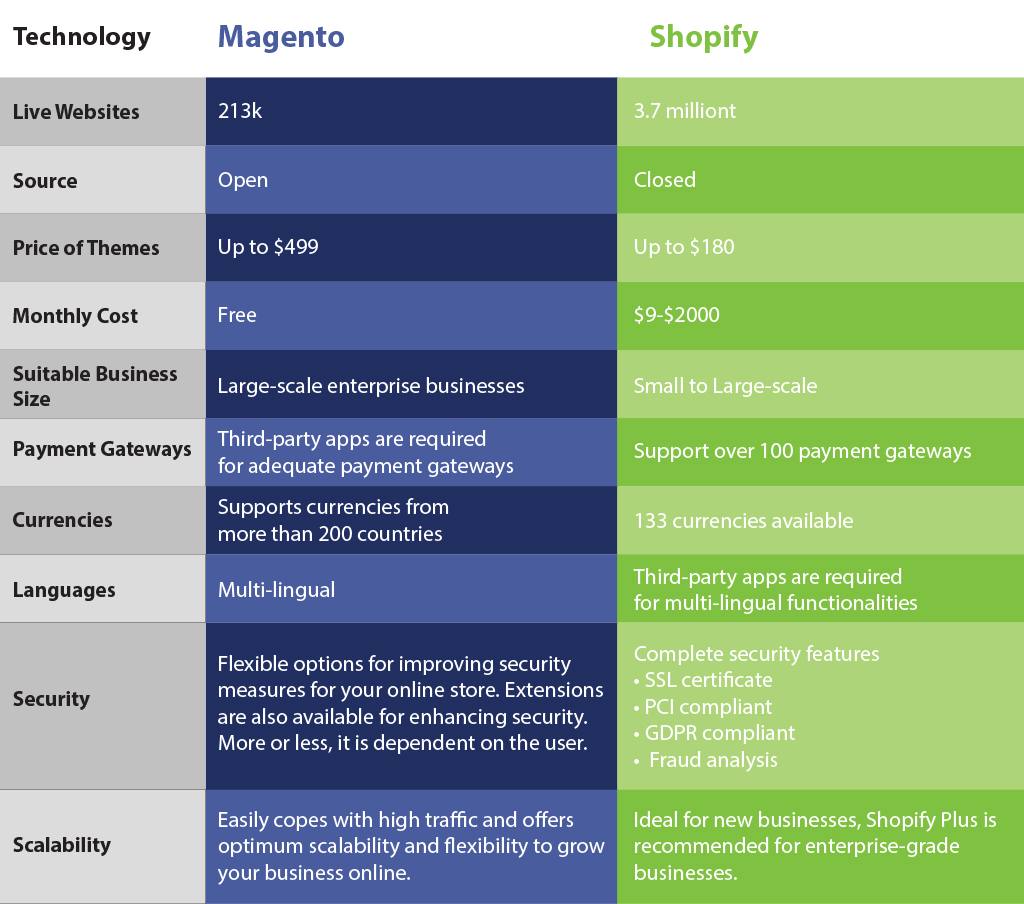
Here’s a detailed account of the difference between Magento and Shopify:

Comparison: Magento or Shopify

Pros and Cons Magento VS Shopify

Advantages: Shopify VS Magento

Major benefits of Shopify:

  • Beautiful and visually appealing themes
  • All-inclusive eCommerce store builder
  • In-built app store for different functionalities
  • In-built security features
  • Effective customer support
  • Extremely easy to use
  • Many payment gateways

Major benefits of Magento:

  • Effective community support
  • High flexibility for personalized eCommerce development
  • Adequate themes and extensions, allowing animations for high engagement
  • Mobile-friendly
  • Open-sourced nature
  • Free to download and use
  • In-built SEO features

Disadvantages: Shopify VS Magento

Major drawbacks of Shopify:

  • Monthly subscription payment model with additional charges for themes
  • Difficult to modify website content for SEO
  • Limited customizations due to the closed-source nature
  • Subpar product categorization and filtering, deteriorating online retail experience

Major drawbacks of Magento:

  • Steeper learning curve
  • Requires more time to set up
  • Many additional charges required for themes and extensions
  • Lacks security features

Summary
Magento VS Shopify for eCommerce development has been a long-standing debate between business owners and web developers.

Although it’s difficult to announce a winner between Magento or Shopify, the final decision boils down to your eCommerce development needs.

Magento is a more flexible and scalable eCommerce development platform for enterprise-grade businesses, while Shopify is an all-in-one eCommerce solution for new and growing businesses.

Our eCommerce development experts have compared every important aspect of Magento VS Shopify, and we hope it helps you make better eCommerce business decisions in the future.

If you have further queries or need assistance with eCommerce development, feel free to contact us.

Communication Crafts is an experience-led eCommerce development company with an enviable list of clientele. Our expert Shopify developers and Magento developers analyze your business goals and target audience to deliver cost-effective and future-proof eCommerce solutions.

Building your present, for a fruitful future.

Looking for an online store to captivate your audience?

Look no further!


WordPress Development Agency: Ways to Find the Best WordPress Developers

No business can escape the trend of eCommerce anymore. Having a fully functional online store is a basic requirement for every business in the digital era.

Companies are always in search of improved ways to develop eCommerce stores for better customer engagement and brand recognition. Currently, WordPress is the go-to choice for eCommerce development around the world.

WordPress accounts for a staggering 62% of all Content Management Systems worldwide.

As the popularity of WordPress increases, the demand for WordPress specialists is on the rise as well. Even though there are countless developers available to work, finding the right WordPress development agency with experts is an extremely difficult process.

That’s why we came up with this blog to help you find the best WordPress developers. Read further to find answers to questions like:

  • What is WordPress?
  • How long has WordPress been around?
  • Why choose WordPress?
  • What are the ways to find top WordPress developers?
  • What are the things to consider while shortlisting the top WordPress development companies?

What is WordPress?

WordPress is free to download and use platform for eCommerce development. Due to its highly customizable open-sourced nature and efficient content management system, WordPress is one of the most popular platforms for blogging.

WordPress uses a highly sought-after plug-in known as WooCommerce for eCommerce development. WooCommerce can be used to create full-fledged online shops for full-scale eCommerce businesses.

How long has WordPress been around?

Approximately 18 years, it was introduced in 2003 by Matt Mullenweg. WordPress uses MariaDB and MySQL database and it is written in PHP programming language.

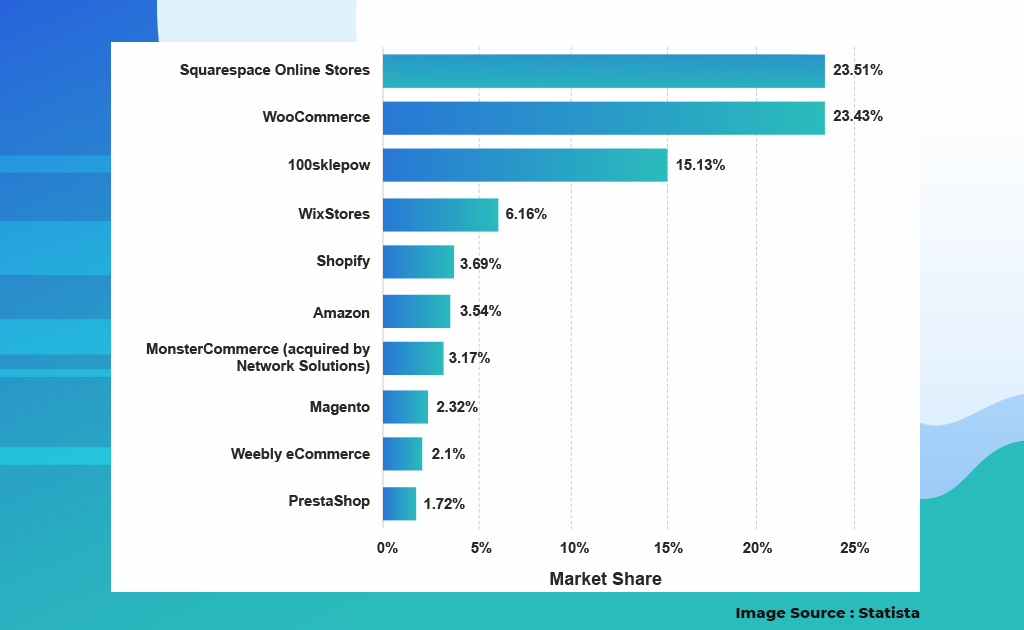
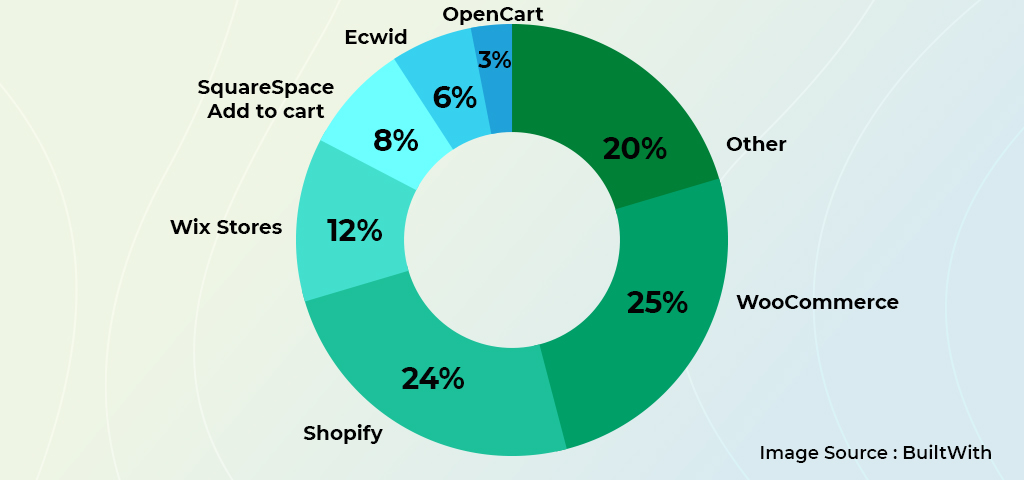
WooCommerce, facilitated by WordPress is the leading eCommerce development platform in 2021 with approximately 25% market share globally.

 eCommerce development

Image source: Statista

WordPress has more than 455 million websites around the world.

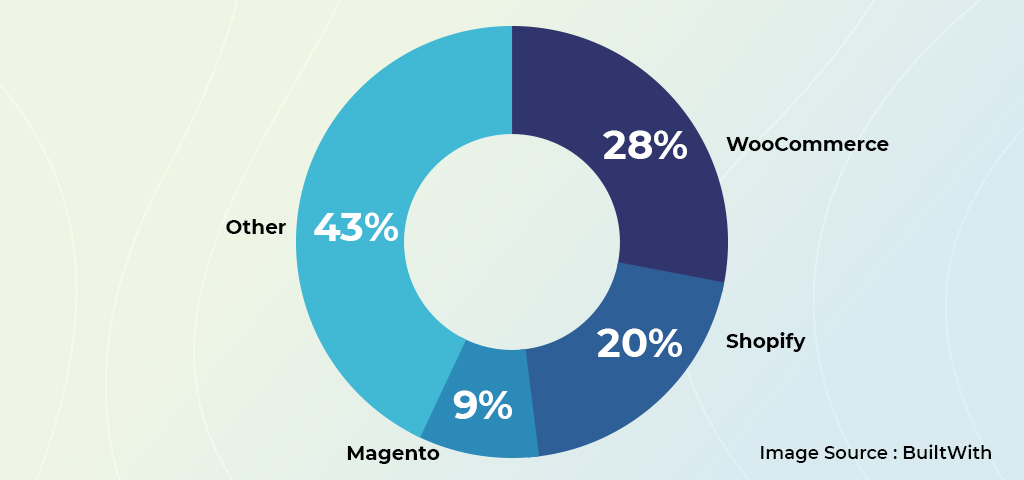
Here’s a graphical representation of WordPress usage in different categories of websites (Top 10k, top 100k and top 1 million) by BuiltWith:

 WordPress

Image Source: BuiltWith

WordPress pricing is simple, it does not require any initial fee. However, you are responsible for hosting and purchasing the domain name along with other payments to unlock certain plug-ins, themes and extensions while using WooCommerce through WordPress.

Apart from an all-inclusive eCommerce development platform like Shopify, the usability of WordPress is unparalleled.

You can setup WordPress in 4 simple steps:

  1. Get a domain name and hosting account;
  2. Install WordPress;
  3. Install a preferred theme in WordPress;
  4. Install WooCommerce plug-in and start building your online shop.

Before we discuss how to find the best WordPress Developers, let’s understand why choose WordPress.

Ways to Find the Top WordPress Developers

There are three ways to find the best WordPress website specialists:

  1. Full-service WordPress development agency;
  2. Hire in-house WordPress specialists;
  3. Hire freelancing WordPress specialists.

Full-service WordPress development agency

Partnering up with a full-service WordPress development agency is the safest and most efficient option for hiring WordPress website specialists.

Opting for a WordPress development company eliminates the time-consuming hiring process. You get access to skilled WordPress developers from the chosen web development company.

This is an ideal option if you prefer a team of highly skilled WordPress specialists developing your projects, attaining maximum ROI.
Most business owners ignore this option because of its high cost, which is more expensive than freelancers, but the benefits of a WordPress development agency produces satisfying value for money. However, partnering with a full-service WordPress development company is not viable for short-term projects.

The benefits of a WordPress development company:

  • Flexible WordPress development services depending on your web development requirements.
  • Systematic, effective and focused delivery by dedicated WordPress developers.
  • Saves time by eliminating the hiring process, enabling remote work immediately.
  • WordPress developers from a web development agency can easily become a part of your existing workforce.
  • Skilled WordPress specialists from an agency can provide you with high-quality work and impactful results.
  • A WordPress development agency becomes a long-lasting part of your organization, facilitating regular updates and maintenance.

Clutch is one of the best platforms to look for WordPress development services and companies. It provides precise and honest reviews of WordPress development companies along with portfolios and client testimonials.

It includes important attributes of the agencies like: Average hourly rate, number of employees, client focus, development focus, industry focus, etc.

Before we discuss the best WordPress development company, let’s examine the important things to look out for while choosing a web development agency.

Hire in-house WordPress specialists:

Hire WordPress specialists:

The process of hiring in-house WordPress specialists means going through a complete hiring process with defined budget plans and job offer advertisements to recruit new employees in your existing team.

There are different employment platforms for job hunting that you can utilise for shortlisting in-house WordPress website specialists:

Glassdoor connects you with business owners and employees from around the world. Making it easier to find suitable candidates with filters and advanced search.

LinkedIn creates a professional network for employment and promotional purposes. You can search and shortlist ideal candidates with impressive CVs and experience.

Indeed is a job-hunting search engine that lets you access a wide range of job opportunities, allowing in-house hiring at your fingertips.

In this option, the WordPress development services are fully under your control. Also, the newly hired in-house employee becomes a part of your workforce, enabling streamlined and easy communication.

However, the screening, shortlisting, interviewing process for in-house hiring is quite lengthy, making it arduous and time-consuming. Also, the whole process may end up being futile if the new employee doesn’t fit in with your existing team.

Hire freelancing WordPress specialists:

If you’re looking for a temporary employee as a web developer for just a couple of WordPress projects, then looking for freelancing WordPress specialists is the way to go. The search process is comparatively quicker than in-house hiring as there is an abundance of freelancing WordPress developers online. Although, searching for high skilled developers is getting increasingly difficult with the ever-increasing online clutter.

You can explore various platforms like Upwork, Toptal and Fiverr for hiring freelancers.

In scenarios with a restricted budget for short-term WordPress development, freelancers are the best way to go. $15-$55/hour is the average wage of web developers.

Hiring freelancing WordPress specialists is pocket-friendly as you pay by the hour. Nevertheless, this option also includes a lengthy hiring process and the new hire will not be a part of your web development team, deteriorating communication and teamwork.

Top Things to Consider While Choosing a WordPress Development Company

WordPress Development Company

The WordPress development agency compliments your web development strategy

Define your web development goals and match them with the portfolio of the WordPress development agency. Consider the following before finalising an agency:

  • Website migration
  • Data integration
  • Content strategy
  • SEO-based strategy
  • All-inclusive payments
  • Website accessibility
  • Website security

If the above-mentioned aspects of web development meet your needs and requirements, then you may proceed.

Check client testimonials and portfolio

Reading portfolio and testimonials thoroughly provides an in-depth insight into the company’s experience and expertise in WordPress development.

Effective and active communication

The WordPress development agency must be available to you at all times. Successful web development heavily depends on efficient communication between the client and the agency. Emergency changes, feedback and updates are always going back and forth between them, accentuating the importance of communication.

Steps for effective communication:

  1. Appoint a coordinator to convey messages between the client and the agency
  2. Get to know the WordPress development team from the agency
  3. Build a communication schedule for 100% availability
  4. Make sure that your WordPress development specialists from the agency respond to feedback effectively and quickly.

Technical competence

Make sure that the WordPress specialists from the agency are skilled in other programming languages and web development platforms like PHP, CSS, HTML, JavaScript, Angular, React, etc.

The size of the agency

The workforce of the WordPress development agency determines the magnitude of resources it has to offer. If your web development project is highly complex and requires a lot of resources, then the size of the WordPress specialist agency matters.

Return on investment

Study the quality of work produced by a WordPress development company to measure it against the possible revenues generated by the project. The quality of the eCommerce website and its ability to drive sales defines the top WordPress development companies.

Conduct rigorous research on the cost VS value of the top WordPress development companies’ before spending your money.

Benefits of WordPress Business Development

Why choose WordPress among other eCommerce development platforms is a frequently asked question by business owners. Here’s a list of WordPress advantages to better explain its significance:

  • User-centric pricing of WordPress is one of its core benefits. Start-up companies can build a brand new online shop for free using WooCommerce, and gradually make purchases to scale their eCommerce retail businesses.
  • Rapid development speed with a reasonable learning curve.
  • Open-sourced nature provides complete freedom to customize WordPress developers.
  • Flexible inventory management system, giving you complete control over inventory reports and product listings.
  • The SEO-friendly nature of WordPress lets you optimise meta tags, URLs, meta descriptions and other website content, making it easy for your website to rank high on search engines.
  • WordPress has more than 600 extensions and 50k plug-ins for easy creation and maintenance of high-functioning eCommerce stores.
  • When it comes to eCommerce growth and development, data is key. WordPress offers comprehensive analytical tools for easy monitoring of business processes.
  • eCommerce stores powered by WordPress exhibit high scalability, making them sustainable inthe long run.
  • Customer-centric themes, perfect for attracting potential consumers.
  • Multiple payment gateways like Amazon Pay, Authorize.net, PayPal, etc.
  • powerful community to identify and eradicate issues and provide regular updates
  • Multi-lingual support with 60 different languages using various plug-ins

Now that we’ve established the significance of WordPress, let’s get the different options for hiring the best WordPress developers.

Communication Crafts: End-to-end WordPress Development Services

Communication Crafts (CC) is a trusted and experience-led website development agency. We implement a productive mix of innovation and the latest technologies to provide end-to-end WordPress development solutions under one roof. We leverage customer-centric web designs for high-quality WordPress development services that span many industries like food & drink, banking & finance,eCommerce, entertainment,health & fitness, photography, eLearning, logistics, and more.

Our WordPress development services help you better connect with your current audience, entice potential consumers, maximise ROI and conversion rates.

Hire versatile web development teams from CC:
We offer dedicated web developers for the following categories

Build your online store with CC in 3 steps

  1. WordPress development team selection and resource allocation
  2. eCommerce store design and development process with active feedback
  3. Delivery and post-development support/maintenance

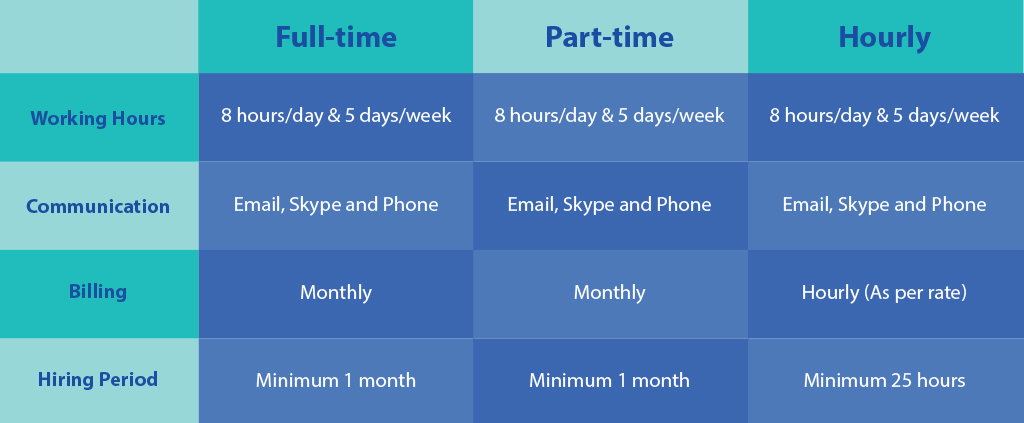
Flexible hiring models by CC

Hire Developers

For further queries about WordPress and eCommerce development, feel free to contact us.

Our eCommerce development experts are here at your service.

Starting your online retail business is just one click away!


Looking for bespoke eCommerce development?

We’ve got you covered.

Single Page VS Multi Page Websites: What attracts users more?

With an ever-increasing amount of online clutter, consumers are looking for unique and impressive user experiences. The demand for web development is at an all-time high, and most brands are confused about the effectiveness of different types of websites.

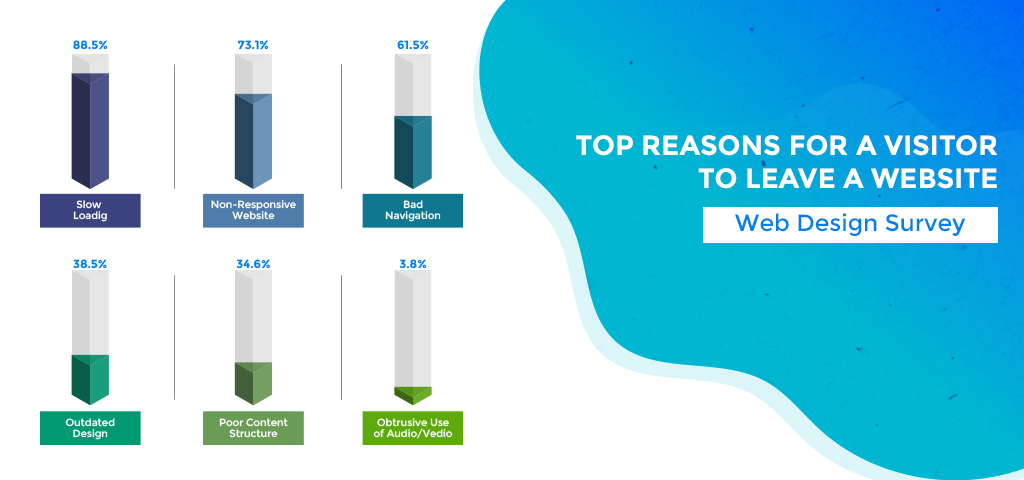
Customers tend to leave a website within seconds if they don’t get the expected user experience or relevant information.

Here are some of the reasons why people leave a website:

Single Page VS Multi Page Websites

There are more than 4 billion internet users globally, and the main question for web development is: Which type of website is the most effective between Single Page Websites VS Multi Page Websites?

Our expert web developers have created this article to help you understand the difference between single page websites and multi page websites.

We hope this blog aids you in making better web development decisions for your business.

Let’s start by understanding the meaning of one page websites and multi page websites.

One Page Website

Single page website follows a very simple and straightforward approach. All the required content is provided concisely on a single webpage.

This website is designed to provide all the necessary information on a single page. Such websites are ideal for small businesses or startups that want to present a clear and concise message to their visitors. 

Single-page websites are also popular for personal portfolios, event websites, and landing pages.

But, don’t let this minimalistic approach fool you, building a single-page website requires a carefully planned content design to display all the information for the users in an easy-to-digest way.

This type of website eliminates the need to have separate pages for different services or products. The users get everything in one place without additional navigation.

One-page website examples:

One Page Website

Multi-Page website

A multi-Page website is followed by a standard design for most of the websites on the internet. It’s a very flexible and scalable approach for all sizes of companies, brands and businesses.

This design style can be utilised for building all kinds of websites, providing different sections for products and services.

Users have the option of choosing specific sections according to their web surfing needs. From news websites and bank websites to eCommerce and enterprise-grade websites, the multi-page format is used for its freedom of using various types of content offering maximum versatility.

Multi page website examples:

Multi Page website

Let’s discuss the pros and cons of one page websites and multi page websites to clearly understand the difference between them.

Pros and Cons of One Page Website

Benefits of Single Page Website

Single page website design is ideal on many occasions, let’s examine the upside of building a one page website.

Simple & straightforward navigation
The main objective of building a single page website is to keep it simple. The user has only two options for navigating, scrolling down and scrolling up; and it offers only one way of consuming content, beginning to ending.

The clutter-free and linear web design lets the user get the desired and relevant information quickly and easily without any distractions.

Content like contact information, case studies, product information, etc. can be found in one place without having to click on additional links.

Easy to Digest Content
A skilled web designer plans the content on a single-page website that aims to get the desired results from the users. For example, an eCommerce website aims to get higher conversions and sales and a news website aims to deliver the news in descending order of importance.

You get complete control over the consumption of your website’s content, providing an effective way to influence the actions and decisions taken by the user.

From a basic description of your products to a detailed account of the benefits of the product, your website’s design guides the user through the content to achieve optimum results.

Mobile-Friendly Design
The lack of additional links and a concise design leads to an amazing mobile experience. Scrolling is ideal for mobile user interfaces, and a one page website offers only a scrolling form of navigation.

With more than 6.8 billion unique smartphone users in 2023, it is getting increasingly important to deliver mobile-friendly experiences through brand websites.

The need for providing mobile commerce options has also accelerated since the Covid-19 outbreak.

Mobile-Friendly Design

More than 70% of total eCommerce is taking place through smartphones in 2021, making it absolutely necessary for companies to have a mobile-friendly website.

The mobile-friendly single-page website design can also utilise lazy loading. Conserve resources and anticipate low internet availability by rendering only the displayed content, and the additional content is loaded as the web page is scrolled down.

Gain Valuable Page Authority
What this webpage design lacks in SEO features, it makes up for in building higher page authority.

Page Authority (PA) and Domain Authority (DA), like SEO, affect the ranking of a web page on search engines or SERPs. PA and DA are fuelled by the number of websites linking to your web page.

With a single-page website design, every link from other websites will redirect to a single URL, boosting your DA and PA rapidly.

Low Maintenance
With a predefined content size and no additional links, it becomes easy to maintain a single-page design. This process eliminates the need for regular content and template updates.

Website-building platforms like WordPress, Shopify, and Magento may require updates from time to time, but other than that, you can build a one-page website and leave it as it is.

Additionally, finding and eradicating bugs and glitches are much easier on a single page of content.

Boost Conversion Rate
A single-page website design is ideal for attracting consumers, subscribers, and leads. That’s why this web design is chosen widely for landing pages and eCommerce websites.

With full control of your website’s content distribution, you can easily guide your users through the website with a narrow focus to get the desired actions from the users.

One-page websites offer clear content with zero distractions, letting you control your users’ navigation throughout your website.
Check this website for instance: Onepagelove


Drawbacks of Single Page Website

Single-page website designs have downsides as well, let’s explore the major drawbacks of a one-page website.

SEO
Between single-page VS multi-page websites, single-page website design lacks SEO performance, making it difficult for your website to rank higher on search engines or SERPs.

The limited content size lacks the ability to incorporate enough keywords. One-page websites don’t include in-depth and fresh content about products and services.

Moreover, the single-page website design utilizes only one URL, limiting the ability to share various links through various types of content.

Low Scalability
A website in one page offers low scalability because you cannot expand your content indefinitely. Expanding product categories and descriptions along with portfolio and case studies is severely limited in a one-page website.

If your business is projected to grow exponentially, it is ideal for you to choose a multi-page website template that offers more versatility and scalability with numerous links for different types of content.

This brings us to multi-page websites, let’s dive in, shall we?

Pros and Cons of Multi-Page Website

Pros and Cons of Multi Page Website

Benefits of using a multi-page website

This is the standard design used by many companies for building a feature-rich website with in-depth content about its products and services. Let’s discuss the benefits of using a multi-page website.

SEO
The biggest advantage of building a multi-page website is SEO performance. By delivering different types of content through blogging and providing in-depth information through siloing (creating different categories and sections), you can easily target more volumes of keywords. This keeps your website SEO-centric, leading to a higher rank on SERPs.

Additionally, it’s easy to measure SEO performance and audience reaction with performance monitoring tools like Google Analytics.

Standard Navigation
Clicking on different links and menu bars has been the traditional and standard way of surfing on the internet for years.

Users are habituated to this type of navigation, making your website more user-friendly as a result.

Although it should be noted that creating too many categories can have a negative effect by distracting your audience and leading them away from the desired actions.

High Scalability
There is no limitation when it comes to a multi-page website design. New URLs and web pages can be added for a growing business for categorizing and increasing content for your products and services.

Marketing
A multi-page website is ideal for spreading brand awareness and advertising. Blog posts, different URLs, categories, etc. can be advertised through social media posts. Different segments of the audience can be targeted for advertising different parts of your website.

For example, an eCommerce store can attract different consumers (male/female/kids/adults) by utilizing different segments of its products.

Drawbacks of using a multi-page website

Before making any concrete decisions, let’s explore the downside of multi-page websites as well.

Heavy Maintenance & Regular Updates
A large multi-faceted website requires more attention, making it time-consuming to keep the website up-to-date.

You have to keep a check on website elements such as:

  • Security
  • Internal links
  • Codebase
  • Optimized and updated content (text/image/video)
  • Product categories and details
  • SEO
  • Content

All of these elements must remain bug-free and optimized at all times for delivering satisfying user experiences.

Not Mobile-Friendly
If the multi-page website is not optimized for a mobile-friendly and responsive design according to the dimensions of a smartphone, then you may lose customers. The growth of mobile commerce has made it a necessity for brands to optimize their websites for smartphones.

Bounce Rate
Multi-page websites have shown greater bounce rates than single-page VS multi-page websites.

Bounce rate is the percentage of users that leave your website without exploring or clicking any additional links. A high bounce rate shows that the website has issues that need resolving.

The issues that can cause the bounce rate to spike are as follows:

  • Slow-loading web pages
  • Unimportant or irrelevant content
  • Bad headlines or descriptions
  • Poor navigation
  • Poor UI/UX design
  • Stale content

Takeaway

Choosing the right type of website is very important for a brand, and it completely depends on your business goals and target audience.
With such varied benefits and drawbacks, it is difficult to determine which one comes out on top between single-page VS multi-page websites.

The two factors that can help you decide are Content and Marketing.

Decide the type and size of Content you want on your website. If all the information can be displayed concisely on one web page, then the one-page website is ideal for your business. If you require different sections for different products, services, case studies, portfolios, contact information, etc. then the multi-page website is the one for you.

If you want to market your website through social media and SEO, then multi-page websites work better than one-page websites.

Define your audience and web development needs to come up with the type of website that is best suited for your business.

If you require further assistance regarding web development, feel free to contact us!

With 17+ years of experience and a team of expert web developersCommunicationCrafts is a leading web development company that caters to your business needs and offers a wide range of web development services.

We build websites that win!

Looking for bespoke web development solutions?

You demand, we deliver!

Benefits of Mobile Apps in Education Explained

Educational apps are unequivocally the future of EdTech and education.

Surveys suggest that 73% of students prefer online courses in a post-pandemic era. Additionally, eLearning enhances knowledge retention by 25%-60%, while students only retain 8%-10% of knowledge through conventional learning methods.

Growth of eLearning:

Mobile Apps in Education

This rapid growth of EdTech and eLearning solutions is turning heads all over the world, and EdTech start-ups are flourishing now more than ever. This is the reason why many companies are looking for new and unique eLearning methods.

This is where educational mobile apps for students comes into play!

The educational app market is expected to grow by an astonishing figure of $46 billion between 2020-2024.

The benefits of mobile apps in education make them a significant and impactful part of EdTech.

Let’s discuss further.

Examples of Mobile Apps in Education

Here are some of the best Android educational apps and iOS educational apps:

  • Duolingo
  • Remind
  • Kahoot!
  • edX
  • Photomath
  • Udemy

Duolingo
Duolingo is one of the most comprehensive and effective language learning platforms in 2023, available for both iOS and Android. This online learning mobile app uses gamification techniques to simplify the strenuous task of learning a new language. It is free and available in 30+ languages.

Mobile Apps in Education

Remind
Remind is one of the mobile apps for education that facilitates active communication between teachers, students and parents. This app for Android and iOS can be used to send reminders regarding assignment deadlines, home works, upcoming exams or tests and other classroom activities. This educational app can be used to send messages to an entire class or individual students.

Kahoot!
Kahoot administers quizzes with game-based learning elements for teaching various topics in a fun and interactive way. You can play with 2000+ online contestants where the quiz is displayed on a big screen and the students can answer them via iOS and Android smartphones. This technique makes the students feel extremely satisfied when they get the right answers.

educational app

edX
Available on Google Play Store, edX helps students achieve the dream of attending ivy league colleges. This app does not provide actual degrees from colleges, but it offers an opportunity to gain knowledge from actual college lectures and video tutorials. It has more than 2000 courses from top universities and colleges spanning various subjects and topics for free.

Photomath
Mathematics has always been a complex and hard-to-grasp subject for many students. Photomath attempts to solve this issue by providing an interactive platform to learn and understand mathematics. This educational app uses a unique method: It lets you scan the written or printed math problem and provides a step-by-step explanation with animated instructions and interactive graphs.

education App Photomath

Udemy
Udemy is one of the best and most effective mobile apps for education. This educational app offers more than 130,000 video tutorials for 32,000 courses. The topics and subjects can range from business and technology to personal development. With paid and free online classes and tutorials from expert instructors, Udemy delivers an interactive and effective learning experience.

Let’s find the answer to the question “How do mobile apps benefit the educational sector?

Perks & Benefits of Mobile Apps in Education

Benefits of Mobile Apps in Education
  • Interactive Modern Learning Techniques
  • Parent-Teacher-Student Communication
  • Miscellaneous Tasks
  • Unlimited Online Learning
  • Systematic & Personalized Learning
  • Multimedia Learning
  • Sustainable Learning with Reduced Costs

Mobile apps in education can deliver learning experiences that were previously impossible to achieve through traditional learning methods. Let’s examine further.

Interactive Modern Learning Techniques
This is one of the most significant benefits of mobile apps in educationEducational mobile apps for students integrated with next-gen technologies like Augmented Reality can help them perceive intangible topics and concepts like Quantum Physics, Chemistry, Astronomy, etc.

For example: Skymap is an app that uses the phone camera integrated with AR to display the precise location of stars, planets, constellations, etc. for Astronomy students.

MoleculAR is an app for iOS and Android that teaches organic chemistry using AR technology.

AR educational apps can also be used as a safe and immersive environment to train professionals like healthcare workers and pilots.

Some educational apps like Duolingo and Kahoot! (mentioned above) delivers interactive and engaging learning experiences with the help of gamification techniques and game-based learning.

Click here to learn more about the benefits of Game-Based Learning.

Parent-Teacher-Student Communication
Educational apps can effectively enhance the communication between parents and teachers, providing deeper insight into their children’s education and learning experiences. Teachers and parents can easily discuss gaps in knowledge of the students and how to ameliorate them. This is one of the most valuable benefits of mobile apps in education.

The communication between students and teachers also improves with educational mobile apps for students. Real-time performance assessment lets the instructor know the parts where each student needs help.

The students can also communicate the teachers and students from all around the world, facilitating a learning community to discuss different learning methods, concepts, topics, etc.

This active communicative environment enhances the overall learning and teaching experience for everyone involved.

Miscellaneous Tasks
Various mundane and simple tasks like fee payments, attendance management, grading papers, participation monitoring, etc. can easily be automated and handled via educational apps.

Most of these tasks are time-consuming if done manually, educational apps can be used to utilise this time to conduct classes.

Unlimited Online Learning
Students can choose the time and place for learning without any restrictions, and that’s why they love online learning mobile apps.

Along with 24×7 availability of learning, educational apps provide the students with limitless course materials, e-books, video tutorials, etc. They have access to the entire internet for knowledge, letting the students refer back to the learning materials anytime they want for revision or any other purpose.

The sheer flexibility and versatility of eLearning through educational apps are unparalleled in the new age of teaching and learning.

Systematic & Personalized Learning
First of all, educational mobile apps for students provide a unified platform to access all the learning materials for a course or subject. From e-books and quizzes to video tutorials and webinars, everything can be found in one place, which is a significant boon for students and teachers alike.

Moreover, traditional learning methods have a huge flaw. Every school and institution tends to follow a similar pattern of teaching, making it quite monotonous for students. Also, this method is ill-suited for many students as every individual has a different pace of learning and require individual attention to achieve optimum results.

Educational apps can resolve this issue with ease. Artificial Intelligence can be integrated for monitoring the knowledge gaps and learning pace of individual students to form a customized and personalized learning experience for each student.

This can be achieved even without AI, the instructors or teachers can track real-time performance assessment via educational app to develop a course structure that delivers comfortable learning experiences for everyone.

Multimedia Learning
This is also a significant benefit of mobile apps in education. Learning through only textual information provides the least knowledge retention.

Different media options for learning creates a versatile and engaging environment for learning. Learning through videos and images helps students retain maximum knowledge in a fun and immersive way.

Sustainable Learning with Reduced Costs
First of all, eLearning with educational mobile apps for students eliminates the need for physical books. The students don’t need to carry heavy books, not to mention the trees saved in this process.

Secondly, educational apps minimize the resources required for teaching and learning. Along with the reduction in the cost of buying physical books, educational apps can also eliminate the need to pay for classrooms. The same level of effectiveness can be achieved through remote learning.

High-quality education is not limited to only rich individuals anymore, anyone can access courses from top-notch instructors and institutions using educational apps.

With mobile apps in education, all a student needs is enthusiasm for learning, a smartphone and an internet connection.

Benefits of Mobile Apps in Education for Students

  • Engaging and interactive learning with multimedia options
  • Immersive learning techniques with AR and gamification
  • Quizzes and tests for enhancing and polishing difficult concepts
  • 24×7 access to knowledge and learning
  • Limitless access to learning materials via the internet
  • Virtual classrooms, webinars and video tutorials
  • Remote learning
  • Enhanced communication with teachers

Benefits of Mobile Apps in Education for Teachers

  • Branding and marketing of schools and institutions through educational apps
  • Interactive and engaging school activities and events
  • Enhanced communication with parents of the students
  • Real-time performance assessment for an improved teaching experience
  • Providing reminders to students for upcoming assignment deadlines and exams
  • Integrating AI and chatbots to automate mundane tasks like grading papers, taking attendance, solving queries instantaneously, and more.
  • Eliminates paperwork
  • Deliver unique and personalized learning experiences for students
  •  

Benefits of Mobile Apps in Education for Parents

  • Easy communication with school administration and teachers
  • Understand the student’s knowledge gaps and provide additional help at home
  • Online fee payments
  • Monitor and track class schedules

Summing Up

With significant benefits like personalized learning, gamification, and modern learning techniques, online learning mobile apps are being welcomed by teachers and students alike. Educational mobile apps can enhance the learning experience by making it more engaging, simplified, systematized, captivating, immersive and accessible for everyone.

It is a great responsibility to create a learning platform, and delivering the most effective and efficient learning experiences should be your priority. By implementing the use of mobile apps in education, teachers and institutions can create an impeccable learning structure for their students.

All in all, these perks and benefits of mobile apps in education are gradually revolutionizing learning experiences all over the world.

If you need an educational mobile app for students or require maintenance in an existing one, contact us!

Communication Crafts is an experience-led app development company that offers bespoke eLearning solutions to satisfy your customers and reach your desired goals efficiently.

Our EdTech expert can build a cost-effective, robust and engaging educational app that attracts new users, engages your current audience, exhibits all the important benefits, and more.

Educational apps are the future of education, and we make sure it stays bright!

Looking for a team of the best remote developers?

You’re in the right place!
OWASP Top 10 Vulnerabilities: The Ultimate Guide for App Security in 2023

In the age of digitalization and online consumerism, it is getting increasingly important to provide safe and secure online retail experiences.

In the digital era, web applications are susceptible to cyber-attacks, web security risks and data leakage at all times.

Cybercrime is at an all-time high, and it is estimated to cost companies an astonishing amount of $10.5 trillion annually by 2025.

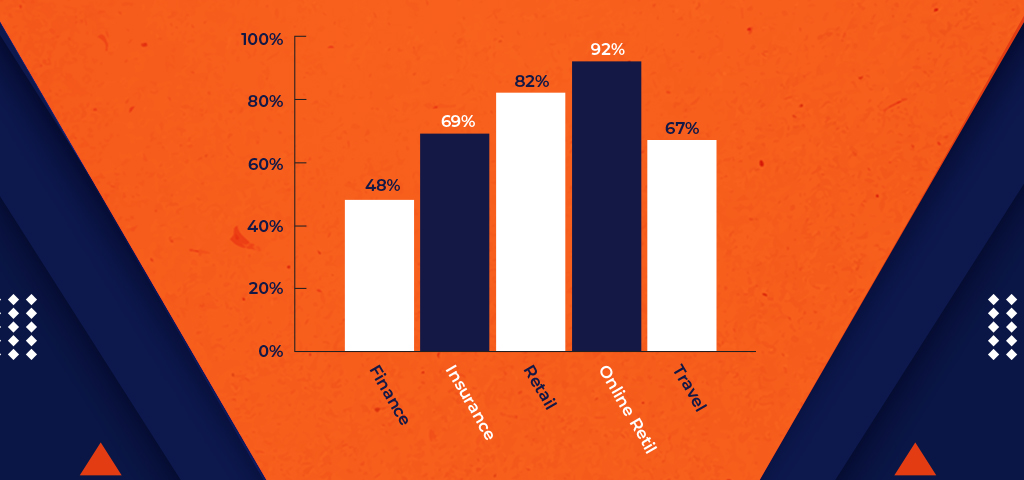
Here are the types of apps that are at the risk of sensitive data leakage:

Guide for App Security

What is data leakage?

Data leakage is an unauthorized transmission of sensitive or confidential data used for malicious purposes by hackers.

An insecure app can lead to a loss of credibility and brand loyalty for a company as the consumer can no longer trust the company’s app to make a purchase or any kind of transaction.

It is crucial for companies and developers to be aware of the security risks to successfully prevent cybercrime and deliver safe user experiences.

This is where OWASP Top 10 comes into play!

Let’s start by discussing what is OWASP…

What is OWASP?

Founded in 2001 by Mark Curphey, OWASP is a non-profit international organization dedicated to improving the security of web application software all over the world.

What does OWASP stand for?

Open Web Application Security Project

OWASP meaning is simple: Through numerous open-source projects, thousands of community members and educational training conferences, the OWASP organization is the main source of software security for developers.

They offer a plethora of software security materials like videos, tools, forums and documentation, and all of their content is freely available for everyone on OWASP’s website.

The best content that they’ve released as of yet is the OWASP top 10 for tackling software and mobile vulnerability from issues like data leakage and cyber-attacks.

Now you may be wondering what is OWASP top 10, let’s clarify.

What is OWASP Top 10?

The OWASP Top 10 represents a list of the most threatening security risks to web applications and web development, and the list is updated and optimized every few years. It is a standard report for spreading awareness among developers and technologists.

This ranked list is created by security experts around the world, and the web security risks are ranked according to the frequency of the vulnerabilities, the impact of the security risk and the severity of the security flaws.

Its main objective is to help developers produce a better and more secure codebase for companies, minimizing security risks and building a robust software development culture.

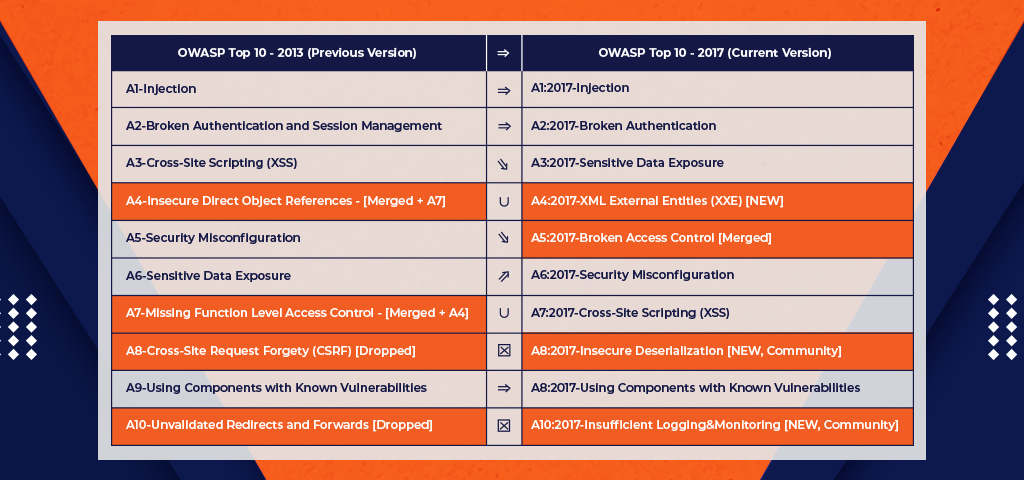
Here’s a list of the OWASP top 10 of 2013 compared to the updated OWASP top 10 of 2017:

web applications and web development

Without further ado, let’s discuss each of the latest OWASP Top 10 in detail.

Injection

Broken Authentication

Sensitive Data Exposure

XML External Entities (XXE)

Broken Access Control

Security Misconfiguration

Cross-Site Scripting

Insecure Deserialization

Using Components With Known Vulnerabilities

Insufficient Logging & Monitoring

1. Injection

All the data in a website or web application is stored in databases in form of queries, which is written in a Structure Query Language (SQL) most often than not. Web application retrieves, adds, removes and modifies data through SQL, like when a consumer fills up a questionnaire with personal information and data.

The users’ sensitive data in the questionnaire can be easily hacked for malicious intent by changing the web application’s code specifically for the SQL query.

With this insecure cryptography, a hacker can gain access, steal, view, delete and tamper confidential data for personal gain.This web app vulnerability is the result of insufficient authentication of user information, allowing intruders to input special requests that deceive the web application.

The best way to avoid this OWASP top ten security risk is by separating the database from the queries and commands, which means segregating them from the web app logic.

This can be done in multiple ways:

  • Remove the use of parameterized queries and interpreters by using a safe & secure API
  • Add a whitelist (server-side input authentication)
  • Use the escape syntax in the interpreter to avoid special characters in the web application
  • Minimize data exposure in case of an SQL injection by using database controls like LIMIT SQL within the queries

2. Broken Authentication

This is one of the most critical security risks in the list of OWASP top 10. Whenever a web application needs to distinguish and identify users, it uses session cookies. After the login is authenticated via username and password, a specific identifying cookie is saved in storage. This is the process of user identification and recognition of a web application.

If the web application’s IT architecture does not implement additional verification of the user’s IP address or multiple access in a single session, a hacker can gain access to the identifier and the web application via the user’s account.

If it’s a bank account or a web application that contains payment gateways, the consequence of this security breach and unverified access can adversely affect the original user.

This OWASP top ten security risk can be avoided by:

  • Implement password optimization by checking the strength of the password used by a user
  • Implement multi-factor authentication for double-checking login information
  • Avoid using URLs for sessions IDs and make sure that the URL in use is terminated after logout
  • Block the use of default credentials
  • Limit the number of login attempts and monitor failed login attempts. Inform users and admins when an account is under cyber-attack

3. Sensitive Data Exposure

Data Exposure

The data or information transmitted through HTTP is not encrypted when it goes through multiple routers. All types of data transfer in a web server from device to user travel between many nodes like office router, home router, provider router, host provider server, data centre router, and many more.

If any of these nodes contain malware, known as “sniffer”, the data is read and transferred to the hacker, which provides access to all types of sensitive and confidential data going through the different routers.

This insecure cryptography in data transfer leads to the vulnerability of sensitive information like bank account details and user passwords.

This OWASP top ten security risk can be avoided by:

  • Enforce a Transport Layer Security (TLS) to protect data transfer
  • Encrypt the stored data
  • Implement HTTP Strict Transport Security (HSTS) for encryption
  • User responses with sensitive data should not be saved in the cache
  • Implement controls on different data classifications like stored, transmitted or processed
  • Use robust and secure keys, protocols and algorithms
  • Implement hashing functions like PBKDF2, Argon2, scrypt, brcrypt, etc.

4. XML External Entities (XXE)

XXE can be exploited in a wide variety of ways. It can be implemented in a complicated way or a simple way, if a part of external code reaches an XML document, then the web application has been breached and compromised.

The most famous XXE attack is called the “XML Bomb” or the “Billion Laughs” attack. This type of cyber-attack can overload the web application’s server and its resources quite simply. A hacker can define a tiny and insignificant element like “haha” or “lol” or a collection of other elements to shut down a specific server.

This OWASP top ten security risk can be avoided by:

  • Train developers to test, recognize and deal with XXE attacks
  • Implement simpler data formats like JSON to avoid serialization of sensitive data
  • Implement whitelist server-side input authentication to avoid XML documents with malicious data
  • Implement XSD validation to authenticate incoming XML using XML schema
  • Ensure regular up-gradation and patching of XML libraries
  • Manually review and analyse source code for anticipating XXE attack

5. Broken Access Control

This security risk in OWASP top 10 has resulted from the lack of authentication of accessibility when data or object is requested. Web applications implement permission checks before giving access to data on the user interface. However, if the data request is not carefully authenticated, hackers can trick the web application by using a falsified request to gain unauthorized administrative access to sensitive data and system functionalities without the required permissions. This can allow the hackers to add, tamper or delete important data for personal gain.

This OWASP top ten security risk can be avoided by:

  • Provide access control through server-less API or trusted server-side code
  • Avoid public resources
  • Implement access control functions and use them all over the web application
  • Implement record ownership
  • Identify and track access control failures and let the admins and users know in case of suspicious login behaviour
  • Unauthorize JSON Web Tokens (JWT) after logout
  • Ensure that the wen roots don’t contain backup files and metadata
  • Introduce integration and access control unit tests
  • Remove invalid and inactive user accounts
  • Introduce multi-factor authentication during login
  • Introduce Principle of Least Privilege (PoLP)
  •  

6. Security Misconfiguration

Security Misconfiguration

The security of web applications controls the whole infrastructure, framework and all types of servers. Server component default settings are, most often than not, insecure and open to potential data leakage.

A disabled cookie HTTP only setting can easily lead to theft of session cookies through JavaScript in an XSS attack (section 7), and this is caused by the default setting. If the cookie HTTP only setting is enabled, then the session cookie remains secure from malicious hackers. Such a significant and simple setting is overlooked in most web applications with personal accounts and payment gateways.

The database server default settings like Memcached and Redis are also some examples of Security Misconfigurations. This weakness or vulnerability leads to situations where private sessions and services get displayed on public IP, making it easy for hackers to access and tamper data using an XSS attack.

The web application must be regularly updated and optimized to avoid this kind of data leakage because vulnerabilities emerge every day in different components of a web application. Your app may be secure, nicely written and carefully examined, still weaknesses and data leakage may arise in the web or operating server at any time.

This OWASP top ten security risk can be avoided by:

  • Use a secure and safe web application installation process
  • Automate the process of deploying a secure web application environment
  • Eliminate rarely used features and frameworks and deliver a minimal web application
  • Segregate the tenants and components by implementing segmented web application architecture
  • Examine, review and regularly update the configurations of updates, patches, security notes and cloud storage permissions
  • Automate the process of monitoring and authenticating the efficiency of the secure web application environment
  • Automate workflows to ameliorate security issues in real-time

7. Cross-Site Scripting (XSS)

Cross-Site Scripting or XSS is another type of authentication error. Like an SQL injection, a hacker can steal session cookies and sensitive data using HTML injection. This type of injection is executed on the user’s browser.

Most web applications are exposed to this kind of HTML injection attack. User information like CVC code, bank account information, debit or credit card details, etc. are vulnerable to hackers. Using malicious scripts, user sessions can be stolen and information can be altered or monitored in real-time by hackers.

This OWASP top ten security risk can be avoided by:

  • Distinguish and segregate unauthorized data input from live browner content.
  • Using frameworks that prevent XSS attack by default like Ruby on Rails and ReactJS
  • Follow OWASP’s cheat sheet for XSS prevention and avoid suspicious HTTP data requests in HTML
  • Prevent DOM-based XSS by implementing context-sensitive encoding
  • Introduce Content Security Policy (CSP)

8. Insecure Deserialization

When using object-oriented programming frameworks like .Net or Java for building a web application, deserialization and serialization are crucial concepts.

A security breach or data leakage occurs when the web application exhibits insecure or vulnerable deserialization.

In default settings for deserialization, a web application loses all control over what data is serialized or deserialized. This leads to incoming serialized data from unauthorized sources without any authentication or precautions. Other security issues that can occur because of this vulnerability are SQL injection, Application denial of service, Path Traversal and Remote Code Execution.

This OWASP top ten security risk can be avoided by:

  • Avoid serialized data from suspicious sources
  • Implement serialization methods that allow primitive data types
  • Analyse the integrity of serialized data by introducing digital signatures
  • Identify unanticipated clauses by implementing strict type constraints while deserializing
  • Monitor scenarios where deserialization failed or acted suspiciously
  • Run deserialization code by isolating it in low privilege environments to block unverified actions
  • Eliminate exchange of network connectivity from deserializing containers and server

9. Using Components with Known Vulnerabilities

On many occasions, developers utilise frameworks or special libraries provided by third parties to build web applications. Most of these libraries, components and frameworks are open-sourced, giving source code access to people all around the world.

Hackers can study the vulnerabilities and weaknesses of the web application components to exploit them for personal gain.

This exposes the web application to different kinds of cyber-attack, leading to server takeover and data leakage.

This OWASP top ten security risk can be avoided by:

  • Use frameworks, components and libraries from official sources
  • Avoid components and libraries that are not maintained or updated regularly
  • Deploy patches to identify and eradicate problems with unpatched frameworks
  • Eliminate useless features, components, documentation and files
  • Keep an on the sources for vulnerabilities and weaknesses in the components and update server-side and client-side inventory and dependencies regularly
  • Frequently monitor, update, modify and optimize configurations of the web application

10. Insufficient Logging & Monitoring

Insufficient

This issue of insufficient logging and monitoring is not just faced by the internet web application, but by the entire Information Technology sector.

The core of this security risk is the number of logs, countless logs are being generated by modern systems. That’s why log management is a widespread issue.

The magnitude of the logged data is too huge to keep track of manually.

This security risk, when linked with inefficient integration with incident response leads to cyber-attacks that can persist for a long time, transfer to other systems and retrieve, modify or delete sensitive data.

The average time to identify a security breach or data leakage is more than 200 days, mostly noticed by external entities instead of internal monitoring.

This OWASP top ten security risk can be avoided by:

  • Spot malicious accounts and activity by logging adequate user context during login, server-side input authentication failures, and access control failures
  • For high-value transactions, introduce audit trails with integrity controls to prevent attempts of data leakage
  • Utilise log formats that are easily handled by log management solutions
  • Implement an incident response and recovery plan to prevent and anticipate cyber-attacks efficiently

Now that we’ve discussed the OWASP top ten security risks, here are a few of the other vulnerabilities you may face while maintaining a web or mobile application…

Other NON-OWASP Vulnerabilities

  • Compromised passwords from other websites
  • Access via malicious insider’s credentials
  • Malicious website scraping
  • Malware and phishing
  • Physical theft
  • Attacks via physical equipment (ATMs, POS)
  • RDP exploits

Final Thoughts

The above-mentioned list of web application vulnerabilities must be avoided to eliminate the risk of potential data leakage and cyber-attacks.

The OWASP top 10 list of security risks spreads the awareness of web safety for developers and companies. From security breaches to sensitive data leakage, OWASP top 10 provides a detailed explanation of the most dangerous security risks.

We have encapsulated the latest list of top web application security risks and their solutions in this blog, and we hope it will help you in developing secure mobile and web applications for your end-users.

If you require further assistance or need answers to any queries, feel free to contact us.

With 16+ years of hands-on experience, Communication Crafts is a top-tier web development company and mobile application development company dedicated to helping businesses grow and flourish.

Our expert dedicated developers let you get involved in the project with a completely transparent development process to deliver cost-effective and customer-centric web applications.

We understand that this is a complicated subject for many readers, that’s why we’ve included an FAQ section…

FAQS – OWASP Top 10

What does OWASP stand for?

OWASP is the acronym for “Open Web Application Security Project”

WHAT IS AN OWASP VULNERABILITY?

OWASP vulnerabilities are security problems or weaknesses published by the Open Web Application Security Project. These issues are gathered by businesses, organizations, and security experts, which are then ranked by the seriousness of the security risk they pose to web applications.

WHAT ARE THE TOP 10 OWASP VULNERABILITIES?

OWASP’s top ten list is edited, compiled and published every three to four years, highlighting the most noteworthy web app security vulnerabilities. Also, the list includes examples of the weaknesses, how they can be exploited for cybercrimes, and suggested methods that reduce or eliminate application vulnerability.

WHAT IS THE NUMBER 1 APPLICATION SECURITY RISK REPORTED BY OWASP?

Injection is the number 1 flaw reported by OWASP. Injection can send suspicious data through SQL or other paths such as LDAP, allowing the interpreter to access unauthorized data or execute commands not intended by the application.

HOW CAN OWASP TOP 10 VULNERABILITIES BE TESTED?

OWASP provides an in-depth testing guide that offers test cases for a series of test scenarios. Many web app security teams have adopted a more automated solution by utilizing software to scan code for vulnerabilities with automated warnings and consistent application of best practices.

HOW SHOULD THE OWASP TOP 10 BE USED?

OWASP’s top 10 list offers a tool for developers and security teams to evaluate development practices and provide thought related to website application security. It does not make your web application free of vulnerabilities, but it provides a benchmark that encourages visibility of security considerations and concerns.

Looking for feature-rich mobile and web applications with high security?

We’ve got you covered.


WordPress VS Shopify: which one to pick for successful eCommerce development?

Building your own online store has never been easier!

The increasing demands of online consumerism have fanned the flames of eCommerce in recent years. New and improved eCommerce development platforms are emerging as a result.

Market growth of eCommerce was gradually increasing since the beginning of the digital era. The outbreak of covid-19 has made it all the more necessary for businesses to invest in online stores, resulting in a staggering rise of the global eCommerce market.

eCommerce market.

Currently, two of the most trusted and leading eCommerce development platforms are Shopify and WordPress.

Business owners need to gain a deep understanding of WordPress and Shopify to meet their desired eCommerce development goals.
In this blog, we’ll go over a detailed comparison between two of the best eCommerce development platforms, WordPress VS Shopify, and answer frequently asked questions like:

  • What is WordPress?
  • What is Shopify?
  • What does Shopify do?
  • What is a WordPress website?
  • What is the main difference between Shopify and WordPress?
  • Is WordPress good for eCommerce?
  • Which is better between WordPress VS Shopify for eCommerce?

Let’s dive in!

Shopify VS WordPress Definitions

Let’s start with a simple explanation to answer the questions “What is WordPress?” and “What is Shopify?”

What is WordPress?

WordPress is an open-source and free eCommerce development platform. It is mostly used as a blogging platform due to its effective Content Management System (CMS). However, WooCommerce is a prominent plug-in used for developing eCommerce websites or feature-rich online shops through WordPress.

Initially released in 2003 by Matt Mullenweg and Mike Little, WordPress is written in PHP programming languages along with MySQL and MariaDB databases. Its main features comprise plugin architecture and different themes, which acts as a template system for your online WordPress shop.

What is Shopify?

Shopify is a closed-source hosted eCommerce development platform that lets you build full-fledged online stores without any technical expertise, handling every aspect of a website like domain, security, hosting, etc.

Founded in 2006 by Scott Lake and Tobias Lutke, Shopify charges a monthly fee to facilitate eCommerce businesses with a plethora of features helpful for eCommerce beginners and experts alike.

All you need to do is purchase the Shopify package to start your own online retail business.

Here’s a helpful video describing the difference between Shopify and WordPress by “Tooltester

Shopify VS WordPress Popularity

BuiltWithdata provides a deep insight into the popularity of WordPress VS Shopify in terms of usage:

WordPress (WooCommerce)has more than 3.4 million live websites globally.

Shopify has more than 3.2 million live websites globally.

eCommerce websites usage distribution in the top 1 million websites:

Shopify VS WordPress Popularity

Out of the 307k top 1 million websites, 28% is facilitated by WordPress (WooCommerce) and 20% by Shopify.

eCommerce websites usage distribution on the entire internet:

eCommerce websites usage

Out of more than 23 million websites around the globe, WordPress (WooCommerce) is responsible for 25%, while Shopify is used by 24%.

This data is represented by BuiltWith plaints a clear picture of the fierce battle between WordPress VS Shopify, the top 2 eCommerce development platforms. WordPress leads the overall usage popularity race, however, it is closely followed by Shopify.

When it comes to eCommerce development, it is abundantly clear that WordPress and Shopify are the first options for web designers and web developers.

Now that we have established the significance of WordPress VS Shopify, let’s compare and contrast their main aspects.

Shopify VS WordPress Pricing

WordPress (WooCommerce) Pricing:

WordPress is the best option for small businesses and start-ups as it has no initial downloading fee. WooCommerce is a free and open-source eCommerce development plug-in that integrates well with WordPress.

The open-sourced nature enables WordPress developers to customise the codebase as much as they want. This feature unlocks the door to a vast community of developers for discussing ideas about eCommerce website scaling and management.

Although WordPress is free to download and use, it is important to highlight that you still need to pay for a domain name and hosting. Additionally, more payments are required to avail of different themes, plug-ins, and extensions while using WooCommerce.

Shopify Pricing:

Shopify offers complete solutions with month-based or annual package deals, eliminating the extra payments for hosting and domain names. These packages are a one-stop shop for building full-fledged eCommerce stores.

Here’s the payment structure for Shopify:

Shopify Pricing:
  • Basic Shopify is ideal for starting businesses with a monthly charge of $29 which gets you the core functionalities of an eCommerce store;
  • Shopify Lite is the cheapest option for opening up an online store to sell as many times as you want with a price of just $7 per month. However, this option does not offer sustainability or scalability;
  • Shopify monthly plan worth $79 is best for businesses that are experiencing continuous growth with a need for high scalability;
  • With a cost of $299 per month, Advanced Shopify avails more features and functionalities for mid-sized to enterprise-grade eCommerce businesses;
  • Shopify Plus is the high-end option for large-scale and enterprise-grade eCommerce businesses. This monthly plan of $2000 provides many additional features like automation tools (Shopify flow), multiply payment options for various currencies, high-level security features, a dashboard for store management, analytics and more.

WordPress seems like the obvious cheaper option between Shopify VS WordPress pricing. Nevertheless, running and maintaining a mature eCommerce WordPress website costs almost the same as Shopify.

Even though Shopify requires monthly or yearly payments up-front, you need to make extra payments while working with WordPress for additional extensions, plug-ins, themes, etc.

Shopify VS WordPress Ease of Use

WordPress Ease of Use:

You need to manage a few things on your own while using WordPress (WooCommerce). Installation, updates, backups, hosting, security, and maintenance needs to be handled on your end because WordPress is not a hosted platform.

5 simple steps for setting up an online WordPress shop:

  1. Purchase a WordPress Domain Name
  2. Get a Hosting Account
  3. Install WordPress
  4. Choose and install a theme from WordPress
  5. Install the WooCommerce plug-in on the WordPress platform

After activating WooCommerce, you need to complete a few additional steps on your on-screen setup wizard to start running your eCommerce store.

Shopify Ease of Use:

The in-built and almost all-inclusive online store is one of the core perks of Shopify. Setting up and managing online stores on Shopify is a piece of cake due to its efficient and seamless user interface.

Setting up with Shopify is as easy as one-to-three. Sign up on Shopify.com, follow the set-up instructions and start running your eCommerce store. Shopify exhibits maximum usability as it requires no coding or technical expertise.

In terms of usability, Shopify wins the round. WordPress caters to skilled web developers, while Shopify is designed for everyone.

Shopify VS WordPress Design, Themes & Templates

WordPress has a wide range of themes and designs to choose from, as beautiful and eye-catching templates for different types of businesses and websites. The features and designs are customizable as it is open-sourced, giving you the freedom to tweak and edit the given templates and designs.

WordPress Themes example:

WordPress Themes example:

Shopify has limited options when compared to WordPress, yet it offers many variations of elegant and user-friendly themes. Shopify themes can also be modified like WordPress with the help of a theme editor.

Shopify Themes example:

WordPress Themes example:

Shopify VS WordPress Inventory Management

WordPress (WooCommerce) offers a lot of flexibility in many aspects, and the same is true for inventory management. Users can form the inventory reports and modify the product descriptions and attributes. Third-party apps can also be integrated for optimum results.

The opportunity for modifications and creating product variations is truly limitless.

Shopify VS WordPress Inventory Management

Inventory management of Shopify is quite similar to WordPress, providing complete control to the users over the management and tracking of products. Shopify inventory management allows you to track inventory, get re-stocking alerts, revenue reports, purchase order automation and more. You can also add item information, customer data, orders and other information regarding your business. Many inventory apps can also be used with Shopify to run day-to-day business operations with ease.

Inventory management of Shopify

Shopify VS WordPress SEO

Shopify VS WordPress SEO or Search Engine Optimization ability is a significant aspect of Shopify VS WordPress for eCommerce businesses. SEO-centric features help your website rank higher on SERPs like Google, which boosts visibility and brand recognition.

Let’s examine Shopify VS WordPress SEO:

SEO is a major advantage for WordPress (WooCommerce) as it is already a dedicated blogging platform. You can utilise the WordPress editor to modify and optimise website content, redirections, URLs, meta tags, meta descriptions and other website aspects to boost your online store to a higher rank on SERPs (Search Engine Results Page).

WordPress also allows the use of various SEO plug-ins to optimize your online store, Yoast SEO is one of the most-used SEO plug-ins.

On the flip side, Shopify has limited resources for SEO purposes. It has a fixed URL structure, making it difficult for users to modify or optimize URLs. Also, it is not ideal for building sub-categories.

However, Shopify provides enough features to optimize content for eCommerce purposes, straightforward SEO apps are available for Shopify as well.

Shopify VS WordPress Apps, Plug-Ins & Extensions

Even all-inclusive eCommerce development platforms require additional apps, plug-ins and extensions to enhance the online retail experiences. For example, tools for generating leads, marketing, analytics, payments, shipping, etc.

WordPress VS Shopify, both platforms offer a plethora of additional tools. Let’s discuss this.

WordPress (WooCommerce) Tools:

WordPress provides more than 50,000 plug-ins and 600 extensions to serve a wide range of categories. This feature helps you run your eCommerce store easily and efficiently, delivering exceptional user experiences at the same time.

WordPress (WooCommerce) Tools

Shopify Tools:

Shopify has more than 2,400 apps and nearly 4,000 plug-ins in its app store. From inventory management to shipping, there is a plug-in, app or extension to serve every purpose. This feature helps you track your eCommerce business’s growth and attract more traffic at the same time.

Shopify Tools:

Shopify VS WordPress for DropShipping

DropShipping is the process of ordering and purchasing items without the need of a merchant with stocked goods. When a purchase is made by a customer, the retailer gets the product from a supplier and delivers it to the customer. DropShipping is slowly gaining popularity, making it a viable option for the future.

That’s why Shopify VS WordPress for dropshipping is another major aspect of comparison. Let’s discuss.

WordPress for DropShipping

WordPress DropShipping:

WordPress (WooCommerce) is ideal for dropshipping companies. Drop shippers can utilize different plug-ins that support product imports and fulfil orders from your eCommerce website. With more than 8k active installations, DropshipMe is an effective solution for dropshipping through WooCommerce.

Shopify DropShipping:

Some apps can be easily integrated with Shopify for the most popular dropshipping markets. Whatever app (Yakkyofy or Printify) you choose for dropshipping through your Shopify online store, the benefits of Shopify’s feature-rich environment cannot be undermined.

Syncee is a B2b dropshipping application with a collection of dropshipping features for eCommerce stores, and it can be integrated with both WordPress and Shopify.

Shopify VS WordPress Security

An online eCommerce business cannot run without durable security measures. Customer database, product information, payment information, and other sensitive information must be kept securely. An eCommerce company can suffer a heavy blow to their brand loyalty and credibility with weak security measures.

Let’s see who wins the round of security between WordPress VS Shopify

WordPress Security:

You are responsible for the security features while using WordPress (WooCommerce). WordPress eCommerce development requires you to get website security plug-ins, SSL certificate, PCI compliant, 2-factor authentication and other security measures for a safe online retail experience. Also, the open-source nature of WordPress makes it all the more vulnerable to notorious hackers.

Shopify Security:

Shopify is an all-in-one eCommerce store, providing adequate updates and security features in-built. It already comes with an SSL certificate and already runs on a PCI compliant server, encrypting all of the transferred data between server and client and providing safe payment options.

Between WordPress VS Shopify for eCommerce, Shopify is a much more secure option for eCommerce website development with in-built security features.

Now that we have discussed the main difference between Shopify and WordPress, let’s examine further and discuss the pros and cons of WordPress VS Shopify.

Shopify VS WordPress Advantages

Benefits of WordPress (WooCommerce)

  • Free to use and download, making it beneficial for new businesses and start-ups;
  • Open-source nature provides 100% customizations, letting the developers tweak the codebase with ease. Also, WordPress offers a wide range of high-quality templates and themes;
  • There are a plethora of useful plug-ins and extensions for simplifying various tasks;
  • Mobile-friendly themes and designs are also available in WooCommerce;
  • flexible inventory management system that allows owners to stay up-to-date with their re-stocking needs;
  • SEO-centric plug-ins that let you modify HTML links, meta tags, meta descriptions and other website content to rank higher on search engines;
  • Multiple currency support and flexible payment gateways.

Benefits of Shopify

  • Attractive and mobile-friendly themes that provide a professional look for your online store;
  • In-built security features for the safety of customer database, product information, payment information and other sensitive data;
  • In-built App Store for a wide range of plug-ins and extensions to simplify eCommerce business procedures;
  • Personalized Domain that lets you modify your domain site and your domain store;
  • Useful analytics for tracking consumer behaviour, customer feedback, inventory, conversions and ROI;
  • Efficient Customer Service via phone calls, FAQs, emails and chats;
  • High Scalability to handle sudden growths in traffic and anticipate future plans.

Shopify VS WordPress Disadvantages

Drawbacks of WordPress (WooCommerce)

  • Lacks advanced features that could make online store management much easier;
  • Frequent updates are a continuous hassle for eCommerce businesses;
  • A steep learning curve as you need the technical knowledge for developing eCommerce websiteson WooCommerce;
  • Using a lot of plug-ins can hold your online store back due to performance glitches;
  • Insufficient security features.

Drawbacks of Shopify

  • A monthly or yearly fee is required to download and use Shopify;
  • Limited customizations because it is a closed source platform;
  • Difficult to modify website content for SEO purposes;
  • Poor Content Management System (CMS); making it difficult for business owners to promote their products and services through quality content like blogs or vlogs;
  • Product categories and filtering aresubpar which deteriorates the online retail experience.

Final Thoughts

Shopify VS WordPress for eCommerce has been a long-standing debate between web developers and business owners.

There can’t be a conclusive winner between the two because WordPress and Shopify both have their specific advantages and disadvantages. The final decision boils down to your eCommerce development requirements.

WordPress is a more flexible eCommerce platform with high customization possibilities, while Shopify is an all-in-one eCommerce solution.

Our eCommerce development experts have compared every important aspect of WordPress VS Shopify, and we hope it helps you make better eCommerce business decisions in the future.

If you have further queries or need assistance with eCommerce development, feel free to contact us.

Communication Crafts is an experience-led eCommerce development company with an enviable list of clientele. Our expert Shopify developers and WordPress developers analyze your business goals and target audience to deliver cost-effective and future-proof eCommerce solutions.

Building your present, for a fruitful future.

Looking for bespoke eCommerce development services?

We’ve got you covered!

AI in Education: Modern Technologies Reshaping the Future of Learning

EdTech is one of the fastest-growing trends in the past decade, and it continues to grow exponentially. Education and new technologies go hand in hand nowadays, ideas that seemed far-fetched and unrealistic are being implemented in recent years. And artificial intelligence is one of those new technologies.

AI in education is making enormous strides in simplifying learning and teaching experiences around the world.

As of 2020, the global market of artificial intelligence in education has already surpassed $1 billion, and it is projected to reach more than $20 billion by 2027.

However, the importance of AI in education is still being overlooked by many organizations. That’s why our EdTech experts have prepared this detailed blog on the impact and benefits of artificial intelligence in teaching and learning.

But first of all, let’s discuss the meaning of artificial intelligence.

What is Artificial Intelligence (AI)?

In simple words, artificial intelligence or AI is the simulation of human minds through machines and computer systems.

Alan Turing would describe it as “systems that act like humans

AI utilises machine learning and deep learning to identify different and recurring patterns in data and behaviour. Then it uses this data for qualitative decision making and automation processes.

It is a system that perceives the environment and acts upon it to maximize the chance of achieving the desired goals. AI has endless applications across all industries, but let’s delve deeper and understand its impact on the education industry.

Significance of AI in education

AI in education sector and AI in EdTech can take learning experiences to a whole new level, reducing human effort, saving time, and producing effective learning experiences all over the world.

Let’s discuss the impact and significance of AI in education:

Personalized Learning Experiences

One of the biggest drawbacks of traditional learning methods is providing the same course structure and learning process for every student. Artificial intelligence in education solves this issue by delivering personalized learning experiences. Students get unique learning experiences according to their individual needs and preferences.

AI based learning platforms can utilise machine learning to understand a student’s pace of learning, knowledge retention capacity, strengths, weaknesses, academic history and gaps in knowledge to form a unique learning process that saves time and delivers effective results simultaneously.

AI and machine learning in education also help educators to better understand their students’ learning patterns and specific needs to restructure the course according to the student’s preferences. This makes it much easier to overcome teaching challenges and deliver impactful learning experiences.

Training artificial intelligence for education is done with the Knowledge Space Theory. This theory is used to identify gaps in knowledge by forming a mathematical knowledge structure of a particular concept and determining the possible states of knowledge of a student.

Here’s a representation of knowledge spaces:

 learning platforms

AI-Powered Learning Content

Artificial Intelligence in schools and eLearning courses can enhance learning content remarkably.

  • Digital Learning Content: Customizable and engaging digital books, guides, micro-learning content, etc. can be developed with AI. Eliminating the need to carry heavy books and reducing paper waste.
  • Content Visualization: Subjectsorconcepts which can’t be perceived in normal circumstances like quantum physics, astronomy, biology, chemistry, etc. can be simulated with augmented reality powered by AI. Concept visualization through AR glasses or cameras can provide an extremely immersive learning environment and a much better understanding of the concept.
  • Up-to-date Learning Content: Course materials and content can be regularly updated and customized in accordance with the latest regulations and different learning curves.

AI-Powered Task Automation

Artificial Intelligence

AI in the classroom and AI based learning platforms can easily automate mundane, repetitive and time-consuming tasks. Tasks like grading tests, attendance tracking, identifying learning patterns, answering queries and other administrative work can be automated with the help of artificial intelligence in education.

By automating these tasks, educators can save valuable time and focus on their students’ individual concerns and requirements. This process uplifts the quality of courses and training programs by streamlining the teaching and learning experiences.

Additionally, AI-powered automation provides a great opportunity to create more effective student enrolment, shortlisting and admission procedures.

AI-Powered Tutoring

Constant updates and changes in courses ultimately leads to confused students and more gaps in knowledge. Although it is extremely difficult for teachers to provide individual attention to each student at all times, AI-powered tutoring can solve this issue with ease.

AI tutors can be used to solve queries and explain challenging concepts outside the classroom. Yes, AI tutors can’t replace human teachers but they can provide extra information and guidance when needed.

AI in education with AI-powered personal assistants and chatbots can save tremendous amounts of time and help students by solving their doubts at all times. By using machine learning along with the school’s learning content database, AI chatbots and assistants can deliver answers to repetitive and generic questions without the need of any educator or faculty. This automation process lets the teacher focus more on building effective lesson plans for dynamic and stimulating learning experiences.

Moreover, AI-powered tutoring provides mental peace for students and teachers alike. Teachers don’t have time to be pursued with continuous doubts and queries and it is frustrating for students to wait for the answers. Artificial intelligence in schools resolves this issue efficiently.

Access to Education for Differently Abled students

Artificial intelligence in teaching and learning can bring forth innovative and interactive techniques for differently-abled students. Education should be accessible to everyone, and AI can make that happen.

Creatively personalized learning experiences can be generated with AI for students with special needs.

AI in education examples for differently-abled students:

  • Easy-to-understand text summarizations for students with learning impairments;
  • AI-powered text to audio conversionfor visually impaired students;
  • Voice-controlled deviceswith AI-powered voice recognition for visually impaired students;
  • Lip-reading AI-powered recognition for students with hearing impairment;
  • Captioning in real-time for students with hearing impairment;
  • Special classes for students with Autism to learn new skills comfortably.

AI can break all barriers to knowledge and facilitate education for everyone by delivering specially designed learning experiences with unique communicative approaches.

24/7 Global Access to Learning

AI-powered tools like chatbots, tutors and digital assistants can facilitate 24/7 learning opportunities from anywhere. Learning is no longer limited to specific places like classrooms, students can access course materials and enable a comfortable and top-quality learning experience without travelling expenses or the availability of teachers.

With 24/7 access to education, students can enjoy a preferred learning pace at a preferred learning location.

Artificial intelligence can also break the language barrier by providing subtitles or translations for students who speak different languages. Unified global webinars or classrooms can be formed with the help of AI where students from all around the world can gather and learn on an AI-powered digital platform.

A Few Perks of AI for Students

From instantaneous query solving to maximum accessibility, students can gain a lot from AI. Let’s look at a few student-centric AI benefits.

Interactive and Immersive Learning

Interactive Learning

AI in education can easily uplift learning experiences because it is a technology that learns and understands the students thoroughly.
Custom class schedules, personalized learning experiences, integration of modern technologies like augmented reality, quick responses and individual attention creates a nurturing environment for students. The students tend to stay more attentive, focused, engaged and immersed while learning with AI.

From lower level education to specialized training programs for employees, artificial intelligence works like magic.

Less Performance Pressure

Students always suffer from performance pressure among other students, because they keep comparing themselves to their peers. Asking a question amid an entire class may feel like a daunting task for some students.

This problem can be easily simplified and solved with the help of AI-powered tutors. Students can comfortably type a question or query in a chat box to get precise and instant answers.

AI in EdTech can fuel enthusiasm and make the students feel more relaxed and confident while learning by reducing individual pressure and eliminating unnecessary stress and anxiety among students.

Enhanced Student-Teacher Communication

By analysing and assessing the students’ performances with artificial intelligence, teachers can get a clear picture of the needs and wants of their students. By learning the gaps in knowledge and individual preferences, teachers can better communicate with their students to overcome challenges.

Additionally, AI makes it easy for teachers to identify the reasons behind bad grades or difficult behavioural patterns in the classroom. This helps the educators to anticipate challenges and ameliorate learning experiences for effective and long-lasting results.

Now that we have discussed the impact of AI in education and the benefits of AI for students, let’s discuss the steps for AI implementation.

AI Implementation

If you’re looking to enhance the learning experience in your school, university or training program, the following steps will guide you through the process of AI adoption for education.

1. Identify the purpose of AI in education

The initial stage of AI adoption is recognizing the persisting problems that AI can solve. Identify the pain points and figure out how you can use AI to address the specific issues and bottlenecks in the learning process.

2. Define objectives for AI adoption

Develop a strategic plan for AI adoption that integrates well with your existing education system. Carefully structure a cost-effective AI adoption plan that delivers optimal results.

3. Create a comfortable AI transformation environment
After adequate research and analysis, form a team to support the adoption of AI technology and create the right environment with goal-oriented decision making that affects all departments positively.

4. Oversee and regulate the outcome of AI transformation

Develop a learning environment and teaching process where AI and humans can efficiently work together, learning from each other. A transparent process is recommended during the AI adoption.

5. Take necessary steps to ensure a successful AI transformation

Consider the characteristics of your organization and its employees to gradually introduce the AI transformation. Identify security concerns and decide the features of AI to focus on while creating an efficient technical ecosystem.

Reap the benefits of AI-powered learning methods.

Summary

AI is a boon for the education sector. With endless features and benefits, artificial intelligence and education have proven to be a powerful combination.

From personalized learning experiences to AI-powered tutoring, AI in education can solve many persistent problems for students and teachers.

Students get a more engaging and captivating learning experience, and teachers get a much better easier way to understand the students’ needs and preferences.

Artificial intelligence has endless possibilities in the education sector, and that is the main takeaway from this article.

If you have further queries about AI implementation or EdTech development services, feel free to contact us!

With more than 16 years of experience and a proactive workforce, Communication Crafts offers the best custom EdTech solutions with AI implementations that will help you achieve your desired goals efficiently and cost-effectively.

From bespoke Learning Management Systems to eLearning app development, our expert EdTech developers can handle it all!
Your EdTech development dream team is just one call away.

Stay ahead of the curve with our custom eLearning solutions.

Schedule a free consultation call.

Vue VS React: A Complete Comparison Between React and Vue

As of 2023, the web design industry revenue has already reached $40 billion globally. With 4.45 billion internet users and 1.58 billion active websites globally, businesses are continuously searching for new and improved web development technologies.
The ever-increasing eCommerce battle between businesses has been fueled by the onset of the pandemic. It is imperative for businesses to understand web development technologies to make well-informed online business decisions.

That’s why our web development experts came up with this comprehensive comparison between the best frontend development platforms: ReactJS and VueJS

This article goes into a detailed comparison between VueJS and ReactJS to answer frequently asked questions like:

  • Is Vue better than React?
  • Is Vue faster than React?
  • What are the alternatives to React?
  • Is React a framework?
  • What are the main differences between Vue and React?
  • What are the React and Vue pros and cons?

So without further ado, let’s begin!

Definition: React VS Vue

What is ReactJS?

A JavaScript Library for Building User Interfaces

Developed in 2013 by Jordan Walk from Facebook, ReactJS is an open-sourced JavaScript Library used for frontend development and building customizable and flexible web apps. The answer to the question “is React a framework?” is No, it is a JavaScript library. It follows a “learn once and write anywhere” format to create reusable UI componentsReactJS library delivers flexible and performance-oriented solutions with server-side rendering and it is best for developing highly interactive user interfaces.

React has an easy to understand and simple codebase, and it is maintained by Facebook and other developer communities. It is an effective JavaScript library for the rapid development of simple and complex web applications.

What is Vue Framework?

The Progressive JavaScript Framework

Vue framework is a flexible and lightweight JavaScript framework, ideal for creating progressive web UIs. Being one of the most popular alternatives to react, It offers efficient web tools for building futuristic single page web applications and frontend web apps. It is a very progressive and versatile JavaScript framework that enables you to make changes in the web app without affecting the core codebase. High decoupling abilities allows developers to deliver extended functionalities and customize components and modules with ease.
VueJS was developed in 2014 by Evan You, and it is supported and maintained by him and other active core team members. This JavaScript framework works efficiently with adequate updates without the financial support from big names like Facebook and Google.

Here’s an overall comparison video of Vue vs React by “James Q Quick

https://www.youtube.com/watch?v=QEYC3J1OcmI

Popularity: React VS Vue

Stack Overflow Data

We can study the Stack Overflow trends to determine which web development platform was most talked about or asked about in the last decade:

web development platform

As you can see, ReactJS leads the race when it comes to sheer popularity. The popularity of Vue is stagnant after 2019, while React continues to grow without a hint of decline.

State of JavaScript Data

StateofJS provides an insight into the usage and future prospects of Vue and React.

In terms of usage:

 ReactJS

With 80% of web developers using ReactJS globally, it is the all-time leading web development platform in terms of usage. Vue follows closely behind angular with almost 50% of usage by web developers.

In terms of Interest:

 ReactJS globally

VueJS shows a promising level of interest among web developers globally, proving its future potential when compared to other frontend frameworks. In terms of sheer interest, React loses to Vue by a mere 5%.

SimilarTech&BuiltWith Data

SimilarTech data shows us the precise number of websites that utilise Vue and React and the total market share of these two web development platforms.

 Vue and React

React leads every category of websites by leaps and bounds as already determined by the StateOfJS data. VueJS is slowly growing in popularity and shows great potential for the future.

According to the data from BuiltWith:

ReactJS is used by a total of 9.6 million websites globally

VueJS is used by a total of 1.6 million websites globally

Even though both of these platforms show an impressive number of total website usage around the world, ReactJS still wins the race of popularity in terms of usage.

Maturity: React VS Vue

The maturity of a web development platform plays a significant role. A platform that is not continuously regulated or maintained by a strong community tends to fail over time. Web developers always choose a well-matured web development platform because it gives them access to adequate libraries, tools, add-ons, etc. for a successful and efficient web development process.

The maturity of the platforms determines the strength of their community to deliver adequate and efficient updated features and tools. The web development platforms that have stood the test of time and shown effective results over the years are generally more preferred by web developers around the world.

Web development platforms’ maturity can be determined by the data from GitHub:

PlatformGitHub StarsGitHub Forks
React174k35k
Vue188k30k

Above mentioned data shows that both React and Vue are well-matured web development platforms with adequate tools and community support. With similar numbers of GitHub stars and forks, React and Vue can be effectively used for web development with an ability to easily identify and remove bugs and problems with continuous updates and newer versions of the platforms.

Architecture: React VS Vue

ReactJS Architecture:

React is responsible for an application’s view layer constructed with reusable components. It does not have a specified architecture pattern like other frontend frameworks. The components in React modifies and renders the user interface according to the changes made on the clientside. This constant exchange of data between the client-side and the components keeps the website or web application running efficiently.

ReactJS is very efficient for building simple web apps with limited and pre-defined functionality. For developing highly complex web applications, React needs the support of external add-ons and libraries like MobX, Flux, Redux, Reflux, etc.

VueJS Architecture:

Vue has an MVVM (Model-View-ViewModel) architectural model for the effective development of large-scale or enterprise-grade web applications. It has a connected view and model part with a two-way data binding which looks like:

VueJS Architecture:

Model: A model object of JavaScript. The Model part is used to transform the data into reactive elements for building storage.

View: The View part manages the Document Object Model (DOM) which creates root elements to communicate with the needed DOM components.

ViewModel:The ViewModel part is responsible for the sync between the View and the Model part of the codebase. This is the part with which the developer interacts.

Before we explore further into the ReactJS and VueJS pros and cons, let’s look at the significant similarities between the two.

Similarities between Vue and React

The following are the common features between Vue and React:

  • JavaScript-based web development platforms
  • Utilises a Virtual DOM for rapid data rendering
  • They have a single file structure that supports JSX
  • They have components that allow Uni and Bi-directional flow of data
  • They can be used to work with existing web applications
  • A lightweight approach for rapid development speed
  • Exhibit high-end performance, speed and flexibility
  • They have vast communities to maintain and support the platforms with new updates
  • They offer a wide selection of external libraries and tools

Advantages: React VS Vue

Being two of the most preferred web development platforms, they exhibit a wide range of benefits, let’s discuss the significant ones.

Pros of React:

  • React can be used to build highly efficient web pages where the data is refreshed on the user interface instead of reloading the entire web page.
  • High readability of code allows effective future optimization for optimum loading speed and user experience.
  • React is a component-based JavaScript library with reusable components, accelerating development speed and making it easier to create complex functionalities.
  • React delivers high performance with a virtual structure to refresh the required changes made on the real structure, resulting in faster load times, quick responses and a seamless user interface.
  • Supported by Facebook, ReactJS has a strong and vast community support globally. This makes it easier for React developers to spot and eradicate bugs and get access to important external libraries and tools.

Pros of Vue:

  • Vue is a progressive JavaScript framework that allows easy integration and migration by slowly applying the code during development, saving valuable development time.
  • Vue framework utilises a conventional approach by using in-built solutions for building state support for animation and component management.
  • Vue gets more and more lightweight and efficient with every new update. With a small-sized platform, developers can easily optimize the web application by focussing on adding features rather than repairing lines and debugging.
  • With function-based API features, Vue enables functional extensions, making the components more readable and flexible for extending required functionalities.
  • Web applications made with the Vue framework are future-proof because the need for regular updates and debugging is eliminated. A powerful production environment that makes it much easier to update and maintain.

Disadvantages: React VS Vue

In addition to the benefits, every web development platform has specific drawbacks, let’s look at the important cons of React and Vue.

Cons of React:

  • React is susceptible to continuous updates and changes. React18 is currently underway and this ever-evolving environment makes it difficult for web developers to stay up-to-date with the ongoing version.
  • React uses an extension syntax known as JSX, which combines JavaScript and HTML. It is a burden for React developers as the complexities of JSX makes it difficult for them to learn and use React efficiently.
  • React focuses entirely on the View layer and requires additional frameworks or tools to execute other parts of the web application.

Cons of Vue:

  • The community of Vue has a language barrier as it is most popular in China. The discussions and libraries of Vue are in Chinese, making it troublesome for web developers who speak different languages.
  • The support system community for the Vue framework is still very young and needs time to grow. Novice developers may find it difficult to overcome issues while developing enterprise-grade web applications.
  • The flexibility of a web development platform is desired in general, but too much flexibility can reverse that effect. This leads to over-complicated projects with an irregular and inefficient codebase.
  • Vue framework’s ecosystem lacks external tools, making it difficult for developers to find adequate resources to finish projects.

Use Cases: React VS Vue

The best way to determine the best-suited web development platforms is by examining their specific use cases:

React Use Cases:

  • Community-based websites like forums and marketplace
  • Development of social media websites like social networks or dating websites
  • High functioning and complex web applications
  • Natively rendered mobile applications with React Native
  • Platforms for multimedia content and video streaming
  • Progressive web apps by integrating Ionic

Big names that use React:

  • Facebook
  • BBC
  • PayPal
  • Netflix
  • Twitter

Vue Use Cases:

  • Fast and lightweight web applications
  • Web applications that require real-time communication with multiple users
  • Websites or web apps to deliver content like magazines and blogs
  • Single-page apps
  • Progressive web apps
  • Enterprise-grade applications
  • Functionality extension for existing web applications

Big names that use Vue:

  • Grammarly
  • Gitlab
  • Adobe Portfolio
  • Behance
  • Laravel Spark

Comparison: React VS Vue

Comparison: React VS Vue

Conclusion

The varied range of differences between two web development platforms can be explained easily, but it is almost impossible to determine which one is better.

Leveraging the pros, cons and use cases to satisfy your specific web development needs is the best way to choose a framework or a library.

React has been the most popular frontend JavaScript library for years, but the Vue framework shows a lot of promise as a lightweight web development platform.

We hope this article has helped you in choosing the best web development platform for your web application or website.

If you require further assistance regarding web development, our experts are at your service.

With 16+ years of experience, Communication Crafts offers high skilled Vue and React developers to help your business flourish and prosper with ease.

Our web development services can provide websites and web applications that can captivate your existing audience and entice potential ones.

Building websites that create a difference.

Looking for bespoke web development solutions?

You demand, we deliver!