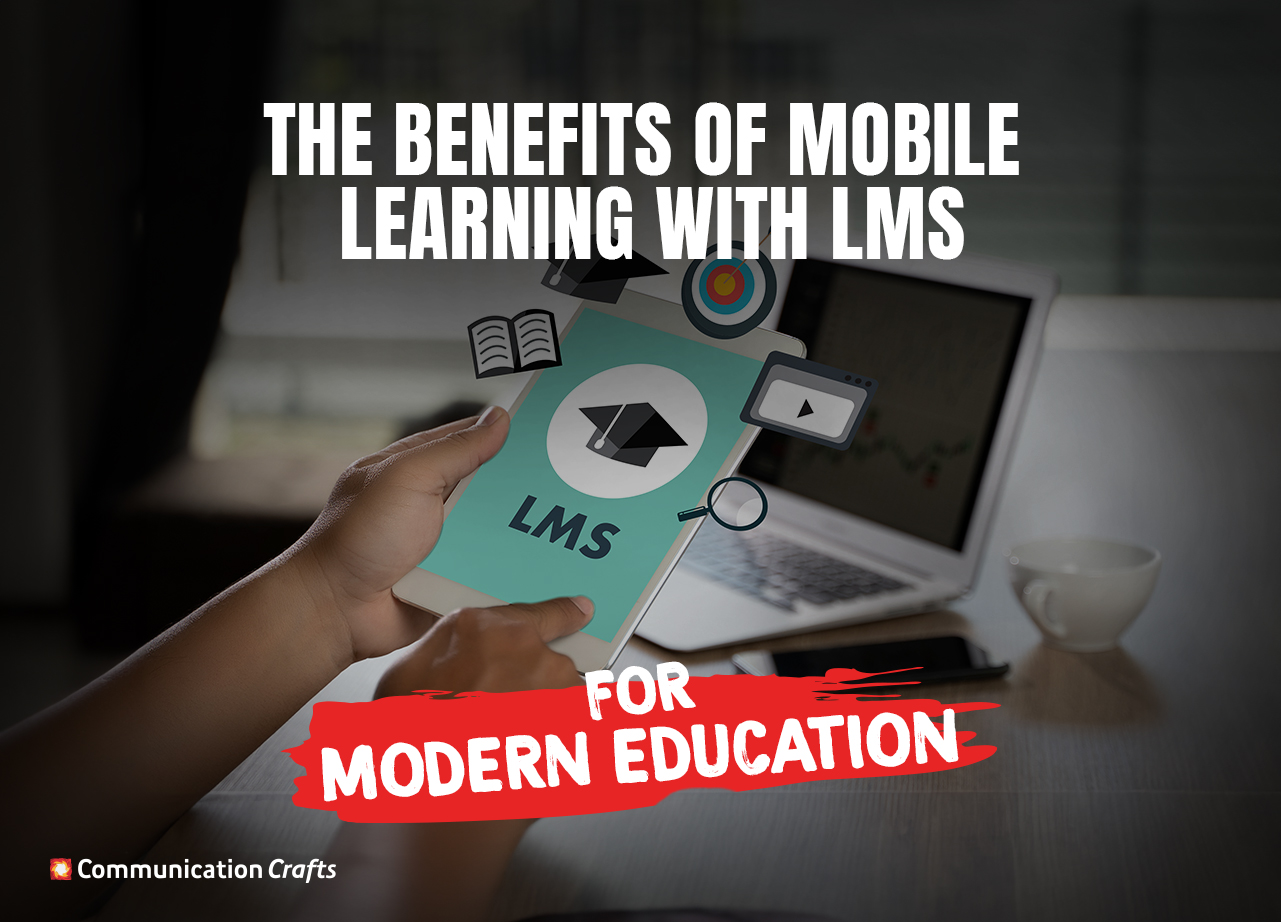
The Benefits of Mobile Learning with LMS for Modern Education

In a world where approximately 7 billion smartphones are at play, sticking to outdated learning methods is a risky game. Today, learners expect access to educational resources on the go. And if your learning resources aren’t mobile-friendly, then don’t expect your course downloads to go higher anytime soon. Infact, archaic methods of learning are leading your institute to a serious fall. Whereas educational institutes that are amplifying their Learning Management Software (LMS), can train their learners better. Partnering with an LMS development company, can help you harness this dynamic approach and empower your learners to seek knowledge anytime, anywhere. Let’s dive into the game-changing benefits of mobile learning with an LMS and why educational institutes must embrace this for a better learning experience.

Redefines Learning Flexibility

Getting stuck in hour long sessions to learn? That pedagogy is used by educators before COVID-19. With mobile learning, your learners can access training modules, interactive quizzes, and can get real-time updates from their mobile phones. No more wasting time on travelling long hours and battling schedules. Whether they are commuting, grabbing a coffee, or sitting at their home, learning happens when it suits their schedule. The advantage? The learning curve remains untouched, and the engagement remains high.

But convenience isn’t the only win here. Learners retain information better when they are learning in a comfortable environment. And who better to deliver such flexibility than an LMS development company?

Instantaneous Updates

Businesses today are moving at a breakneck speed. This implies that if your training materials aren’t updated in real time, you might not be in the race anymore. With a well-implemented LMS, learners don’t have to wait for updated materials and access the course. They get instant updates on matters regarding their learning modules, a personalised learning path and any other updates regarding quizzes. Mobile learning pushes this further ahead. For instance; got a new history lesson? Push it to your learners’ phones and track who’s read it. No more excuses, no more delays.

This is where the role of a mobile app development company steps in to level up your learning management software. A sleek, intuitive app translates into learners staying sharp, informed, and ready to take up on whatever comes next.

Higher Engagement

Studies show that 85% of learners prefer online learning (which includes mobile learning) over traditional learning as it boosts their motivation, engagement, and academic achievement. An LMS lets you add that gamification features. For instance, you can add learning quizzes, games, simulation exercises to turn learning into a thrilling experience. This does not hamper the learner’s knowledge consumption at the same time adds that element of engagement.

Also, you can add a leaderboard to gauge who is able to perform better out of all the students and compare the stage on which learners are at. Furthermore, you can add social learning tools like discussion forums and peer reviews, to take the learning to the next level. Ultimately, creating a learning culture where people challenge each other and share knowledge. To get this right, trust an LMS development company, who will help you gamify and add social learning elements like a pro.

Data Driven Decisions

Training without data is like sailing without a boat, you’re about to drown. If your students are learning through mobile, you need to integrate it with an LMS. As a result, you get insights on the student engagement, the completion rate of the course, the performance on tests, and more. Through such insights, you can optimise the learning path for learners, identify the skills gap and add more content to polish the gap, and predict future training needs.

Here, partnering with an LMS development company, gives you an edge as the software doesn’t just work for you as a tool but also as a strategic asset. Need to check whether the physics module that you added to the LMS is working or not? Check the engagement rates. Want to know who’s slacking in the course? It’s all there in black and white. Data driven training takes your learning from plain boring to smart.

Cost Effectiveness

Let’s calculate the cost of running a physical learning course for an entire month. The list of expenses includes renting out a place, furniture, a tutor’s fee, electricity bills, and other expenses. That is too much! Whereas, when you opt for a mobile-based learning method, the initial investment pays off in no time. Traditional training methods are resource draining. In contrast, mobile learning methodology focuses on cost-effective, flexible and engaging learning.

Plus, when you get your learning solution developed from a top-tier LMS development company, you get a solution tailored to your needs. It means no unnecessary changes before launching the course, no inflated costs. But a streamlined learning experience for your students and other learners.

Scalable and Adaptable

Whether you want to create a course for a class of 60 students or create a course for 6000 students, you can scale your LMS course when it is mobile friendly. A few of the benefits that scalability offers is that educators can add new courses or resources in a few clicks. At the same time, learners can access these courses from anywhere, without their learning being disrupted.

Furthermore, it is not just about handling huge numbers. A thoughtfully developed mobile app from a mobile app development company ensures that your LMS delivers a flawless experience to its users across all devices. Whether students are accessing the course from their mobile phones, tablets or laptops, they will be able to access everything without a glitch.

Personalisation

Learning today is not just about creating a generic self-paced course for everyone but creating a learning path that helps the students achieve the goals that they are looking for. Hence, there are student mentoring sessions where they are guided by mentors on learning paths to achieve their goals. Same should be with your mobile app! You should be able to provide your students with personalised learning paths based on their performance, challenges, and their learning goals.

And that can be made possible with the help of AI and machine learning. But, to leverage these technologies, you need to partner with a seasoned LMS development company who can help you fulfil this requirement and deliver personal learning experiences for students. This learning approach takes your learning methodology from being just course centric to student centric that is transformative in its own way.

Final Thoughts: Ready to go Mobile?

The future is mobile and if your institute wants to stay in the competition, then it’s high time you consider making your LMS mobile centric. Through mobile learning you will be able to achieve that student engagement and academic excellence, that you are looking for. Whether it is about enhancing classroom experiences or providing personalised learning paths; mobile learning acts as a catalyst for your goals.

Now, what’s ahead? Partnering with an LMS development company to improve your educational approach. Furthermore, if you want to create a cutting-edge user experience, we have got you covered in that too. At Communication Crafts, we understand any successful solution whether it be an LMS, or a mobile app isn’t just coded, it is personalised. So, let us take your services to the next level.

Let us transform your learners’ experience together!

Top 6 Advantages of Implementing an LMS for Your Business

Employee training and development is not only advantageous but essential for minimizing organizational skills gaps, keeping talent, and remaining competitive, according to company leaders, learning and development specialists, and staff members. However, according to Gartner, 64% of managers do not believe their staff are prepared for future skill requirements, and 70% of employees feel they lack the abilities necessary to perform their current positions effectively.  

A corporate learning management system (LMS) from a top LMS development company is among the best investments you can make to revamp your organizational learning strategy and fill those gaps. Learning and development in the workplace are evolving quickly. You’re living in the past if you’re still flying trainers to your headquarters, housing them in hotels, providing extensive in-person training, and still getting no results. 

What is an Organizational LMS? 

A corporate LMS assists businesses in planning, monitoring, and managing their training initiatives for personnel, clients, and other external partners. Individualized training programs are managed by corporate LMS packages for onboarding, development, and compliance training needs.  

A corporate LMS is used by organizations to assign courses to staff members or external end users, and to monitor learners’ progress as they finish the lessons and tests in those courses. These courses can be made using either the LMS’s built-in tools or a different course creation program.  

Corporate LMS serves as a consolidated repository for learning materials for administrators and staff, allowing businesses to more effectively provide materials for customer training or employee development. Courses that were produced using third-party course authoring software can frequently be hosted by corporate LMS packages. An integrated human resource management system could also include a corporate LMS. 

Types of Corporate Learning Management System 

LMS systems have two main differences: open-source vs. proprietary software and cloud-based vs. local hosting. Let’s explore these LMS categories: 

1. Open-source LMSs

These are license-free and ideal for nonprofits. They can be customized but require IT expertise and ongoing server expenses. Open EdX is a popular choice, offering easy content creation and platform customization with XBlock technology.

2. Commercial LMSs

Proprietary training software comes with license fees and full support from corporate LMS vendors. They offer both installation and cloud-based SaaS options.

3. Locally hosted LMSs  

are those that you host and keep up yourself. High setup costs and a particular license duration are prerequisites. Your IT department is in charge of maintaining and protecting it. 

4. Cloud-based LMSs

Cloud-based LMSs hosted by suppliers are accessible from anywhere, with no need for complex IT. The vendor maintains, updates, and secures the system. 

Top 6 Advantages of Using an LMS for Business 

1. Information from a Single Source 

The importance of keeping all of your training materials in one place cannot be overstated. Employees are aware that all they need to continue their education is to easily connect onto the LMS. They don’t have to sign into various systems for various kinds of training. They don’t have to search through their email inboxes to find the location of the following video or guide.  

And we’ve all experienced the frustration of not being able to locate the files we’re looking for. A learning management system from a trusted LMS development company makes sure you always know where to search for information on training, development, products, HR policy, and anything else. 

Central storage streamlines processes between departments, like sales and marketing. When they maintain separate documents, it leads to miscommunication. A single source of truth prevents this issue. 

2. Encourage social and cooperative learning  

Employees prefer learning alongside their peers, according to the 2021 workplace learning report from LinkedIn learning 91% of the 2,393 employees surveyed stated they were more successful when they learned together, and 92% said it gave them a sense of community.  

Even when your employees aren’t in the same room together, an LMS makes it simple to develop social learning experiences. The use of collaborative technologies like discussion boards, study groups, and online classrooms allows students to learn from each other’s experience and knowledge while also sharing their own. 

The ability for employees from other offices and departments to interact with and learn from coworkers they might not have otherwise encountered is another advantage of collaborative technologies. This can enhance cross-functional communication and collaboration at work. 

3. Reduced Expenses 

A corporate LMS lowers expenses for things like lodging, meals, and transportation. However, there are non-monetary savings as well, such as flexibility in learning at your own pace. An LMS makes training accessible and scalable regardless of where your employees are because you don’t need to build new classrooms to accommodate more students. 

Your staff will be able to balance work time with professional development time thanks to personalized learning with an LMS for corporate training, which prevents them from investing hours in training they don’t need. Learners can benefit most from their learning when using collaborative tools and easy interfaces, which increase uptake and engagement. 

4. Performance Evaluation

How do you tell who has finished the training when employees can access the materials on their own time and from anywhere in the world? Training evaluation is a difficult beast to master. However, a corporate LMS has sophisticated performance tracking systems that keep management informed of the status of training. 

You can view details about every employee, including the training they’ve begun, finished, and the outcomes of any subsequent evaluations. Managers can assess how effectively staff are learning the material by giving them follow-up tests. 

5. Scalability 

A lot of problems confront expanding enterprises. It takes time to train current employees in new capabilities, onboard new team members, update documentation, etc. High stakes are involved. Your business will have setbacks if your personnel are unable to keep up with its growth. 

Comparatively speaking, LMS for corporate training is far simpler to scale than conventional training programs. You merely need to create extra accounts; you don’t need to print more booklets. New training may be developed, tested, and implemented fast. 

And you’ll frequently discover that growing the system is more economical than you might anticipate due to the pricing mechanisms of a corporate LMS. 

6. Flexible learning 

Finding the time to fit in with staff learning is the biggest difficulty, according to LinkedIn Learning’s 2018 Workplace Learning Report. By making corporate training and development programs accessible to your employees anywhere, at any time, and on any device, an LMS tackles this issue head-on. 

Employees don’t have to wait for the next opportunity that works into their busy schedules to build the skills they need to conduct their jobs effectively because of the improved access to more learning opportunities on an as-needed basis provided by this flexibility. 

Summing Up 

Employers boost employee skills through corporate learning, which also enhances teamwork, welcomes new hires, and tracks progress. When creating an LMS, you can choose between using an existing system or building a custom one. Smaller teams prefer ready-to-use LMSs, while large companies with long-term goals opt for custom solutions. 

Learn more about the many advantages of establishing a cutting-edge Learning Management System (LMS) for your company. At Communication Crafts, we take pride in being the foremost LMS development company, specializing in creating tailored solutions to elevate your business to its full potential. 

Elevate Your LMS Game!