We live in this all-new digital age where businesses are constantly looking for new and innovative ways to engage with their target audience on all digital platforms. And one of those innovations in web development has come from using React and Node js together.
There are some scenarios where React and Node js technologies can work wonders in getting remarkable end results. They will not only save precious development time but together, React and Node can help make your web app code highly efficient and scalable.
But what are the reasons behind it? Why are we seeing an increasing number of developers using React, Node js together?
It’s simple, React and Node js are providing businesses to easily scale their businesses to new heights.
Let us see why React and Node are powerful together:
1. Helps in maintaining high server load
Using React js and Node js together is great for web apps that require handling of multiple requests & also need to maintain the server load balance.
2. Helps in maintaining a dynamic website
Real-time database connectivity is an essential aspect of dynamic websites. If your web application is based on Real-time Data-Intensive management, then you should definitely use Nodejs for uninterrupted database connectivity.
Single-page applications (SPAs) like Facebook and Gmail can easily be created using React and Node. React will provide an intuitive and interactive UI/UX, whereas Node provides a lightweight backend model asynchronous data loading via callback functions.
4. Helps in building JSON for your APIs
JSON files stand for JavaScript Object Notation. The main use of JSON is to transmit data back and forth between a website and a server.
Now APIs are used to program an app. By using React node js framework, you can easily create JSON APIs for your web application due to the high code reusability & sharable code function of React.
5. Helps while creating MERN stack applications
React and Node js can be used with MERN stack apps- MongoDB, Express, React, and Nodejs stack. Developers can create large scale, highly functional eCommerce stores, baking websites and much more easily.
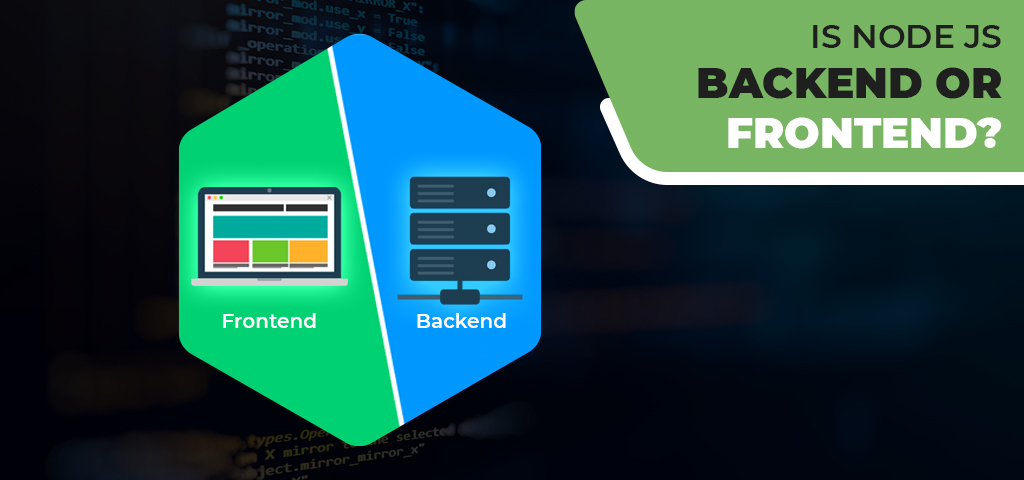
Many times our clients even ask us: is React front-end or backend technology? Same questions and doubts arise for Node as well.
So we thought it was essential to discuss that in this blog. Here is everything you need to know:
Is React Front-End or Back-End Library?
React is a front-end JavaScript library, developed by Facebook back in 2015. React libraries work seamlessly with Apache, NGINX or backend frameworks such as PHP, Ruby on Rails and more.
Originally React had a React DOM library, which worked great with the web browser’s DOM. However down the years, with new technological upgrades, React became React Native- a cross-platform framework used to build Android & iOS native-like apps.
Is Nodejs backend or frontend?
According to Nodejs User Survey Report, more than 43% of Nodejs developers prefer this technology for their enterprise development project. Since Node js is an ideal preference to build high-quality solutions based on microservices, WebSockets and event queues, it makes an outstanding choice for the backend since it is asynchronous, event-driven nature and has non-blocking I/O.
The surprising part is that Node js can also be used as a standalone programming language. The developers can write code for front-end & back-end for server-side apps in JS using the runtime environment.
As it is a scalable platform and has a huge developers’ community, Node has become the developers’ favorite for backend development. Even MNCs like NASA, Twitter, and Walmart use Nodejs for their backend.
Summing Up
Most developers around the world love to harness the power of both ReactJS and NodeJS to build reusable UI modules. Ideally, in the long run, the combination of Node and ReactJS yields great results. However keep in mind that if you want to use React with Nodejs, you need to know how to use NPM.
We know that React is a front-end technology, while nodes technology is for the backend development. Using React and Node js together can easily help you create a high-performing, scalable web application.
And that’s why MNCs like Netflix, and PayPal have leveraged the power of Nodejs for their respective web apps to achieve tremendous results that have helped them take their businesses to new heights.
If you are looking for a vetted team of Nodejs developers & React developers to work on your next web development project, you can always hire a remote team of experts from Communication Crafts. Get in touch with our expert consultants today- let us help move your business forward!
It’s a no-brainer that programming and web development services are the pinnacle of any business- small or big, that help in increasing product knowledge and popularity while maintaining communication between you and potential clients. From e-commerce websites, food ordering mobile apps, and digital marketing, to cloud computing; web development is an integral part of all businesses.
The list of programming languages and frameworks is extensive which makes it confusing to choose the best for your projects.
Angular and React, both lead the pack in terms of popularity amongst developers. But before deciding which of the two is better? Let’s see why they are popular in the first place.
Angular (also known as Angular 2) is a TypeScript-based open-source web application framework led by Google.
As of now, Angular 2, represents the collection of all the versions of Angular released after AngularJS. It has a complete tool kit to build large applications, which we will explore later in the article.
Some of the global leading multinational companies that use Angular are:
BMW
Forbes
Microsoft Office Home
What is React?
Developed by Facebook, React is a JavaScript library used to build a user interface (UI) for front-end of applications.
Some of the global leading multinational companies that use React are:
Uber
Airbnb
Facebook
Although both are good for web development, it’s time to settle the frequent debate of React vs. Angular once and for all!
Through years of serving a global clientele as a leading mobile app development company, our developers at Communication Crafts are used to working with both; React and Angular. Using our expertise and years of experience, we can help you choose the better of the two.
In the technological aspects, let us see the difference between React and Angular, in the following order:
Difference between React and Angular
1. Data Binding
Data binding, as it sounds, is connecting data from both, business logic and UI with each other. For example – If a person using a web app word processor wants to change the color of a certain text, he can select it from the drop-down menu feature on the app; from the available options (connection of backend to User Interface). There are many types of data binding techniques. What is interesting is the approach Angular and React take to it.
Data Binding in Angular
Angular uses two-way data binding. It synchronizes the data continuously from the view to the component and vice versa. Change in either would trigger the other.
Data Binding in React
But React uses one-way data binding, in which information flows in only one direction. From data source to the UI. This helps make the code more stable and also makes debugging an app build with React much easier.
But, the two-way binding of Angular is simpler to work with.
2. Performance & DOM
React or Angular both are great for the front-end development of large-scale applications.
But what is DOM?
Documented Object Model (DOM), allows access to the user to change the structure, content and layout of their application. But both are not quite the same. One primary difference between both makes all the difference.
Angular 2 uses Real DOM which is a complex process to use!
Consider a case where you want to change your home address. What Real DOM would do is – update the whole tree structure of HTML tables until the desired data is reached. In this case, it is a ‘home address’. Now that would make Angular a time-consuming process.
While React uses Virtual DOM (having the same properties as Real DOM) that allows updating the changes the user wants to make without rewriting the entire HTML code virtually! It makes updates faster and ensures faster performance regardless of the size of the app! Manipulating the Virtual DOM is faster than Real DOM as nothing gets drawn on the user screen.
On average, React completes a task in 3289ms compared to Angular taking 3295ms. That doesn’t seem like a lot, but in computing, it makes a huge difference in processing speed!
Which is why React wins this round.
3. Architecture
React Architecture
Contrary to other frameworks and User Interface libraries available. React doesn’t oblige to a rigid architecture like the rest. Behind the interface, there are React components that are combined together to form a well-functioning UI.
But here is the thing, a React component can hold a data state(data storage of other components that is needed to make the app work), however not necessary! Each component is independent and reusable throughout the application while having little or no knowledge about the other components in the application.
But React does need some outside help! It cannot function without multiple integrations and supporting tools while working with larger applications. Some of the main ones are:
• Redux (Inbuilt React library for managing JavaScript apps) • Webpack (Open source, bundles JavaScript files together) • Babel (For the app to be understood by browsers, it converts JSX into JavaScript )
Angular Architecture
Now Angular is a completely rigid architecture model, written in TypeScript that uses its libraries to import into an application for implementation of app functionalities. Some of which are:
• RxJS ( library for reactive programming to compose asynchronous or callback-based code easily) • Angular CLI ( Powerful command-line interface) • Angular Universal (Used in server-side rendering)
Both Angular and React have a friendly environment to work with. React is easier to understand, but needs multiple integrations to achieve its maximum potential while Angular doesn’t!
As React is a library, you can integrate it into any given project, even if the project is written in Angular!
4. Scalability
When choosing React or Angular, keep in mind the future scope of your project. React relies heavily on third-party tools, even for scaling your apps.
Yet a sustainable architecture with server-side rendering can be easily developed with React. This is why Facebook, WhatsApp, and Instagram scale to a large extent; all use React!
On the other hand, Angular consists of all the main features that developers may need for scaling an existing app by adding new functionality. It is very easy to scale due to its design and command-line interface (CLI).
5. Bundle Size
You may think does size even matter in programming?
Well, it does! The smaller the size of the file, the faster it can process and load. The faster the loading speed, the better the performance hence the higher the conversion rate.
Angular (766KB size) is larger than React, resulting in longer load times and slower performance on mobile.
While React (97.5KB size) is smaller than Angular, hence faster!
6. SEO
It is a known fact that good web development is an essential part of Search Engine Optimization (SEO). It is known that for client-side rendering, the HTML needed to be indexed is only visible when the JavaScript is rendered on the client side. Which is why it is not the best for SEO.
On the contrary, in server-side rendering, all of the HTML content is there in the source code itself. Which means search engines can crawl and index faster. This in turn offers a favorable ranking in search results.
React and Angular are both server-side-oriented.
But which is better React or Angular?
React is proven for better SEO performance as it is a library for building UI. It doesn’t bother the user, the way Angular does!
Angular needs to use additional tools for SEO such as PhantomJS to tackle SEO issues. But this increases more workload for the developers, as they have to create an additional AngularJS module for SEO, link it to PhantomJS to present an HTML snapshot to the search engine for SEO. Although the updated versions have significantly reduced the performance gap!
7. Backward Compatibility
An application needs to be regularly updated.
The difference between React and Angular is that React has full backward compatibility. Being a library in itself, it’s easier for React to update its previous releases with new ones.
As for Angular, you will have to go through the hassle of updating to a newer version of Angular before you can even begin to make any changes! So if you have plans to add new features to your app as you go on, React is suitable for you!
8. Learning Curve
No one likes learning to be that difficult a process! But if you are working with Angular, you have no other choice but to endure what comes your way. Having a rigid architecture makes it more complex to work with. If that wasn’t a problem enough, it has irrelevant syntax and components that need to be managed.
Compared to this, React.js is much easier to learn and understand due to its loosely-coupled architectural structure. All you need is good coding in JavaScript and a decent understanding of the Redux library.
9. Popularity Among Developers
According to the Stack Overflow survey I’ve just mentioned, more developers said they choose to React over Angular: 31.3% of React.js vs. 30.7% of Angular. According to insights provided by, stateofjs.com. Which took a survey of approx. 21,000 people show us that:
71.7% of developers had used React before and would happily use it again. Out of which, 16,099(89.3%) users were satisfied. That’s quite a majority!
While Angular trailed React by quite a margin! In fact, only 35.8% had used Angular before and would want to use it again. Only 11,582 users (37.95%) were quite satisfied.
Clearly React is the favorite among developers.
But What Would We Choose?
With 15+ years of experience and a team of 150+ experts, we at Communication Crafts have worked on unique and custom projects throughout the globe. As a leading mobile and web app Development Company, our team of experts work on mobile and web development on a regular basis and provide exquisite results for our customers. Having years of experience working with such technology at hand, we work smoothly with both – Angular and React! We use both extensively to provide excellent customers service. Being innovative and offering diverse and scalable solutions is our forte and we tend to stick by it!
Need a mobile & web app developer to help your business flourish?