Power Up Your Web Development Game in 2023 with These Top PHP Frameworks

PHP was created by Rasmus Lerdorf in 1994 as a set of Common Gateway Interface (CGI) scripts to track visitors to his personal website. Over time, Lerdorf added more functionality to PHP, and it evolved into a server-side scripting language that could be used to build dynamic websites and web applications.

PHP’s popularity continued to grow, and with the release of PHP 4 in 2000, it became a more mature and stable language. PHP 4 included many new features, including support for object-oriented programming, and it became the most widely used server-side scripting language for building dynamic web applications.

There are many PHP frameworks available, each with its own strengths and weaknesses. In this blog post, we’ll take a look at some of the most popular PHP frameworks and help you decide which one might be right for your next project.

Hire top PHP Developers in less than two days

What is a PHP Framework?

In simple words, a PHP framework is a collection of pre-written code that makes it easier for developers to build web applications by providing a structured and standardized way to develop software.

A PHP framework can be thought of as a set of tools and guidelines that help developers write code more efficiently and effectively. It provides a foundation of code that can be reused across different projects, saving time and effort.

PHP frameworks are designed to help developers overcome the challenges of building complex web applications, by providing a standardized way to handle tasks such as database access, user authentication, and session management.

PHP Framework Features 

Routing and URL handling: The framework provides a way to map URLs to specific controllers and actions in the application.

Database access: The framework provides a way to interact with databases using an ORM (Object-Relational Mapping) layer, making it easier to work with data.

Templating: The framework provides a way to separate the presentation layer from the logic layer, using templates that can be reused across the application.

Security: The framework provides features such as input validation, output escaping, and authentication to help developers build secure applications.

Testing: The framework provides tools and libraries for testing code, making it easier to write and maintain high-quality code.

Top 7 PHP Frameworks you should know about

Laravel – A full-featured framework for web application development, including features like routing, ORM, MVC architecture, and more.

Symfony – A flexible framework that emphasizes modularity, allowing developers to pick and choose components to use in their projects.

CodeIgniter – A lightweight framework designed for rapid development, with a small footprint and simple syntax.

Yii – A high-performance framework that emphasizes security and extensibility, with features like caching, authentication, and more.

CakePHP – A framework that follows the “convention over configuration” approach, with built-in features for scaffolding, authentication, and more

Zend Framework – A modular framework that emphasizes loose coupling and allows developers to use only the components they need.

Phalcon – A high-performance framework that’s implemented as a C extension, providing fast execution times and low resource usage.
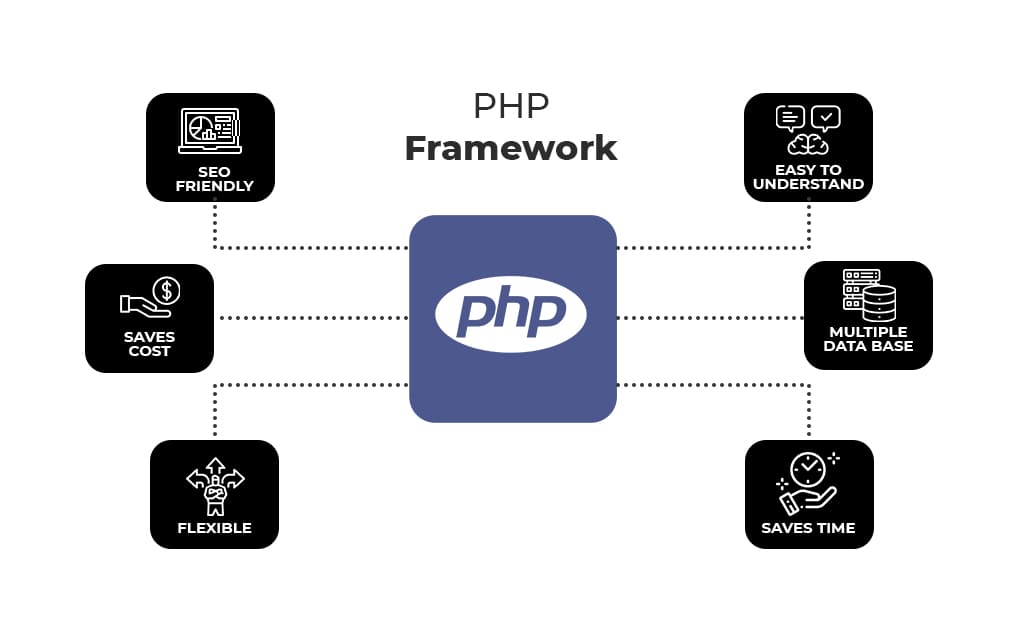
PHP Framework

Why Use a PHP Framework?

Speed up development: A PHP framework can help you build applications faster, thanks to the pre-built components and libraries that provide a solid foundation for your project.

Improved code quality: Frameworks can help enforce best practices and coding standards, leading to cleaner, more maintainable code.

Easier maintenance: Frameworks often include built-in tools for debugging and testing, making it easier to maintain and update your code.

Scalability: Frameworks provide a modular architecture, allowing you to easily add new features and scale your application as your needs evolve.

Better security: Frameworks often include security features like input validation, SQL injection prevention, and cross-site scripting (XSS) protection, helping to keep your application secure.

Community support: Frameworks are often backed by large and active communities, providing resources, documentation, and support for developers.

Code reusability: Frameworks provide pre-built components and libraries that can be reused across multiple projects, saving time and effort.

Flexibility: Frameworks can be tailored to your specific needs and requirements, with the ability to add or remove components as needed.

Improved collaboration: Using a framework can help teams work more efficiently and collaboratively, with a shared codebase and consistent development practices.

Reduced costs: By using a PHP framework, you can save time and effort, resulting in reduced development costs and a faster time to market.

Points to consider when choosing the best PHP framework for your business:

Choosing the right PHP framework for a project can be a critical decision that can affect the overall success of the project. To make the right choice, it is essential to consider a few key factors such as the project’s requirements, team expertise, community support, scalability, and security.

Purpose and Requirements: The first step is to identify the purpose of your application and the requirements needed to accomplish it. This will help you narrow down your search to frameworks that cater to your needs.

Popularity and Community: The popularity of a PHP framework is important as it indicates its level of support, stability, and resources available. A popular framework will have a large community of developers who can provide support, tutorials, and plugins.

Security: Security is a crucial factor in choosing a PHP framework, especially if your application involves sensitive data. Look for frameworks with built-in security features such as CSRF protection, XSS protection, and input validation.

Scalability: Choose a PHP framework that can easily scale with your business needs. A scalable framework will allow you to add more features and functionality as your business grows without compromising performance.

Performance: Performance is a key consideration for any web application. Choose a framework that has a good balance between performance and functionality, and consider frameworks that use caching and optimization techniques to improve performance.

Documentation: Good documentation is essential for efficient development and maintenance. Choose a framework that has comprehensive and up-to-date documentation, including tutorials, API references, and code examples.

Flexibility: Choose a PHP framework that offers flexibility in terms of coding standards, development approach, and project structure. This will allow you to customize the framework to fit your specific needs and preferences.

Ease of Use: A user-friendly PHP framework can save development time and reduce the learning curve for new developers. Choose a framework that has a clear and intuitive API, easy-to-use syntax, and built-in tools for debugging and testing.

Licensing: Consider the licensing terms of the PHP framework you choose, as it can affect the cost of development and distribution of your application.

Compatibility: Make sure that the PHP framework you choose is compatible with your development environment, hosting platform, and third-party libraries or services that you plan to use in your application.

Overall, there is no one-size-fits-all answer when it comes to choosing the right PHP framework. The best approach is to carefully evaluate your project’s specific needs and requirements, team expertise, community support, scalability, and security before making a decision.

At communication crafts,  we ensure that your PHP application is developed efficiently and effectively, saving you time and money in the long run.

As a leading PHP development company, with a group of expert designers and developers, we have a track record of producing high-quality apps that are tailored to the particular requirements of organizations.

Hire dedicated and proactive PHP developers within 48 hours



Dope Hiring Strategies For A Dope Generation in Software Development

Generation Z which includes 67 million people is not just limited to Netflix and Reels.
These true digital pundits have officially entered the workforce producing a whooping figure of 60 million employees in the next decade. Gen-Z has a very different outlook on careers and how to measure success in life and the workplace than Millennials.

Hiring Software Development

Gen-Z’s are competent, diversified, and socially aware but distracted at the same time.

So, What motivates Gen Z in the workplace?

Regular Feedback

Born in the era of getting instant feedback in the form of comments, likes , shares, and DMs, Gen Z seeks regular feedback on their performance and areas that they can improve. They are eager to learn new things and imbibe creativity in everything they do. Communicating with them on a regular basis will make them feel valued and motivated and in turn, will help them boost their confidence and productivity.

Flexible Hustle

Gen Z believes in a fine balance of hustling and taking care of their mental health. Getting things done by taking unnecessarily excessive stress is not the hill they would like to climb on. They would rather go for convenient options than rooting in traditional workplaces. No wonder why, the concept of working remotely, anywhere in their comfy oversized t-shirts is highly accepted and looked out for by most. Implementing a flexible working policy, hybrid or fully remote will attract talented individuals easily.

Promise Them Career Growth

Personal life or Professional life, Gen Z hates anything that lacks freshness. They are ambitious with a never-ending desire to upgrade. Gen-Z can be easily motivated if they are provided with a pathway to career advancement.

Don’t Make Them Go Antisocial

Embrace social media and new technology in the workplace. From the earliest youth, Gen-Z has been exposed to social media and digital networks. Eliminating paperwork with any software or having different technologies for different departments will do wonders.

Promote Inclusiveness And Diversity

Gen-Z is the most accepting and diversified generation. They love interactive generation that includes ideas and perspectives from different cultures and generations. Promoting inclusiveness is one of the key factors of employee retention.

Gen-Z

How to Hire Gen-Z?

Prioritize Campus Recruitment

Maintain a close tie with colleges and universities to connect with Gen-Z. Go digital with your recruitment hunt and use recruitment software for filtering applications and speeding up the process.

Enhance Your Career Site

Give your career page a nice makeover. Include the perks of working in your company, the culture you promote, your values, practices, mission, vision, about us, projects done, and more.

Revamp Your Job Description

Be very precise regarding the roles and responsibilities in your job description. According to data by Deloitte, 37% of the Gen-Z generation have rejected a job based on ethics. Showing the company’s core values and purpose will invite more job applications from Gen-Z

Make The Recruitment Process Fun

Gen-Z has figured out that they cannot forgo fun. They will quickly lose interest due to a tedious hiring process and the availability of alternative employment opportunities. They are interested in learning about the intriguing projects they have planned for the future. It’s ideal to highlight the variety of tasks and projects involved during the hiring process, as well as the areas in which candidates can develop abilities.

Let Them Refer And Earn

Money attracts Money, and Gen Z can attract other Gen Z to the workplace. Invite team members to suggest new applicants when there are new openings and reward them with incentives. Hearing about the workplace culture from the staff members themselves helps attract applicants to your company.

It takes more than free wifi and pizzas to attract Gen-Z to a workplace

So, How To Retain Gen Z In A Workplace?

  • Look Beyond Compensation
  • Provide them with Job Security
  • Give them development guidance
  • Onboard like you mean it
  • Build an environment of self-improvement
  • Encourage workplace flexibility
  • Value them as an individual
  • Welcome their curiosity
  • Employ strategies to reduce burnout

Gen-Z is raising the bar for employee standards. One of the main problems with hiring Gen-Z employees is that they are more inclined to change jobs if their expectations of the workplace do not match those of your company. To address these issues, initiatives that lessen burnout, enhance mental health and work-life balance, and provide new possibilities for learning and development should be developed.

Long Story Short

Keep up with time and stay true to values

While recruiting Gen-Z employees, you must keep in mind that they are young professionals with distinct professional goals who are looking for a mentor to support them in the corporate environment. Hiring and retaining individuals from this group requires having a thorough understanding of their values and providing them with an environment that supports them.

Hire Gen-Z Developers With Communication Crafts

Communication Crafts offers a wide pool of Gen-Z developers to hire. Let’s admit it, Gen-Z developers are in high demand and it’s not easy to hire the right candidate in this cutthroat competition. We filter out high-performing developers from a wide pool of talent and help you hire a Gen-Z developer whose abilities match best with your requirements.

Our dedicated project managers and a tried-and-true remote ecosystem, offer a transparent development process, 24x7x365 communication, and an optimum performance account.

With 17+ years of experience and serving as a key strategic technology partner to market leaders such as Colgate, Infosys, Wipro, Mercedes Benz, Versace, etc., we ensure that the process of remote talent acquisition stays simple, secure, and compliant.

Top Gen-Z Developers are just a click away

Hire Now

The Paradigm Shift Towards a Fluid Workplace – Does it work for the IT industry?

Remote work always existed, but it came into the limelight in 2023

As a consequence of the global pandemic, decision-makers across the world quickly ran out of options and accepted, willing or unwillingly, the possibilities of the work-from-home concept, reshaping the tech industry forever

The historical narrative of remote development goes back nearly 50 years. Jack Nilles, a former NASA engineer, coined the term “Telecommuting” and ignited the idea of Remote-Work in 1972. After years of sluggish growth, the remote-working trend finally sped up after the Covid-19 outbreak. With a dichotomy of opinions and experiences, some companies adopted it confidently, while others remain doubtful.

Fluid Workplace – A popular choice in the IT industry

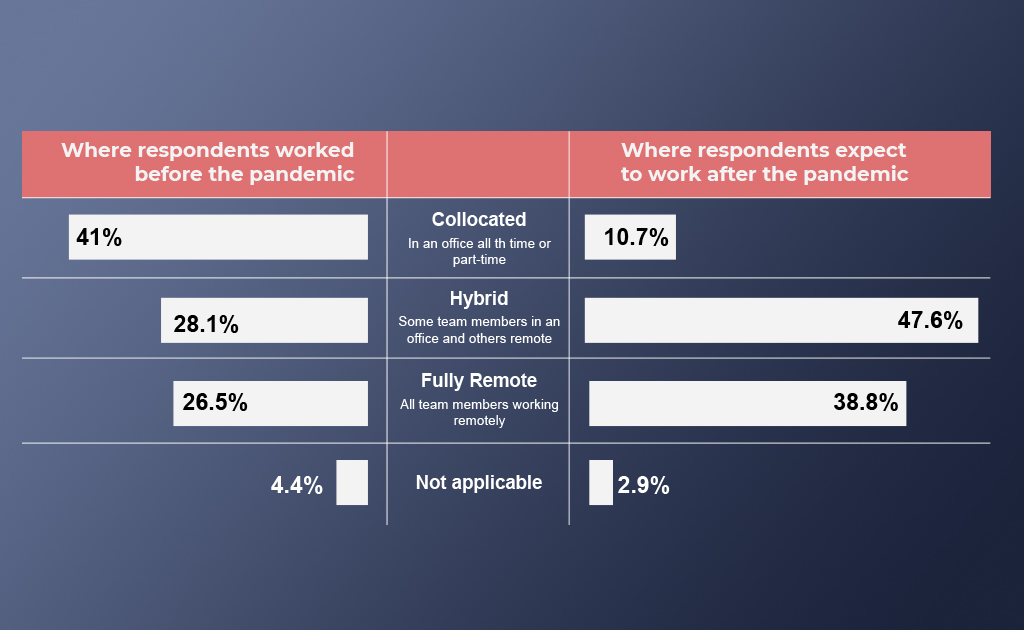
The pandemic has tipped the scales towards a remote-friendly world. The State of the Octoverse report 2021 by GitHub unveils work preferences before and after the pandemic.

Fluid Workplace

Source: GitHub

Out of the 12,000 developers surveyed, 

– 10.7% of developers expect to work from the office after the pandemic.

– 46.6% of developers expect a hybrid work environment.

– 38.8% of developers expect to work fully remote.

A vast majority of developers prefer a fully remote or hybrid work environment, highlighting the importance of fluid workplaces in the post-pandemic era. And the Future of Work survey by Growmotely accentuates it even further:

– 76% of entrepreneurs & 74% of professionals believe that remote work will become the new normal.

– 97% of entrepreneurs & professionals want to continue working remotely in the post-pandemic era.

– 61% of employees prefer a completely remote work environment.

Fluctuations in Remote Productivity

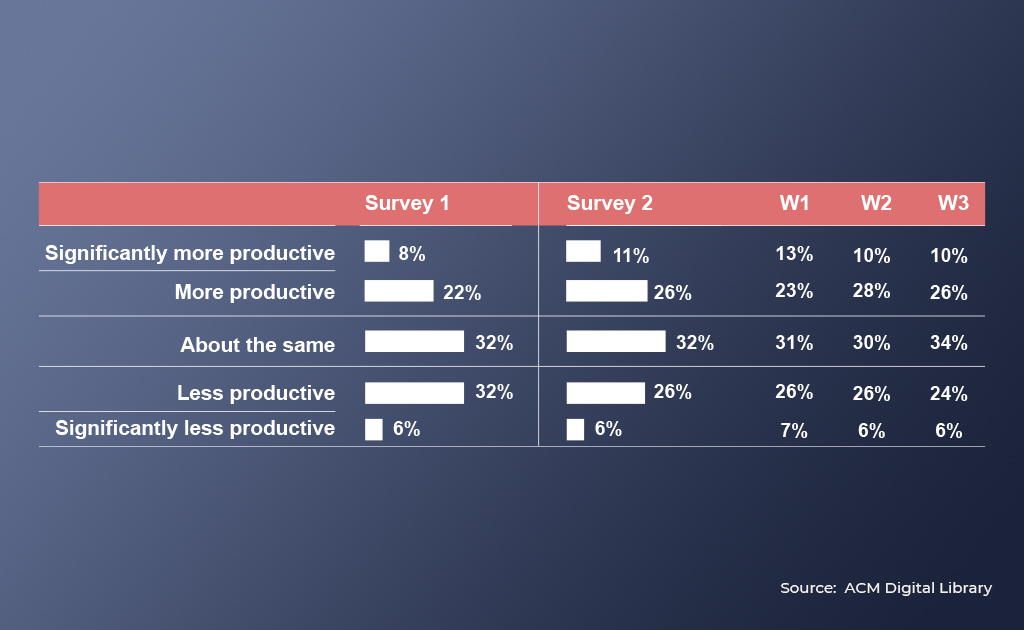
The ACM Digital Library survey paints a clear picture of the changes in productivity while working remotely:

ACM Digital Library survey

Source: ACM Digital Library

A majority of developers reported that the productivity level stayed the same or improved (62%-68%) in both surveys. Nevertheless, a considerable percentage of developers claimed that they felt less productive (32%-38%).

Balancing the Imbalanced in the New Remote Normal

The opportunities of remote work in software development can easily outweigh the drawbacks. 

 remote work in software development

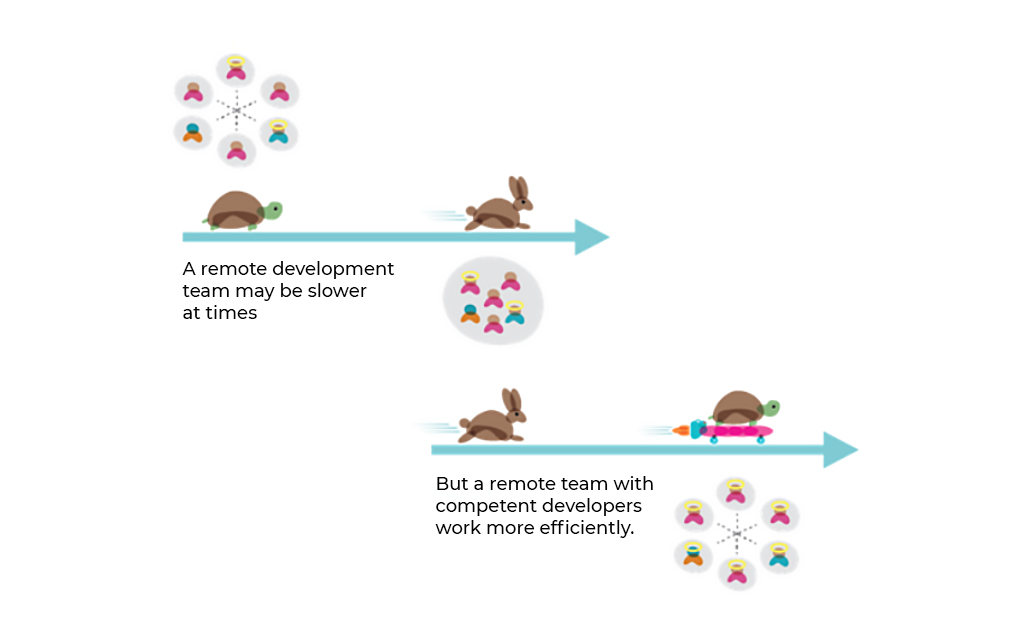
A remote development team can be as efficient as a colocated team, if not more so. With quality sourcing, rigorous vetting, dedicated project managers and seamless communication, IT outsourcing agencies can meet the escalating demands for software development with ease.

But what constitutes a well-oiled remote ecosystem in the IT industry?

  1. Build a network of the industry’s finest remote developers through elaborate screening.
  2. Assign dedicated managers for each project to ensure optimum performance accountability.
  3. Maintain effective communication channels to keep the clients in the loop at all times and facilitate a transparent development process.
  4. Eliminate the time difference issue by building a team that works across multiple time zones, with at least 4 hours of overlap. 
  5. Employ visionary leaders who can direct the team members, and inspire them to take initiative and innovate.

An IT outsourcing agency can transform itself into a full-fledged technology partner and help businesses across the globe by following the 5 points mentioned above.

And what are the key benefits offered by a fluid workplace?

Remote-friendly organizations can expand their search and find the best developers without geographical limitations, a win-win situation for employers and employees.

Remote work helps outmaneuver unfair work environments and biases. In a remote environment, the behavioral traits of employees get rather sidelined and the work gets more focused on results.

Last but not least, it can help eliminate employability barriers for people with depression and anxiety, letting them work comfortably from wherever they prefer.

In a nutshell,

Remote work is a multi-faceted concept, there are countless strategies that an organization can adopt to integrate remote developers seamlessly.

With the technologies and platforms we have in place in the post-pandemic era, success through remote collaboration is easily achievable. 

Effective communication, minimized distractions and satisfied employees are some of the perks that can be unlocked with a well-managed fluid workplace. From entrepreneurs to enterprise owners, companies with effective remote working patterns have a significant competitive advantage for the foreseeable future. 

Ignore it or adapt with it, the remote revolution is here to stay. 

Looking for exceptional remote web developers?

We’ve got you covered.

.

Significance of ASP DOT NET Core: Reasons to Adopt ASP DOT NET Core Framework for Web Development

Among the ever-increasing online clutter, businesses are looking for new and improved ways to interact with their users and customers.

Web applications have emerged as a hot trend for eCommerce and many other industries. Progressive web apps (PWA) have shown significantly better results than mobile apps and regular websites.

According to studies, PWAs can yield a 36% higher conversion rate than native apps. Furthermore, web applications can boost user engagement by 50%.

Developing high-quality web applications requires a framework that offers high scalability and flexibility while maintaining high performance.

This is where ASP DOT NET Core web development shines!

Business owners and web developers must know the features and benefits of the ASP DOT NET Core web framework for successful web application development.

So without further ado, let’s begin!

What is ASP.NET Core?

ASP DOT NET Core is free to use and open-sourced web development platform, specifically used for building modernistic high functioning web applications. This framework allows smooth and seamless development of compilers, APIs, runtime modules, etc.

Developed by Microsoft and released in 2016, ASP DOT NET Core became one of the favourites for web application developers because it is simple to use and offers high-end versatile features in the development process.

ASP DOT NET Core development is one of the most prevalent web development options around the globe for building modern web and sophisticated web applications.

Why use ASP Net Core?

  • Running web apps on .NET Core and .NET Framework;
  • Progressive web applications with mobile compatibility and modern features like IoT integration;
  • Web applications that run across multiple platforms including Windows, Linux, and macOS;
  • Web applications with high scalability and versatile functionalities;
  • Web development with cloud-based installation.

These are the answers to “why use ASP Net Core?”

Before we get into the reasons to adopt ASP DOT NET Core, let’s discuss its popularity.

The Popularity of ASP Net Core

ASP DOT NET Core is widely used among developers all over the world. It is most favoured for building dynamic web applications.
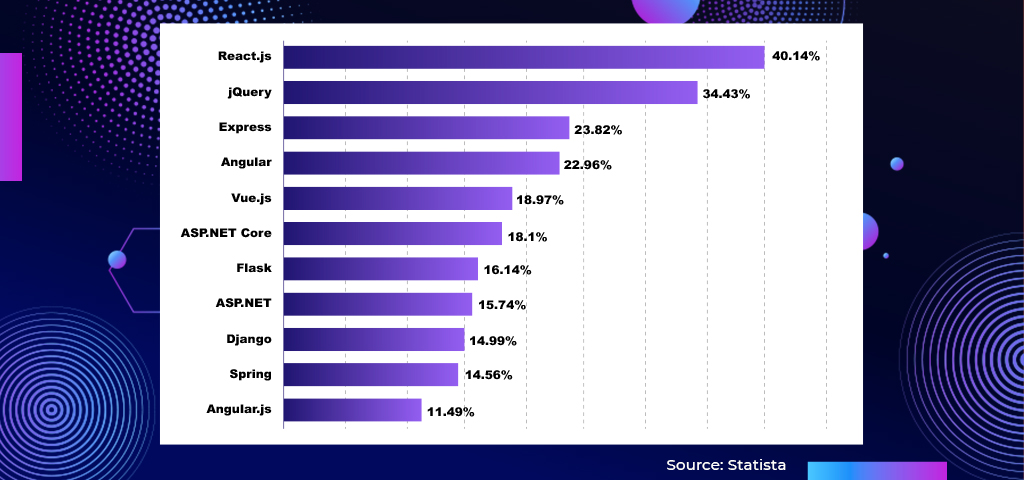
Here’s a ranking of the most used web frameworks by developers in 2021:

Popularity of ASP Net Core

ASP NET Core Framework ranks 6th among other most used web frameworks globally, making it one of the most appealing frameworks for developing web applications

According to Trends BuiltWith108k live websites are powered by ASP DOT NET Core currently.

ASP NET Core Framework is also a well-matured platform with 26.4k stars and 7.1k forks on GitHub.

Now that we have established the popularity of ASP NET Core framework, let’s discuss its major features and benefits.

Why Adopt ASP DOT NET Core?

Here are the top reasons why ASP DOT NET Core is chosen time and again for developing web applications for small to enterprise-grade businesses.

1. Simplicity

No framework is worth the effort if the coding process is too arduous or time-consuming, but that’s not the case with ASP DOT NET Core web development.

The ASP NET Core framework lets you develop a web application with minimal lines of code, making it efficient for developers to add the required functionalities as well as spot mistakes with ease. Also, fewer lines of code make it much simpler to manage the codebase.

Key features like request submission, setup, customer authentication and more are completely seamless and uncomplicated. Moreover, the MVC architecture makes the web application much more customizable and the codebase is easier to write, modify and debug.

2. Open-Sourced Nature

ASP DOT NET Core Framework is open-sourced by nature, which makes it all the more attractive to developers as they can freely collaborate with others during the development process.

A wide range of tools and libraries are available on GitHub for a smooth and seamless experience while developing web applications with DOT NET Core Framework. A strong and ever-growing community supports ASP DOT NET Core web development with regular bug fixes and updates.
This proves the maturity of this web development platform, which is a significant factor to consider when choosing the perfect platform for developing web applications.

Additionally, this feature also saves valuable time during the development process as the developers can get help from community support along with the tools and libraries on GitHub.

3. Cross-Platform Functionalities

Cross-Platform Functionalities

One of the most significant characteristics of ASP DOT NET Core web development is cross-platform functionality. With ASP.NET, you can build web applications for various operating systems including Windows, Linux, and macOS.

This feature provides developers with unhindered versatility with an option to build a single codebase for multiple operating systems, saving valuable time in the web development process.

From the client’s perspective, business owners can unlock maximum exposure by making their web applications accessible via multiple platforms.

4. High Performance

The capacity to deliver high performance is a very noteworthy consideration for adopting a successful web development platform.

The ASP NET Core Framework keeps performance at its foreground, making sure the web applications deliver optimum performance after deployment.

Along with other important features, this framework enhances the codebase on its own during code compilation, making it one of the best platforms for developing top-grade web applications.

Along with libraries and external tools, developers can develop a maintainable and efficient code base with optimum performance. Additionally, regular updates and new releases added more reliable and efficient features like space and database management that allows the development of mobile applications, cloud-based integrations and IoT.

This modular framework built by Microsoft is specifically developed to create an all-round solution for developers and all types of industries.

5. Razor Pages

Razor Pages is a new feature added to the ASP NET latest framework. This feature introduces an efficient coding architecture that is page-focused and easy to maintain, allowing developers to maximize efficiency in a web application by programming the codebase in a page-focused development environment.

ASP NET Core framework simplifies the development process with the Razor Pages architecture by providing a way to develop each web page of a web application separately and uniquely. Developers can create high-functioning and highly dynamic user interface for every web page.

Along with the above-mentioned benefits of Razor Pages, the unique web pages can be easily organized and managed together efficiently.
This feature makes ASP DOT NET Core web development one of the best options for building stable and scalable web applications with dynamic user interfaces and optimum performance.

6. Wide Range of Programming Features and Developer Tools

Features and Developer Tools

The ASP DOT NET ecosystem has upgraded a lot, introducing new and improved programming features for the ASP NET Core Framework.

A few additional features:

  • Cross-platform development architecture
  • Garbage collection
  • Package management
  • Memory management automation
  • Language independence
  • Development of web applications with MVC architecture and RESTful APIs with ease
  • Multilingual support
  • Asynchronous programming

These features help asp dot net developers to build modern and high-performing web applications easily, efficiently and rapidly.

The ASP NET Core framework also offers a wide range of developer tools like Jetbrains, Resharper, SQL Multiscript, etc. that further simplify the development process.

The best part is that it can be used with Microsoft Visual Studio, which opens the path to top-notch ASP DOT NET Core web development. This provides high-end features like debugging, unit testing, profiling, GIT integration, code completion, etc.

7. Flexible Deployment

The flexibility and simplicity of web app deployment offered by ASP DOT NET Core web development make it one of the most reliable options.

There are two types of web app deployment in ASP DOT NET:

  1. Self-contained deployment: Shared components don’t alter the deployment process in this type. The .NET Core runtime elements and .NET libraries are separate from the .NET Core applications.
  2. Framework-dependent deployment: This type of web app deployment relies on shared components. Only the developed web app and 3rd party dependencies can be executed, saving host system memory.

Final Thoughts

With top-notch efficiency and high scalability, it’s not a surprise that ASP DOT NET Core is one of the best web development platforms.

Unique features like Razor Pages and Microsoft Visual Studio make it distinct from other web development frameworks. Other benefits like its open-sourced nature, cross-platform accessibility and usability make it the favorite web development platform for developers around the globe.

ASP NET Core framework can be used to deliver high-performing web applications with unique and dynamic user interfaces.

Are you looking for top-tier ASP DOT NET Core developers? Get in touch!

With 16+ years of hands-on experience and a wide range of clientele, Communication Crafts provides expert Asp .NET developers, delivering top-notch web applications that can easily meet your requirements and exceed your expectations.

Building your present, for a fruitful future.

From design to deployment, get end-to-end web development services.

You’re in the right place!

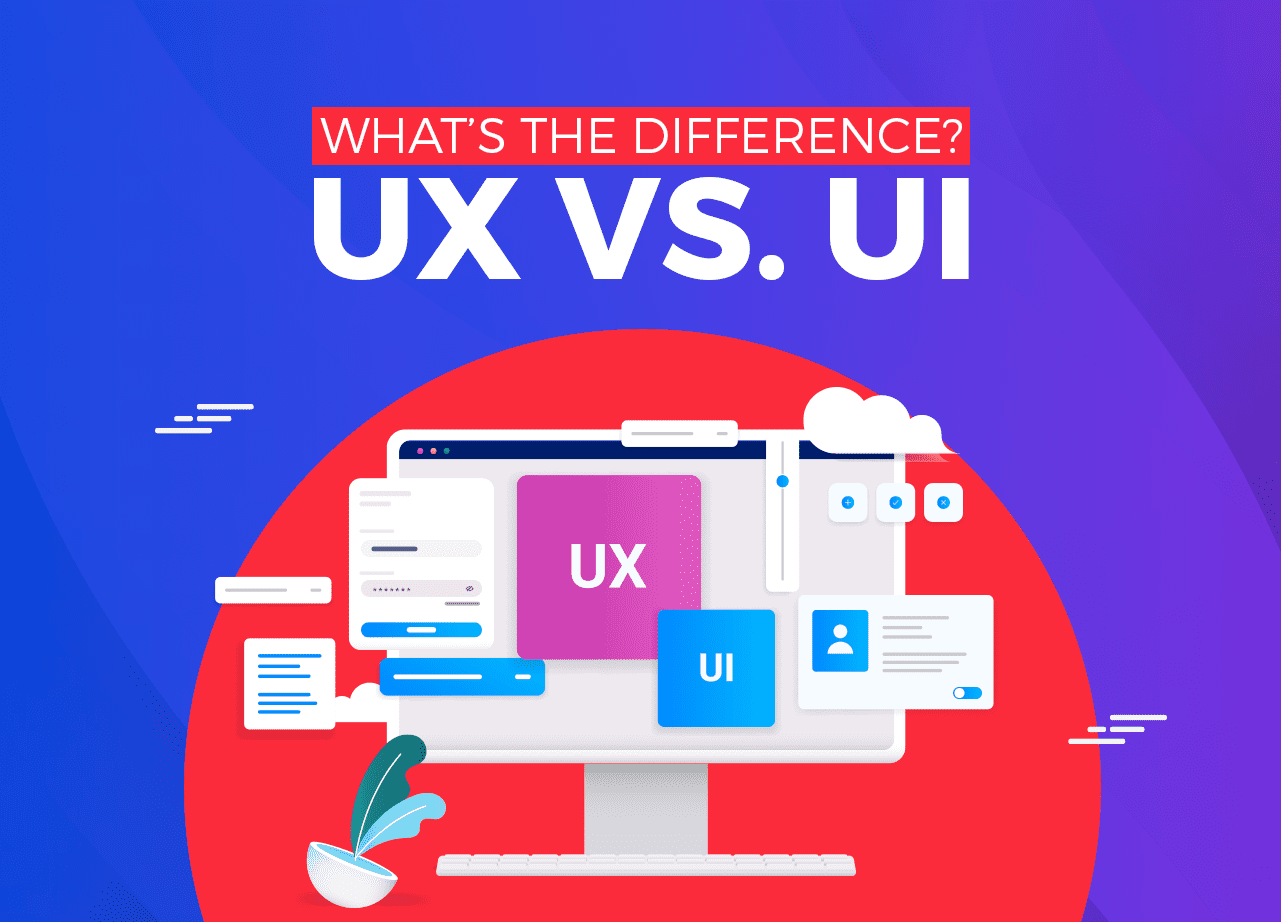
UX vs. UI : What’s The Difference?

It is fundamental to get mobile-app design essentials clear before beginning the development process. UX and UI are key for any business’s web & mobile application development.

It comes as no surprise that designers working with UX and UI for the first time will naturally be finding it tough to find their way around UX and UI. Both the terms have always been misinterpreted or thought of as the same thing. In some technical aspects, UX and UI overlap each other, which is where the confusion arises. It is almost impossible to draw out one discipline from the other. However, both aren’t the same thing.

UX is a combination of tasks focused on improving mobile apps for active and enjoyable use. UI deals with many aspects of what customers see first when they open the app from the intuitive looks, feel, display, and interactivity of the app.

UX design basically helps users achieve practical tasks whereas UI design includes an appealing interface that the user will enjoy using. Usually, the UX and UI designers work on the same development projects but implement different tasks at each stage of the development process.

Being in the development industry for more than 15 years, we at Communication Crafts have worked on creating several successful UX and UI designs for our client’s applications. Keep reading and we’ll make it crystal clear for you to understand the difference between UX and UI.

What is UX Design?

What is UX Design?

UX Design refers to the entire experience someone has with the product from start to finish. Finding the simplest and hassle-free way to help people achieve their requirements on the apps is the main goal of UX. UX design is not about the visuals, but about the overall experience that a user will have with the product.

User experience design begins with keeping the customers’ problem in mind and creating wireframes or prototypes for its solutions. A wireframe is the blueprint structure on which a design is implemented to work on the user level. Once a wireframe is created, the UX designer rolls out prototypes which are effectively tested to understand people’s need better and make relevant changes in the prototypes, which help cater an enhanced user experience.

Design thinking is an integral part of successful mobile app development.

By conducting in-depth research of the users using the prototypes, the UX designer can identify the customer’s liking and requirements in a better way, which in turn helps them design the application better.

What is UI Design?

What is UI Design?

A UI designer’s job begins where the UX designer’s ends- at the prototyping and testing stage. UI is typically what people understand about the user experience.

Simply put, the UI Design is the process of transforming wireframes into an elegant User Interface people would love using. It includes the right typography, appealing images, optimization for different screen sizes, and other visual design elements that turn a basic user interface into something appealing and pleasant.

When you log onto Facebook, Google, and Instagram, the first screen you see is what reflects a well-designed UI. From the right color combination, size of the buttons, text field, dropdown menu- all designed to perfection by a UI designer.

This adds up to create a great influence on the emotional mind of the user.

What’s the difference between UX and UI?

Consider this analogy to better visualize UX and UI: Imagine building a house from scratch. UX would be the foundation, while UI would be the essentials of the house- such as floor, doors, furniture, and much more.

The foundation always comes first. Rightly so does the User Design (UX). A design is created keeping in mind how different functionalities of the app connect with each other, how logic is integrated with the interface. This builds the foundation of mobile app development.

Once the design is rock solid, User Interface (UI) design can begin its work. They combine the right colors to set the user’s mood and create a minimalistic yet intuitive design that the user would enjoy interacting with.

UX focuses on detailed research that aims to discover how to maximize the enjoyment for the users of the product, while User Interface is the transfer of this research to create a visually pleasing and smooth experience. In this way, UX and UI designers work with each other on the development projects. Without its counterpart, one won’t work in delivering effective design.

Why are UX and UI important?

The fusion of UX and UI shapes the entire user experience- from starting to the end. It is such a crucial design aspect because people always want to use the best products available in the market. If there are two mobile apps offering the same end result, the one with a better UX/UI design will surely end up becoming the user’s favorite.

It isn’t just a great practice to have good UX and UI design, but it actually makes a huge difference in experience. And that’s the secret of how most mobile apps succeed in this ever-competing market- an awesome UX and UI design.

Our full-time team of UI/UX developers works round the clock pushing the client’s mobile & web apps to perfection. We wouldn’t want it any other way. Customer satisfaction is of utmost importance to us and we always strive to achieve it no matter what. Your target audience is always an important aspect we consider while designing the user interface. Our brilliant team of mobile app developers, graphic designers, and UI/UX developers never settle for anything less than perfect. Along with gathering insights about your users better, our UI/UX designers use that data to craft your app more effectively to meet your user’s needs. We not only create your application in an engaging and cost-effective way but also provide a superior scope for your business to succeed.

Looking for an awesome UX/UI designer?

Well, you found the right one!

Microsoft .NET Framework Vs. .NET Core: When to use which?

It’s a no brainer that programming and web development services form the core of any business – small or big. Developers frequently have to build & deploy various types dynamic web & mobile applications for business in various domains, for which they prefer developing in the
.NET ecosystem.

The .NET ecosystem includes many software development languages, frameworks, tools, like JIT, BCL, C#, GC, VB.NET, ASP.NET, ML.NET, Entity Framework, WinForms, WPF, F#, Xamarin etc. which has helped developers build many applications.

However, the question still remains unanswered- Dotnet Core or .NET Framework, which is the best choice for developing applications?

When building complex applications for complete server-side rendering, .NET provides two technologies to work with:

  • .NET Framework
  • .NET Core

.NET Framework and .NET Core, both lead the pack in terms of popularity amongst developers. Let us see some key technological aspects that make them unique in their own ways.

What is the Microsoft .NET Framework?

Helping developers since two decades, Microsoft .NET Framework has found its use extensively in developing Windows applications, Web Services and Desktop apps for Windows.

The two most important components of the .NET Framework are:

  • The Common Language Runtime (CLR)
  • The Extensive Class Library

Not only is it object-oriented, but also easy to code in multiple languages. But because it is a closed-source, it is compatible with only a single platform. To overcome this, in 2014, Microsoft introduced the .NET Core.

What is the .NET Core?

.NET Core is an open-source framework that helps developers build applications that are compatible with many operating systems like Linux, Apple’s Mac OS, and Windows itself. It also has libraries & multiple language compatibility -C#, F#, Visual Basic for developing dynamic web and mobile apps.

Unique features like microservices, high-performance, multiple APIs & web components, make it an easy-to-use platform for software developers to use. From building websites, mobile apps, Cloud computing, gaming, desktop, web, and AI applications; .NET Core does it all.

Although certain key aspects are key differentiators in both. Let us see which one is an ideal choice in different situations.

When to choose .NET Core

a. Microservices architecture

Microservices – also known as the Microservices architecture – is an architectural style that structures an application as a collection of different services. It can be easily maintained and also reduces deployment time by carrying out automated testing. The loosely coupled architecture, allows teams to work independently, but also makes it easier to deploy complex & secure apps. This is the main reason why many companies tend to use .NET Core as they can release updates quicker, which in turn, enriches the customer’s experience, leading to increased business sales.

b. Performance & Scalability

Apps built on .NET Core perform better than those developed on .NET Framework. Developers can significantly improve the performance of their apps without additional hardware to scale their data. This is made possible because of the automatic recompilation feature that optimizes the apps build with .NET Core.

It is widely suitable for developers working on Cloud platforms who need to scale and deploy their apps frequently. Working with Dotnet Core is efficient because it helps the developers optimize their code, which in turn, helps increase the performance of their apps!

While development in the .NET Framework is redundant in terms of security, compatibility and performance speed.

c. Containers

Containers are an abstraction at the app layer that package code and dependencies together. .NET Core allows multiple containers to run on the same machine and share the OS kernel with other containers. Multiple web apps or services can easily be created and deployed using a Windows Container on Linux, Cloud or a Windows infrastructure itself.

Microsoft’s, Azure Cloud’s Kubernetes Service can easily manage, orchestrate, and scale container-based applications in the Cloud efficiently.

Simply put, the .NET Core is a better choice if you:

  • Want to build apps on Windows, Linux, and Mac operating systems.
  • Can handle complex features of .NET Core.
  • Love programming in an open source environment.
  • Want to deploy apps quickly.

When to choose Microsoft .NET Framework?

In cases where developers don’t want to migrate from their existing applications to .NET Core, they can simply write code in the ASP .NET Core for the new web services they wish to add to their existing apps.

However there are certain features that are not available in the Dotnet Core such as:

a. Third-party libraries not available in .NET Core

While .NET Core is widely preferred, developers need to use the .NET Framework if they are working with .NET libraries that aren’t compatible with Dotnet Core. Such is the open source NutGet packager for .NET Framework, which provides the ability to develop apps quickly using its packages.

Applications built on the .NET Framework can take advantage of the in-built class libraries that enable easy operations like file reading/writing, graphic rendering, XML document manipulation, and DB interaction.

b. NET technologies only available in .NET Framework

Some of the .NET Framework technologies aren’t available in Dotnet Core. Although few might be available in later Dotnet Core versions, most .NET technologies are never available. Some technologies only available in .NET are:

  • ASP.NET Web Forms applications: For the time being, ASP.NET Core cannot be used for ASP.NET Web Forms.
  • ASP.NET Web Pages applications: ASP.NET Web Pages aren’t included in ASP.NET Core and is unlikely to be.
  • WCF services implementations: Although the Dotnet Core has WCF client library to consume WCF services; WCF server implementation is only available in .NET Framework for the time being.
  • Workflow-related services: Windows Workflow Foundation (WF), Workflow Services (WCF + WF in a single service), and WCF Data are only available in .NET Framework.

There are no plans to bring these .NET technologies to the Dotnet Core. But however, in the future, developers may not want to choose .NET Framework, if Dotnet Core’s newer versions become much better. But for now .NET Framework is a better choice if:

  • There’s no requirement of applications to run on different platforms.
  • Need a stable environment to work in.
  • Already working on an existing app and want to extend its functionalities.
  • Don’t want to deal with frequent iterative upgrades to .NET technologies.
  • Wanting to develop, client applications for Windows, using Windows Forms or WPF.

.NET is the most profound technology that has helped shape the technology sector as it is today. .NET developers help turn your business idea into actual growth for your business. Hiring a well-established .NET development company is what makes your enterprise’s application work in this digital world!

As a leading mobile and web app Development Company, our team of experts work on the web and mobile app development on a regular basis and provide exquisite results for our customers. With 15+ years of experience and a team of 150+ experts, we at Communication Crafts, have worked on unique and custom mobile & web development projects around the globe. Our expert coders, web & mobile app developers have years of experience working with .NET technologies and work smoothly with both- .NET Framework and .NET Core. We use both extensively to meet all our client’s requirements and ensure complete customer satisfaction. Being innovative by offering diverse and scalable solutions is our forte and we tend to stick by it!

Looking for a .NET Developer for creating mobile & web apps that helps improve your business operations?

Well, you found it!

5 Technology Trends 2020 Will Define the Post Pandemic World

The constantly evolving digital world is known for heavily influencing customer experiences, online interactions, along with shaping consumer expectations. With the COVID-19 outbreak, the pre-determined definitions of business and experiences have been widely changed. The expectations of physical spaces and stores have been completely re-defined, with new innovative methods of communicating. Digital transformation has been heavily catalyzed through the systems set up during the pandemic.

The impact of the emerging digital trends is likely to improve the day to day operations. When it comes to reducing a human to human contact the latest technology trends have increased productivity while eliminating hindrances amidst the pandemic. The exponential pace at which IT trends are developing indicate a significant breakthrough in the field of computer science which is bound to change and impact the world in profound ways. The pandemic has only emphasized on the importance of data security in the time of crisis. Smarter algorithms only hint at a better and a more advanced future for the humanity.

Here are 5 future technology trends

Artificial intelligence

Artificial intelligence

The benefits of AI are vast, from being able to analyze large amounts of data, learning patterns, computer systems, predicting behaviour and recognition- AI is a groundbreaking phenomena. According to a survey conducted, it is estimated that by 2030 all AI products will contribute more than $15.7 trillion to the global economy. Artificial Intelligence clubs various innovations under the label of AI, these variants include intelligent data processing and face and speech recognition. These technologies are commonly seen and will only be accelerated in terms of its use post COVID-19.

It’s a known fact that consumer behaviors won’t go back to the previously defined processes and norms. Artificial intelligence will be a highly important adaptive tool, providing meaning and value to new processes. Especially on the foregrounds of the retail industry, advanced data analytics, machine learning, and processes will decode and analyze the newer purchasing patterns, thus catering a unique bespoke experience to consumers worldwide. The capabilities of AI such as predicting human behavior and patterns will be extremely valuable to companies as it will enable tools to adapt to changed systems. Hardly predictable behaviors can now be easily forecasted. Chatbots can be known to accelerate the pace between the company and the consumer, beneficial especially due to the lower amount of team members.

Cloud computing

The demand for cloud computing has only increased due to the pandemic. According to a recent survey, Microsoft reports a 775% spike in cloud services demand. Cloud technology is surely to receive an increase in implementation in apps. With more work from home, learn from home and various other remote working opportunities, call in for a cloud-based video conferencing and teaching. Due to this many cloud service vendors have enhanced their features and functions while enabling resources to meet this huge demand. The world is not going back to normal anytime soon, thus businesses are likely to use this technology. Cloud computing is here to stay as one of the technology trends in 2020.

AR/VR

AR/VR

The use of AR/VR has truly increased due to the pandemic. With more people staying at home, the urge to keep connected is on an all-time high. Organizations use this time to benefit from VR platforms, in order to sustain day to day activities such as training employees, collaborating, educating, training and connecting online. Businesses and consumer’s experiences have no limits due to the broad scope of this technology. Post the pandemic, we are likely to see more interactive virtual conferences and innovative methods of interactions throughout the globe.

Cybersecurity

This is one of the most crucial aspects of an organization, especially when the processes are formed on data-driven technologies. With the emergence of thousands of people working from home during COVID19, an extensive amount of private data could become totally vulnerable if not protected rightly. There was also a surge in amounts of phishing attacks, new threats to security, new viruses, and loss of data. Fake domains and cybercriminal activity has been on a rise throughout the pandemic. In addition, there is an increase in hacking attacks on various institutions. Thus, it is imperative all precautions are made to keep an uptight cybersecurity.

Block chain

Block chain

Block chain is a method of storing and sharing information across a chain of networks through a virtual space. It’s a type of distributed technology where data is stored in many places. This system makes it a great tamper proof system, along with high security and transparency. The technology was developed to help manage a chain of actions and consequential transactions, Block chain makes every single transaction throughout the chain available to all. Block chain platforms improve the transparency of businesses while implementing a seamless integration of networks. The COVID-19 crisis has displayed a lack of connectivity and an inadequate data exchange into our global supply chains. This crisis can show us all the importance of building a seamless network.

Furthermore block chain technology can help with:

– Tracking the outbreak of various diseases
– Tracking the donations and support needed
– Enhanced crisis management
– Proper medical chains

Communication Crafts is known for its bespoke approach. Innovation and creativity combined with advanced technology is our niche. The pandemic has halted various businesses, but our expert services provide high-end strategies enabling success to companies even during the pandemic. Opportunity to accelerate your profits while cutting cost can be availed through our offshore mobile app developers. Our team of dedicated developers help you achieve futuristic goals through significant strategies while highlighting the important aspects of your project. Our in-house PHP & .NET developers enable excellent and precise projects. With 15+ years of experience and a team of 150+ experts, Communication Crafts has leveraged unique and custom projects throughout the globe. Don’t let the pandemic put a halt on your business operations, enhance and successfully leverage current technology trends through communication Crafts

Achieve futuristic goals today!