Top Programming Languages for E-Commerce Website Development

As the world evolves, businesses have to evolve with it. The scale is shifting towards digitalization with 22% of all retail sales set to be digitalized by 2024.

The retail e-commerce sector is booming. With e-commerce sales reaching $4 trillion in 2020 alone! Yes, you heard it right!

This is just the gist of what the future has in store for the e-commerce industry. The Future of E-commerce development has picked up its pace for all the right reasons.

But why has online shopping been gaining more traction over the years? What’s happened to traditional shopping? Going to the malls and making a purchase once in a while.

Well, in this digital age online shopping has become more convenient than ever. With the constant innovations in technology, e-commerce stores have the capability to bring a whole new experience to the users.

In fact, here are some of the top reasons why consumers are preferring online shopping over conventional ways:

  • Shopping in the comfort of their own homes
  • Saves valuable time
  • Wide variety of products
  • Easy to compare products
  • Easy to search specific products
  • Refund or replacement was never easier
  • Customer reviews

Having in-depth knowledge of e-commerce web development is crucial for succeeding in the global commerce race. And that’s why, in this article, we are going to speculate the best programming languages for e-commerce web development.

E-commerce websites are the new-age stores:

Your e-commerce website is the face of your company. The first impression matters. That’s why it’s essential to play your cards right from the start and provide your customers with a remarkable user experience that makes them stay and take the desired actions.
Some qualities that can make consumers gravitate toward your website are:

  • Stable and fast loading times
  • Seamless navigation
  • Attractive aesthetics
  • Responsive web design
  • Responsive customer support
  • Consistent and secure payment methods
  • Simple & crisp descriptions and high-quality images
  • SEO optimized
  • Compatible with multiple devices (mobiles, computers, tablets)

Small steps for a business, a giant leap in profits:

An e-commerce website should be carefully planned out to achieve its true potential. So before diving into the topic of programming languages, let’s discuss the steps to increase consumer traffic.

  • Identify your product: This is the first and the most obvious step towards building an e-commerce company. You must decide the product or products you want your company to be associated with and understand its market accordingly.
  • Understand your audience: A business is nothing without its consumers. Identifying your potential customers is vital for your e-commerce development. Your web design, interface, colour scheme, images, information, and every aspect of your web page should cater to your targeted audience.
  • Originality is key: The name of your company can make or break your e-commerce operation. It is the first thing your consumers notice when they visit your website. Take your time, and be original, and witty while you decide on a name for your company. Brand names like Google, Yahoo, Lego, and Asus have proven to be quite lucrative in the past.
  • Domain name: After you have decided on the domain name of your website, purchase or register the domain as soon as possible. It’s wise to stay a step ahead, as the internet is a very unpredictable place.
  • Branding: Strategize your marketing techniques. Building an e-commerce website gives you the power to control the story and the image of your brand. Branding is what makes your company stand out among countless distractions on the internet. It is the only way to truly connect with your consumers and create a consistent retail experience.

Programming languages and platforms:

You’re new to the world of e-commerce, and you’re looking to start a small-scale online store without the hassle of coding. You can use numerous content management systems (CMS) that can help you in creating a terrific online presence for your company. While there are many, WordPressShopifyMagneto, and WooCommerce power the majority of the eCommerce market.

With a few tutorials and guides, you can create your own website using these content management systems.

However, if you need to meet all your business needs successfully, hiring an e-commerce developer becomes necessary.

Because let’s face it, a spectacular, people-pleasing & revenue-generating online shop is what you would ultimately want. And hiring e-commerce developers with years of proven experience using the latest technology for e-commerce development is the answer to that problem.

But you need to choose the best programming languages that can adhere to your business needs. Every programming language is unique and has its advantages and disadvantages. And selecting the right one for your online shop can be pivotal to your business success.

Top 7 programming languages for E-commerce Development:

Java:

Java is one of the most popular and relatively simpler programming languages for building e-commerce websites. It is quite similar to C and C++ and it has some unique features.
E-Commerce Website Development

Java is object-oriented, as well as most reliable among other programming languages. Its versatility makes it compatible with multiple platforms and browsers.

The main drawback to Java is that the programmer gets no right over garbage collection, and that’s why it needs a lot of memory to run. This results in expensive hardware requirements and a relatively slower runtime.

JavaScript:

JavaScript is used almost everywhere on the internet. It runs rapidly on the client-side unless outside resources are required. It has numerous applications as developers can insert small JavaScript programs into existing web pages, because it works well with other languages. One of the biggest reasons for its popularity is the ability to work on most modern web browsers.

The only downside to JavaScript is due to some of its security implementations. The code is executed on the user side, and therefore people can exploit bugs and overlook mistakes. JavaScript can’t be used to code across different browsers, as there are minimal differences in interpretations by different browsers.

PHP:

PHP is one of the developers’ favorite programming languages for creating e-commerce websites. It is responsible for the creation of Magento, one of the most popular content management systems. It has the ability to incorporate both functional and object-oriented formats. PHP is backed up by a large community of developers who maintain and regulate the extension libraries, and also detect and eradicate bugs promptly. It is fairly easy to create website scripts with this language.

 e-commerce websites

Since PHP is open-source, everyone can have access to the source code of the website, source code, which makes it vulnerable to cyber-attacks.

Another thing to keep in mind is that if you’re looking to create an e-commerce website with complex functionalities and scalable features, PHP will not be the ideal language to go with.

Python:

Python yields the best results when using for e-commerce development. It is widely used around the globe and is one of the most efficient programming languages for e-commerce purposes. It has an extensive library that makes a developer’s life quite easy. Moreover, it helps the developers to create elaborate websites in minimal time.

Python codes can be integrated with other languages, and it is portable across multiple platforms. It is not at all arduous to read a Python code, unlike other languages, as its language is quite simple and straightforward.

However, if you’re looking to create an e-commerce mobile app, keep in mind that Python can only be used to create web development. Also, it needs a lot of test runs because the errors don’t show themselves till the application is run.

Ruby on Rails (RoR):

RoR may not be the first choice for developers, but if you’re looking to quickly launch your e-commerce site, then RoR can be the ideal choice. Ruby on Rails can work three times faster with its Mode-View-Controller (MVC). This divides the process into three subparts, which makes the process all the more seamless. Business owners tend to incline towards this language because it saves time while increasing profits. RoR also has an extensive library maintained by a large community, and in this library, there are many “gems” (codes) that are used as solutions to various problems by developers to further simplify the process.

Additionally, RoR has many features that focus on security, and many “gems” can be used to eradicate security breaches.

Ruby on Rails is not supported on all browsers, and its performance is quite slow compared to the other object-oriented programming languages.

HTML:

HTML is a globally used language that is supported by every browser. This language is used to easily alter the appearance of images, texts, layouts, and much more. It is free to use and does not require any additional software.
HTML

HTML is not viable for creating complex web pages. It is mostly used for static and straightforward work. Security features of this language are not reliable

C++:

C++ is adopted by a large number of developers because of its flexibility and scalability. It is an object-oriented language. The programmer can have complete control over memory management. A C++ program can be run across different operating systems and interfaces.

Although, Python is preferred in most cases since it is more developer-friendly than C++. C++ is not only a very complex language to get grasp of, but requires a lot of time to efficiently learn it.

Features to look for in a programming language:

Now that you’ve seen the different programming languages, you must be wondering which language is best for e-commerce development for your business?

You can use these factors to rate the functionality of the aforementioned languages.

  • Simplicity: The framework of a programming language should be easy to understand and developer-friendly.
  • Security: Utmost security implementations must be taken to ensure that the information and data of the users are secure. A secure site will help improve the company’s credibility and trust factor among buyers.
  • Brevity: A high-level programming language requires fewer codes to finish a program. Such a language decreases code length, enables developers to find bugs easily, and boosts productivity.
  • Efficiency: It should have proper garbage and memory management to run at a smooth and rapid pace.
  • Versatility: A high-level programming language can be run across different browsers and operating systems.
  • Portability: It should be possible to easily transfer the program after being developed to different computers.
  • Orthogonality: Change in one aspect of the program shouldn’t affect other aspects of the program. This provides the developer freedom to make changes with ease. And thus enable to roll out updates quickly.

In recent years, online presence has become an absolute necessity. After reading this article, we’re sure you feel the same way. A well-maintained website can work wonders for a company’s conversion rates. It is not just an opportunity to sell, but also an opportunity to increase your brand’s presence and reach potential customers.

Long story short, a beautiful and responsive web design that provides customers with a seamless experience across all devices and enables them to find what they are looking for quickly are the cornerstones to success. Consumers always gravitate more toward such websites.

So don’t sit back and wait, get in touch and let us guide your company through the digital world. We are the one-stop destination for all your e-commerce solutions.

Here at Communication Crafts, as the leading and trusted eCommerce development company, we flaunt more than 17+ years of experience and an ever-growing group of web, mobile, design, branding, marketing, and eCommerce development experts.

We welcome you to exploit our expertise!

Looking for a team of best remote developers?

You’re in the right place!
Odoo eCommerce: All-in-One Business Management System

If you are looking for a full-fledged management system to streamline business operations and increase business efficiency, then Odoo ERP is what you should go with.

Odoo eCommerce is a powerful app/module in Odoo, which you can use to build your eCommerce website. Using Odoo, you can easily integrate it with your Enterprise Resource Planning (ERP) software, Content Management System (CMS), and Customer Relationship Management (CRM) to create the perfect eCommerce shop.

Managing a business is never easy. As your company grows, it gets more and more demanding. The cluster of data and daily tasks can be chaotic and too much to handle. Improper management can be catastrophic for your company.

But don’t panic! This is where Odoo comes to your rescue!

Odoo eCommerce software is an all-in-one business management system that keeps your company running without a hitch. From sales, accounting, human resources, or any other department, you can control them all by implementing Odoo eCommerce development.

Giving you the time to focus on growing your business while Odoo takes care of your day-to-day operations.

From website development and payment integration to warehouse management and shipping integration, Odoo is the solution for all your eCommerce problems.

You can use a collection of more than 1000 built-in business modules and 16,000 plug-ins available to streamline every aspect of your online business.

So why adopt an Odoo ERP system in the first place?

Did you know that 88% of organizations agree that an ERP system proves to be successful for their businesses?

Moreover, ERP is one of the biggest markets in the software industry. Its revenue was valued at $43 billion in 2020 and is projected to reach $70 billion by 2026.

To have an edge in the ever-growing competition of businesses, you need to keep track of all data and operations accurately. And this can be a cumbersome process. That’s where Odoo ERP software can simplify it for you:

  • End-to-end control over operations: All the data of your business is integrated continuously by an ERP system, making it easy for you to adapt to sudden changes and observe day-to-day operations.
  • Improved customer service: A good ERP software has a Customer Relationship Management (CRM) system. Overall communications with your customers will drastically improve because of the information collected by the CRM system.
  • Instantaneous Information: An ERP system provides a synchronized flow of data across all departments of your business, improving your overall decision-making process.
  • Quick and accurate estimations: You can instantly evaluate the costs and time that would be required to finish an upcoming project.

Also read: Magento vs Shopify: Choose only the best for your online store

Why choose Odoo eCommerce development?

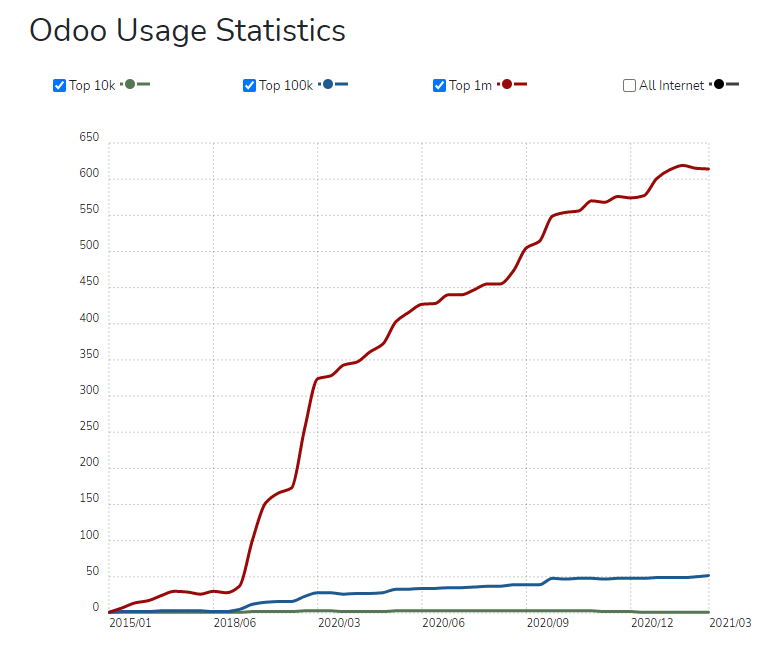
Odoo has swiftly become one of the most favoured ERP software with more than 36,000 live Odoo eCommerce websites globally. As it has a simple and intuitive UI, it is easy to learn and implement.

Why choose Odoo eCommerce development?

Odoo usage statistics

Here are some top reasons why Odoo eCommerce development is favored:

  • Flexibility: Odoo eCommerce development offers a wide range of modules and plug-ins that can be used to tackle any type of business problem. Furthermore, it can be viewed from mobiles and tablets, even though Odoo is completely web-based.
  • Scalability: Your Company’s future is in safe hands with Odoo. Its functionality is conveniently scalable according to the size and complexity of your business.
  • Large Community: Odoo eCommerce has a powerful community of developers who regularly detect and remove bugs and issues. Also, Odoo regularly sees new updates roll out from time to time.
  • Security: Security vulnerabilities are one of the top concerns in this digital age. With Odoo, your confidential data and customer database are always secure. Also, being an open-source ERP system, errors or gaps in the source code are rectified almost immediately.
  • Low Cost: The Odoo community version is free to use, but it lacks certain features. While the enterprise version, with all its benefits, costs only 25$ per month. Which is a tiny portion of all the prices offered by other ERP services.
  • Customizable: Your developers have complete freedom to customize your business operations according to your needs. The source code can also be tweaked as it is an open-source ERP system.
  • Easy Integration: Odoo eCommerce software has a friendly Application Programming Interface (API), making it conveniently compatible with other ERP systems.

As a trusted and leading eCommerce solutions company, we know the importance of choosing the right ERP service for your business to flourish. And we believe Odoo is the go-to platform for all your business needs.

“This system is revolutionary. The advantages Odoo has are comparable to none other. It covers all sides of the workflow for any company: manufacturing, accounting, taxes, HR and so much more. It’s certainly making its mark on the market worldwide. Since the last couple of years, we have seen the need for Odoo developers increases significantly.”

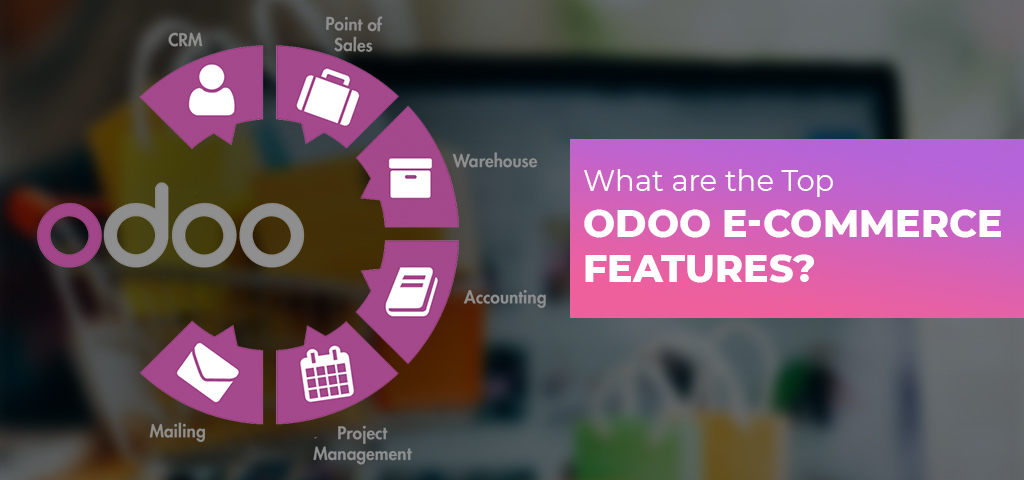
What are the top Odoo ECommerce features?

Odoo eCommerce is always evolving, bringing in new and enriched features. As of now, here are the top features that make it a one-stop framework for all-around business management.

What are the top Odoo ECommerce features?

  • Odoo Website Builder: You can create and maintain your online store with Odoo eCommerce website builder. The Content Management System (CMS) makes it fairly easy to edit designs and texts, and at the same time, manage multiple websites comfortably.
  • User Interface: It has a simple and interactive UI which makes it easier for customers to find what they are looking for. This feature is designed specifically to maximize sales and provide an unforgettable experience which in turn increases repeating customers.
  • Business Intelligence (BI) Tools: A wide range of BI tools that cover every department and aspect of your business. From data analysis to communication, Odoo has a tool, module, or plug-in for everything.
  • Production Management: Odoo manages your Bill Of Materials (BOM) and streamlines the steps of production, with an efficient tracking system for your work orders.
  • Warehouse Management: Odoo eCommerce has the capacity to manage and track multiple warehouses and their inventory, regardless of the company size or complexity.
  • Sales Management: Sales directly affects the productivity of a company. Odoo eCommerce features a way to analyse customer behaviours and segregate orders in terms of importance or quantity, and thus creating a seamless structure for your entire retail process.
  • Accounting: Odoo eCommerce features a smart reconciliation tool to keep the balance sheets air-tight. It has accurate managing and tracking of payments, bills, and expenses, along with automated tax inclusions.
  • Customer Service: Odoo’s customer portal features an intuitive way for your customers to track the payment, delivery, and shipping status of their orders. The Customer Relationship Management (CRM) system can automatically manage tasks like communication, prioritization, notification, customer identification, etc.
  • Moreover, it can also connect you with your customers and answer their queries in real-time using Live Chat, and thus help boost customer relations and sales.
  • In-built Blogging: Blogs are a great way to stay in touch with your customers. Through blogging, you can increase the reach of your company on search engines and also get the message across to your customers effectively.
  • Search Engine Optimized (SEO): You can customise your meta tags, H1, and titles for SEO purposes with Odoo eCommerce development. This feature makes it easier for your company to be found by potential consumers on search engines.

Also read: Future of eCommerce: 7 Most Popular eCommerce Trends

Some useful features that were added in later versions:

  • IP Tracking: An IP-based lead generation feature mainly used for B2B industries. The IP addresses of website visitors are tracked and matched with specific businesses. This process yields more information and tells you more about the interests of your visitors.
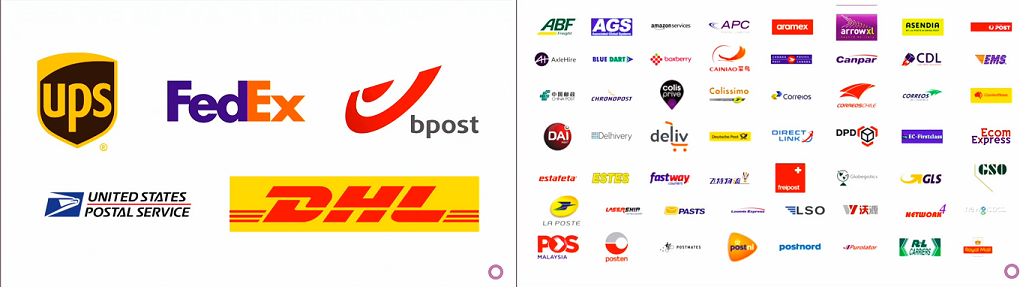
  • Shipping Integrations: Numerous shipping carriers are integrated for impeccable delivery service. Carriers like UPS, USPS, DHL, FedEx, and many more.
features

  • Discount Module: Odoo eCommerce makes it easier for you to promote sales and give discounts to your customers with this new feature.
  • Data Cleaning: Automatically removes duplicate or redundant data.
  • Snippets: You can add a wide range of snippets to different sections of your website for personalising the user experience according to your needs. For example, snippets for charts, timelines, pop-ups, masonry, product list, etc.

What is Odoo Studio?

Odoo Studio is a part of Odoo specially designed for creating powerful and intuitive applications for businesses. Some features of Odoo Studio:

What is Odoo Studio?

  • You can use Odoo Studio to build desktop and mobile apps with ease.
  • You can build a customized application within minutes, with no coding required whatsoever.
  • Switch to developer mode to obtain and edit technical details.
  • It can be used for all types and sizes of businesses.
  • Some of the components of Odoo Studio: Forms, lists, grids, graphs, calendars, custom pivot tables, and charts.

Read more: WordPress VS Shopify: which one to pick for successful eCommerce development?

Let’s look at some large-scale business hurdles that Odoo eCommerce has solved for some of the MNCs

Odoo ECommerce Success Stories:

Toyota

Toyota corporation has a material handling division in France, which manufactures and sells forklifts and trucks. It experienced organizational changes and needed some restructuring for efficiently managing distribution and supplier units in France, Italy, and Sweden.
Toyota material handling units needed a way to easily track orders, invoices, purchases, production, and shipment. Replacing the entire system was too much of a risk for such a competitive company. And conventional ERP systems did not match their needs.

After a lot of planning, Toyota decided to solve their problems with the help of Odoo eCommerce development.

  • Odoo Sales was implemented to track and manage orders;
  • Odoo Inventory was put in place to make sure the availability of products after orders are placed;
  • Odoo Manufacturing was added for streamlining the production of forklifts and trucks;
  • Odoo Purchase was implemented to manage the import of products from countries like the USA, China, and Japan;
  • Odoo Accounting was used to invoice customers straight from Odoo.

It took only six months for Toyota to implement and integrate the Odoo eCommerce solutions. Not only did it help them overcome all of their business hurdles, it even saved them a lot of valuable time and management costs.

The employees could easily adopt the Odoo eCommerce because it was integrated with their existing legacy system. They eased into the implementation of Odoo eCommerce development in every component of their business slowly.

Confetti

Founded in 2006, Confetti is Finland’s biggest shop for baking and party supplies.
As the company grew, it needed an ERP solution for efficient data management and automation of purchasing and inventory.
Along with many other reasons, the Odoo eCommerce system was mainly chosen by Confetti for its Point Of Sale (POS) systems for the stores.

  • Odoo Data Management: Information regarding products, customers, prices, and suppliers were easily tracked and managed using Odoo eCommerce development;
  • Odoo Warehouse Management: They used Odoo eCommerce features to automate their shipping and stocking, along with multi-warehouse management. It was also used to trace food products with expiration dates;
  • Odoo Purchase Management: Seamless communication with the suppliers was achieved with Odoo eCommerce development. Tracking the import of sales orders became relatively easy;
  • Odoo Pricing Management: A coherent pricing system was formed with the help of Odoo eCommerce features and modules. Prices and price lists had to be entered just once. Tax and currency issues were also easy to manage after implementing Odoo.

Customer satisfaction soared due to the seamless user experience offered by Odoo eCommerce development. All of their issues were resolved and the processing time of purchase orders was reduced by more than 50%.

Wrapping up

The growth of your company depends on how well you can manage daily operations. A growing business brings forth many complexities, and Odoo has the capabilities to easily handle them all.

Odoo ECommerce features and tools can cover all of your day-to-day business needs efficiently. It provides you with a streamlined structure for your business and thus helps provide your customers with a seamless user experience.

This gives you the freedom to control and plan your company’s growth. With the number of modules, features, and plug-ins available at such a low price, it surely is the best business management tool.

If your growing company needs an extra pair of hands, and if you need an Odoo eCommerce implementation partner, contact us!

With 15+ years of on-hand experience, Communication Crafts can provide exceptionally skilled Odoo developers. From small-scale website development to large-scale eCommerce development, our Odoo developers are at your service.

Keep calm and Odoo!

Looking for a team of the best remote developers?

You’re in the right place!
How to create a customer-centric Ecommerce Website that sells

6.54 trillion US dollars. A ballpark figure of what the global retail E-commerce sales are going to stand at in a couple of years.

It’s evident that E-commerce has already peaked and is on the path to adapting to a new revolutionized digital age.

If you’re an E-commerce business, it’s time to buckle up! Yes, people are preferring to shop online more and more these days.

But in the end, it comes down to you to convert those visitors into customers.

That’s why customer experience is so crucial to success.

Understanding your target audience’s behavior, what they like and don’t all have a valuable effect on how your site is going to perform. That’s why looking at your website’s UI/UX design, it’s important to keep your customers experience at the forefront of everything you do. From selecting the right colors to the navigation and overall look of the site; you just have a couple of crucial seconds to enable your customers to find what they are looking for quickly. Make one wrong design decision and it can sink your ship.

Take a deep breath, we’ve got you covered. Let us look at some of the things that should be at the forefront of your design aspect.

9 Essentials to get a great Customer-Centric Ecommerce Website Design spot on

1. Create a dynamic website

Create a dynamic website

Whether the user uses a mobile phone, tablet, or desktop- your website should provide a seamless and consistent performance regardless of the device. Adding functionalities and features that help curate responsiveness to the website is what you would need to do. What that means is, responsive websites will automatically adjust their layout of the site and adjust content likewise to fit the screen.

So if your website isn’t dynamic enough, users on a certain level would find it difficult to consume your content and more so, would exit the site in such a scenario. You don’t want to not have a user-friendly design. Get one and enhance your customers’ overall experience and see the difference in a matter of time!

2. Speed up your website loading

8 seconds, that’s the average attention span of a person. Imagine the amount of frustration a person would go through because of a website that takes too long to load. Combine that with the time window on our hands and we have ourselves a situation!
Matter of fact, even a 1-second delay in page response can result in a 7% drop in conversions. It’s pretty evident to what not to do- don’t make your visitors wait a relatively long time.

What you can start with is checking your speed on Google’s Page Speed Insights. There you can find out your site’s speed for mobile and web. But not only that you’ll find out what aspect you can improve your speed and carry out the necessary speed optimization tasks for it.

3. Use premium-quality visuals

Use premium quality visuals

If you want to enhance your customer’s experience you need a touch of high-quality visual content. People don’t have the luxury to shop in-person online- feel, touch, and then decide if to purchase or not. That’s where you can help them decide better. Great and premium-quality photos and graphics can go a long way in psychologically influencing a customer’s purchase decision.
Not only that but don’t forget to upload multiple pictures of any product you sell so that there remains no doubt in your customer’s minds; once they view it from different angles.

4. Customer testimonials

What better way to convince your visitors to buy the products than reaffirming it from the existing customers themselves!

Customer reviews play an important role in influencing a purchase online. At times, that’s what people mainly search for before buying any products.

If you’re looking for a great modern E-commerce website design, then the customer review section is surely going to be part of it.

5. Make carrying out the transaction simple

Make carrying out the transaction simple

E-commerce designers often forget that the transaction part of the page is actually where the “conversions” take place. Unnecessarily making it a complex process can see the potential customers going the other way, just because they’re tired of navigating their way through it.

To make sure this doesn’t happen to your site, give the checkout process a simple and clear-cut intuitive design. The user should be able to complete the transaction hassle-free and within a few simple steps.

6. Enhance your website’s navigation architecture

Imagine getting overwhelmed with having to make so many clicks before you can find what you were looking for in the first place. If you truly want your E-commerce business to flourish, you need to keep the number of clicks to a minimum. The user should easily be able to find what they are searching for. One simple thing you can do is create different categories in your navigation bar. This enables the user to go directly to the category they are interested in.

7. Provide Multiple Payment Options

Provide Multiple Payment Options

In this digital age, there are new modes of payment. Although cash on delivery, credit & debit cards are the go-to payment method. But what if they use PayPal or any other UPI service provider?
Ensure that your website lives up to its standards by providing multiple payment options. If your e-commerce site doesn’t have these payment modes, people might even find your site outdated. To ensure they don’t feel that way, make sure to integrate multiple user-friendly payment options.

8. Add Frequently Asked Questions

While the users surf through the site looking at different products, they might have some concerns. The usual questions they might have can be related to refund & return policy or something else in particular.

That’s why you should add an FAQS section on your website. Make it easy for your customers to find answers without having to take that extra effort to reach out.

Ready to take your E-commerce development that SELLS?

Yes, the customer is always right.

While designing ecommerce websites, customer experience is the most defining aspect of that’ll lead to a great website. That’s where Communication Crafts comes to play.

Our next-gen e-commerce website development services are just what you need. Whether it’s creating an engaging and responsive website that people love using, or increasing business sales- our expert ecommerce developers will help you achieve all your goals. Using the latest e-commerce development platforms: Magneto, WooCommerce, and Shopify, we enable your growth.